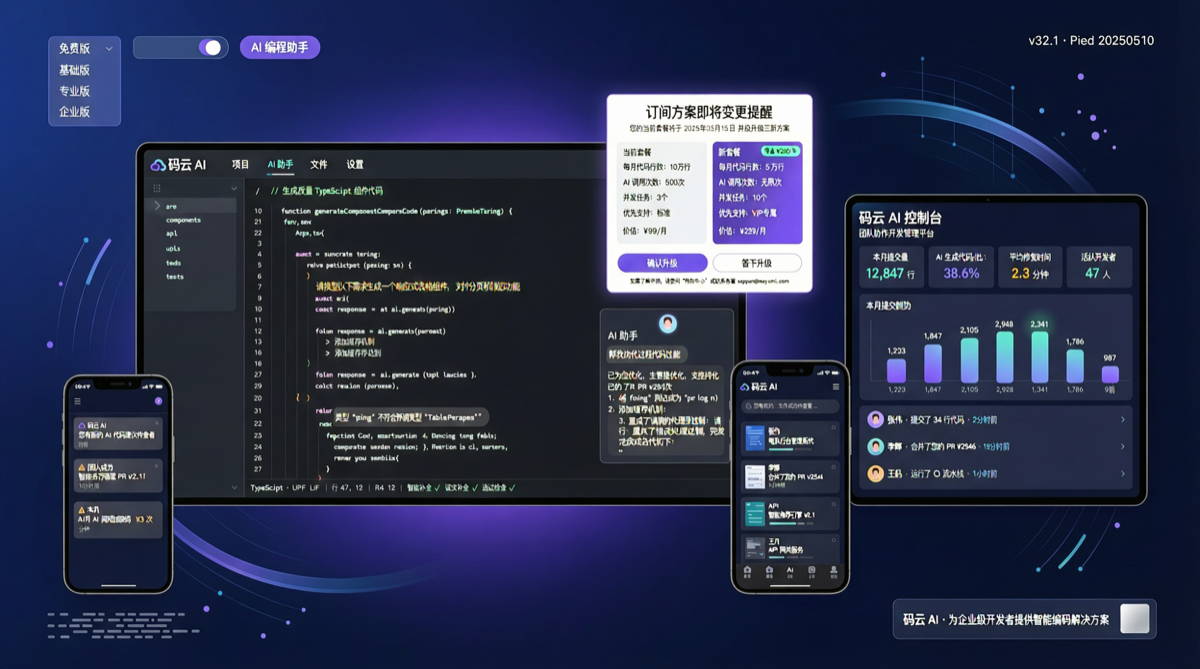
On April 22, 2026, Zhipu AI published a brief but far-reaching announcement: starting from 10:00 AM on April 30, the GLM Coding Plan “no weekly limit” old plan will stop auto-renewal. Affected users will receive 2 months of equivalent new plan benefits as compensation.
This announcement seems like a routine plan adjustment, but it marks an important industry turning point: Chinese AI programming tools are collectively transitioning from “user acquisition-oriented” to “revenue-oriented.”
The End of the “No Weekly Limit” Era
The GLM Coding Plan’s “no weekly limit” old plan was Zhipu’s aggressive pricing strategy launched in late 2025: users pay a fixed monthly fee for unlimited access to the GLM series models for programming assistance. The logic was simple—use extreme cost-effectiveness to attract developers, build usage habits, and establish ecosystem barriers.
Now, this strategy has reached its end.
Change Details:
| Item | Old Plan | New Plan |
|---|---|---|
| Usage limits | No weekly limits | Weekly/monthly usage caps |
| Pricing | Fixed low price | Tiered pricing (higher usage = higher unit price) |
| Model access | Full model access | Tiered access (advanced models require additional payment) |
| Compensation | — | 2 months of equivalent new plan benefits |
Why Now?
Three driving factors behind Zhipu’s decision:
1. Cost Pressure
GLM-5.1’s model scale and capabilities have significantly improved compared to the previous generation, meaning the compute cost per API call has increased substantially. “No weekly limits” was sustainable when models were smaller, but when models become larger and more powerful, the actual usage cost of heavy users may far exceed subscription revenue.
2. Industry Trend
The monetization pace of Chinese AI companies is collectively accelerating:
- Moonshot AI (Kimi): Completed three funding rounds in 90 days, valuation surged from $4.3B to $18B, revenue pressure increases
- DeepSeek: While V4-Pro discount is extended through May 31, its low-price strategy is essentially also exploring revenue scaling paths
- MiniMax: After M3 model launch, enterprise pricing strategy has become more aggressive
When capital markets start demanding “revenue growth” rather than just “user growth,” pricing strategy adjustments are inevitable.
3. Competitive Landscape Changes
GLM-5.1 has proven its strength in programming capabilities (in the same tier as Kimi K2.6). At this point, Zhipu no longer needs “unlimited” to attract users—product competitiveness is sufficient to support healthier pricing models.
User Impact Analysis
Affected users can be roughly divided into three categories:
| User Type | Usage Pattern | Impact Level | Recommendation |
|---|---|---|---|
| Light users | < 50 calls/week | Low | New plan is fully sufficient, no concerns |
| Medium users | 50-200 calls/week | Medium | May need to upgrade plan or mix with other models |
| Heavy users | > 200 calls/week | High | Need to seriously evaluate costs, consider API pay-per-use or multi-model hybrid |
For heavy users, Zhipu’s change may force them to reassess their tool stack. The good news is that there are multiple low-cost alternatives in the current market:
- DeepSeek V4-Flash: Extremely low price, programming capability close to GLM-5.1
- Qwen 3.6 Plus: Outstanding programming and Agent capabilities, reasonable API pricing
- Kimi K2.6: Programming capability in the same tier as GLM-5.1
- Open-source solutions: Qwen3.6-27B, GLM-5 open-source version can run locally
Industry Signals
Zhipu’s decision transmits two important signals:
Signal One: The “free/low-cost user acquisition” phase of Chinese AI is ending
In 2025, Chinese AI companies universally adopted aggressive low-price strategies to capture market share. By 2026, with user bases established and capital pressure increasing, monetization has become the priority. This is not just Zhipu’s issue—it’s an industry-wide trend.
Signal Two: Pricing power depends on product strength
Zhipu dares to cancel “no weekly limits” fundamentally because GLM-5.1’s product strength is sufficient to support this decision. If model capability were insufficient, users would directly flow to competitors. This conversely proves GLM-5.1’s competitiveness in the programming domain—Zhipu believes users won’t churn due to price adjustments.
Developer Action Recommendations
- Check your plan status: If you’re using the GLM Coding old plan, confirm whether auto-renewal has been stopped
- Evaluate your actual usage: Use the 2-month transition period to accurately track your usage patterns and select the most suitable new plan
- Build multi-model backup plans: Don’t rely on a single provider. Configure API keys for 2-3 backup models to quickly switch when prices change
- Watch open-source alternatives: Open-source models like Qwen3.6-27B can run on consumer-grade GPUs—a long-term solution for budget-conscious developers
Landscape Assessment
Zhipu GLM Coding’s plan adjustment is just the beginning. In the second half of 2026, we expect to see more Chinese AI companies adjusting pricing strategies—from “burning cash for growth” to “sustainable business models.”
This is both a challenge and an opportunity for users. The challenge is that costs may rise; the opportunity is that pricing competition will drive companies to invest more in model quality, feature innovation, and customer service—ultimately benefiting the entire ecosystem.
For China’s AI industry, the transition from “burning cash for growth” to “healthy profitability” is an inevitable path. Zhipu has taken the first step—now let’s see how other companies follow.