Intelligence Summary
Zhipu AI’s GLM-5.1 model has officially launched on the 0G Private Computer platform. This 754B parameter MoE architecture model is licensed under the MIT open-source agreement and runs in FP8 format inside a TEE (Trusted Execution Environment).
This is not just another model deployment—it marks the first deep integration between open-source LLMs and privacy computing infrastructure.
The Technical Meaning of GLM-5.1 + Private Computer
To understand the significance of this event, we need to break it down across three layers:
Model Layer: Flagship Specification of 754B MoE. GLM-5.1 is one of the largest open-source models by parameter count today. Its MoE (Mixture of Experts) architecture activates only a subset of parameters during inference, but the 754B total parameter scale still implies an extremely high deployment barrier.
License Layer: MIT Open-Source Authorization. The MIT license is the most permissive among open-source licenses, allowing commercial use, modification, and distribution with virtually no restrictions. This stands in sharp contrast to Llama’s “limited commercial license” or some models’ “research-only” terms. A 754B flagship model adopting the MIT license is extremely rare in open-source AI history.
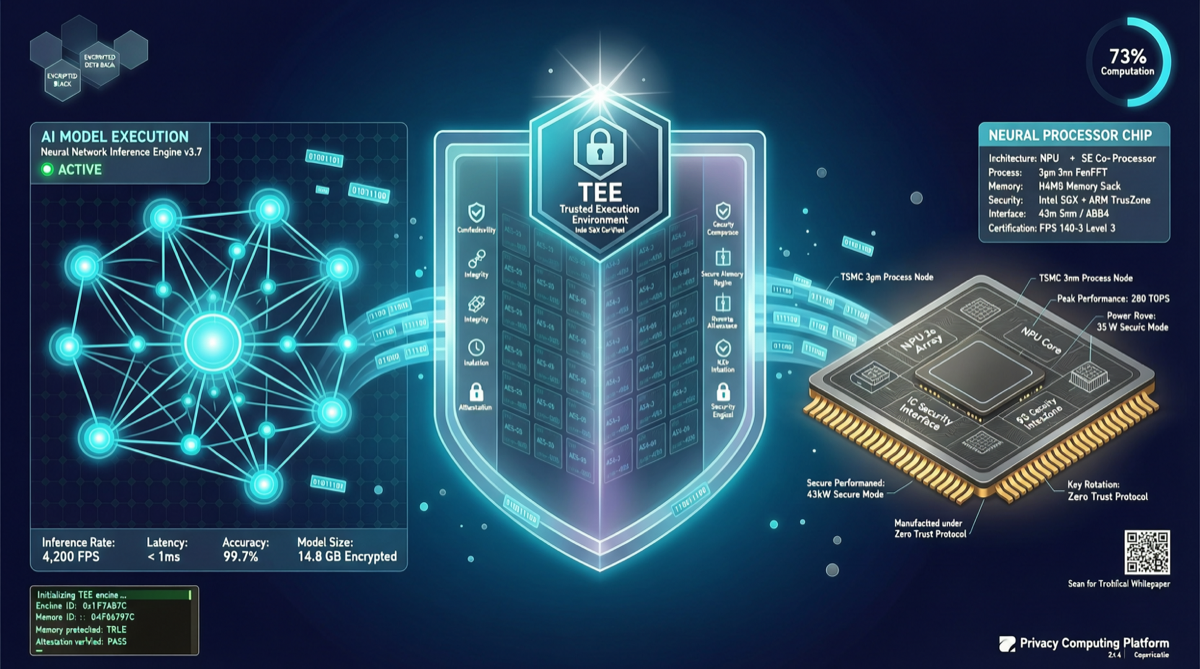
Deployment Layer: TEE Trusted Execution Environment. This is the most noteworthy aspect. Traditional cloud APIs rely on providers’ promises to protect data privacy—you trust the cloud vendor won’t peek at your data. TEE changes the trust model: hardware-level encryption guarantees that the inference process is invisible to everyone, including cloud operators.
Why This Combination Is Breakthrough
In the past, open-source models and privacy computing ran on parallel tracks:
- The Open-Source Model Dilemma: Model weights are public, but deployment requires expensive GPU clusters. Ordinary developers and SMBs can only rely on third-party APIs, and APIs mean data leaving your control.
- The Privacy Computing Dilemma: TEE provides hardware-level privacy protection, but the models running inside are mostly closed-source—users can neither audit model behavior nor freely modify it.
GLM-5.1 on Private Computer solves both problems simultaneously:
- MIT License + Open-Source Weights → Anyone can audit, modify, and distribute the model
- TEE Deployment → The inference process is invisible to cloud operators, with hardware-level data privacy guarantees
This means: you have an AI inference environment that is both fully transparent and fully private.
Comparison with Alternatives
| Dimension | GLM-5.1 + 0G PC | Traditional Cloud API | Local Open-Source Deployment |
|---|---|---|---|
| Model Transparency | MIT open-source, fully auditable | Closed-source, black box | MIT open-source, fully auditable |
| Data Privacy | TEE hardware encryption | Relies on provider promises | Fully local, highest level |
| Deployment Threshold | Medium (cloud TEE) | Low | Extremely high (requires H100/B200 cluster) |
| Cost | Per-inference billing | Per-token billing | Hardware cost + operations |
| Model Controllability | Forkable/modifiable | Uncontrollable | Fully controllable |
This positioning is very precise—it’s not the cheapest solution, nor the most private solution, but it’s the only solution that provides both model transparency and data privacy simultaneously.
Signal Interpretation
This deployment reflects three structural trends:
The “Commercialization” Path of Open-Source Models Is Converging. From Llama’s limited license to Qwen’s Apache 2.0, and now GLM-5.1’s MIT license, open-source model licensing terms are becoming increasingly permissive. This isn’t vendor benevolence—it’s competitive pressure. When DeepSeek offers near-flagship performance at extremely low prices, closed-source vendors must compete with more open licensing to win developers.
TEE Is Moving from “Security-Specific” to “AI-General”. TEE was previously used primarily for encryption key management, payment processing, and other security-sensitive scenarios. Running a 754B AI model inside a TEE proves that TEE computational capability is now sufficient to support frontier AI inference.
0G Labs’ Positioning: Infrastructure Layer for AI Privacy Computing. 0G Labs is not a model company, nor an application company. Private Computer is infrastructure for developers—it provides the capability to “run any open-source model in an encrypted environment.” GLM-5.1 is simply the first flagship model to move in.
Action Recommendations
- Finance/Healthcare Industries: Focus on the TEE deployment model. For scenarios requiring both model auditability and data confidentiality, this is currently the optimal solution.
- Open-Source Community: GLM-5.1’s MIT license makes it an ideal base for forking and secondary development. Combined with Private Computer’s API, customized applications can be rapidly built.
- Agent Framework Developers: Model call latency and stability in TEE environments need to be reassessed. Frameworks like Hermes Agent and OpenClaw should consider integrating Private Computer as an optional model backend.
Cross-Verification
Zhipu has previously launched multiple GLM-5.1 variants (including open-weight versions and Coding Plan subscriptions), and this collaboration with 0G Labs is a continuation of its “open-source + commercialization” dual-track strategy. Meanwhile, global regulation of AI data privacy is tightening (the EU AI Act takes effect in August 2026), further amplifying the compliance advantages of the TEE deployment model.
When a 754B open-source flagship model runs inside a Trusted Execution Environment, the trust model of AI inference is being rewritten. This is not an optimization of a technical detail—it’s the beginning of a new paradigm.