Key Findings
The narrative that “Chinese AI is two years behind” no longer holds up against the May 2026 data.
The State of AI May 2026 report revealed a dataset that silenced Western tech circles:
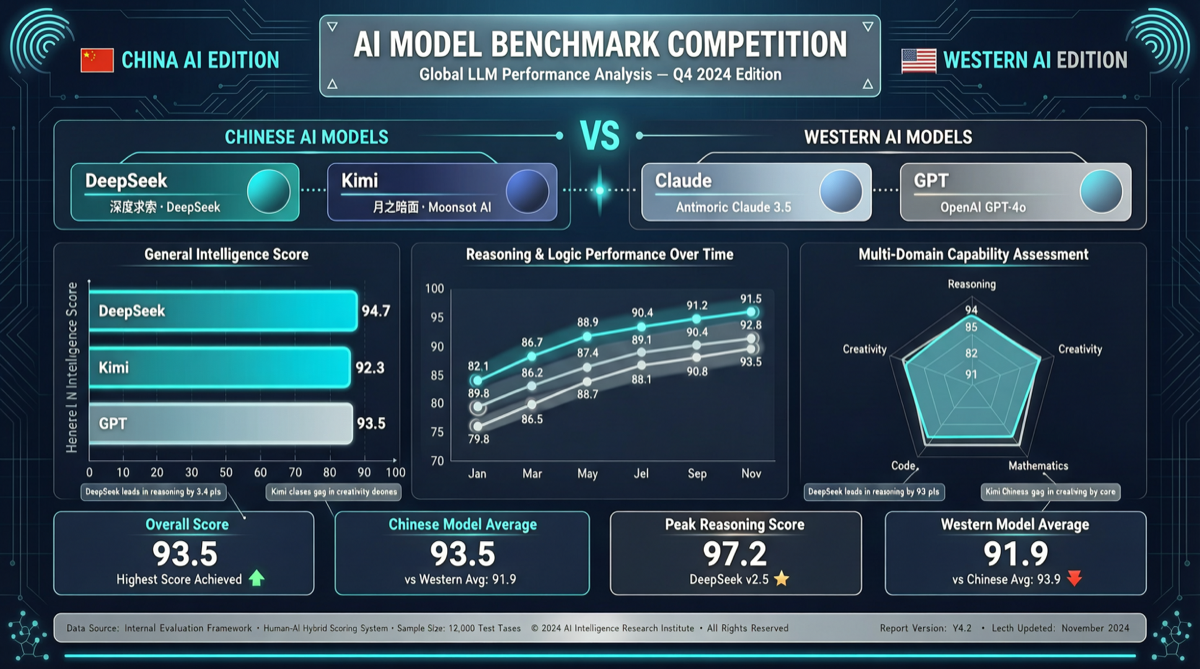
DeepSeek V4 and Kimi K2.6 have matched Claude Opus 4.7 and GPT-5.5 on SWE-Bench Pro. And their inference cost is just one-third.
Data Comparison
| Model | SWE-Bench Pro | FrontierSWE | Inference Cost (relative) |
|---|---|---|---|
| Claude Opus 4.7 | ~58 | ~38 | 1.0x (baseline) |
| GPT-5.5 | ~58 | ~40 | 1.0x |
| DeepSeek V4 | ~57 | ~28 | 0.33x |
| Kimi K2.6 | ~56 | ~25 | 0.30x |
| Gemini 3.1 | ~57 | ~35 | 0.70x |
Key insights:
- SWE-Bench Pro is no longer a differentiator. Chinese open-source models have caught up to and in some cases slightly surpassed select US frontier models on this benchmark
- FrontierSWE is the new dividing line. This benchmark measures long-horizon, multi-step real-world engineering tasks. Here, Claude and GPT-5.5 still lead Chinese models by 10-15 percentage points
- The cost advantage is structural. DeepSeek V4 uses a MoE (Mixture of Experts) architecture with fewer active parameters, delivering significantly higher inference efficiency than dense models
Cyber-Offensive Capabilities: Doubling Every 4 Months
Another warning line from the report is even more alarming:
The cyber-offensive capabilities of frontier models are doubling every 4 months.
Both Anthropic’s Claude Mythos Preview and OpenAI’s GPT-5.5 passed the UK AISI’s full 32-step corporate network takeover simulation (no defenders). This means:
- A frontier AI can complete the full attack chain from initial access to domain escalation without human intervention
- This capability is growing faster than defensive tools and security training can iterate
Landscape Assessment
Where Chinese Models Break Through
The SWE-Bench Pro scores of DeepSeek V4 and Kimi K2.6 are no accident. Their design philosophy differs from Claude/GPT:
- Large-scale distillation + open weights: Rapidly catching up on benchmarks by distilling knowledge from stronger models
- MoE cost advantage: Can process more tokens at the same budget, friendlier to developers
- Agile iteration: DeepSeek has already completed multiple rapid version updates in 2026
The US Moat
The FrontierSWE gap reveals a critical truth: short-range coding capability has converged; the real competition is in long-horizon engineering ability.
Claude Opus 4.7 and GPT-5.5 maintain clear advantages in:
- Cross-module architectural understanding
- Task planning spanning dozens of steps
- Error recovery and self-debugging
Action Recommendations
| Your Use Case | Recommended Solution |
|---|---|
| Daily coding / rapid prototyping | DeepSeek V4 (MIT licensed, ultra-low cost, top-tier SWE-Bench Pro performance) |
| Complex system refactoring | Claude Opus 4.7 / GPT-5.5 (FrontierSWE leaders, more reliable for long-horizon tasks) |
| Cost-sensitive batch tasks | Kimi K2.6 (0.3x cost, SWE-Bench Pro on par) |
| Enterprise security assessment | Launch AI attack surface audit immediately; cyber-offensive capability is growing exponentially |
The “falling behind” narrative needs updating. The real competition has shifted from “who can pass benchmark tests” to “who can handle long-horizon engineering tasks in the real world.”