Conclusion
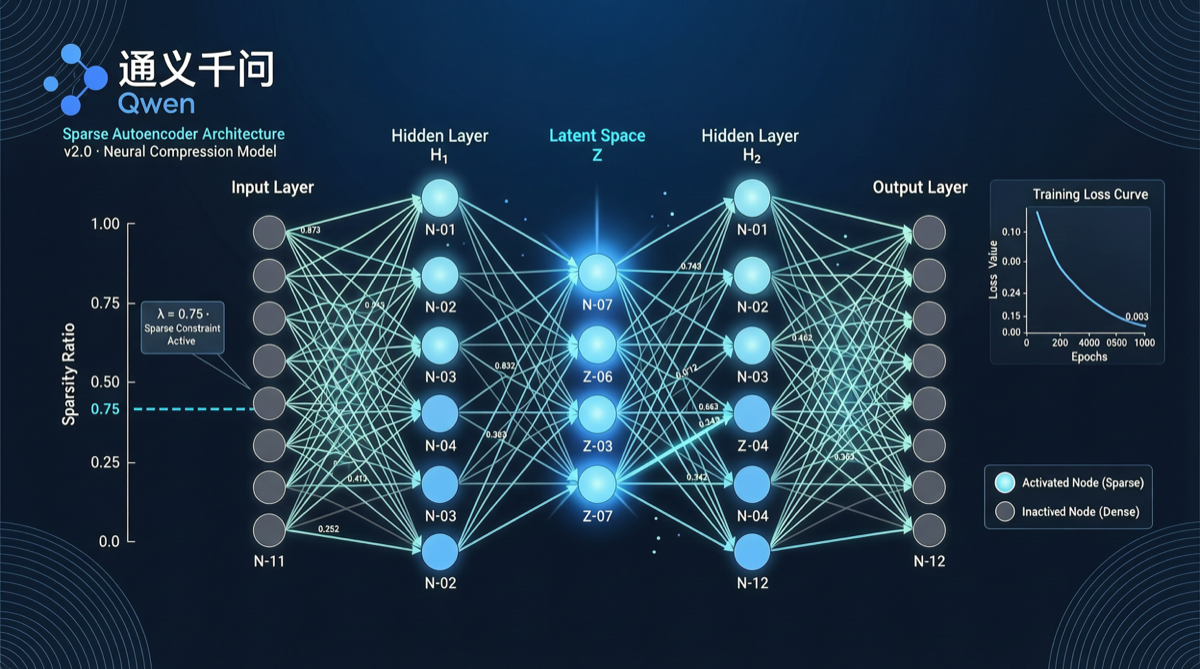
Alibaba’s Tongyi Qianwen team has officially open-sourced Qwen-Scope, a model internal representation analysis and control toolkit based on Sparse Autoencoders (SAE). The tool covers 7 models across the Qwen3 and Qwen3.5 families, with its core value being: you can directionally control the model’s output behavior by manipulating internal features, without fine-tuning the model.
This is not an ordinary open-source toy — it represents the first systematic engineering and adaptation of frontier mechanistic interpretability research (from Anthropic and other institutions) into the Chinese LLM ecosystem.
Core Capabilities Breakdown
| Capability Dimension | Specific Function | Practical Value |
|---|---|---|
| Feature Localization | Locating specific neurons/features inside the model | Understanding “why” the model produces a certain output |
| Output Control | Intervening in feature activation during inference | Adjusting model behavior tendencies without training |
| Classifier Construction | Training feature classifiers with few seed examples | Low-cost detection of specific concepts or intents |
| Sample Synthesis | Generating long-tail samples based on feature activation | Expanding training data for rare scenarios |
| Anomaly Detection | Locating features causing anomalous outputs | Rapid diagnosis of model “bad habits” |
Technical Principle (Brief)
Qwen-Scope’s workflow has three steps:
- Train SAE: Train sparse autoencoders on model hidden layers (typically MLP or Attention outputs), decomposing high-dimensional dense activations into numerous sparse “features”
- Feature Annotation: Automatically or semi-automatically label semantic meanings for each feature (e.g., “Chinese language feature”, “code feature”, “safety refusal feature”)
- Feature Intervention: Enhance or suppress specific features during inference to achieve precise output control
The elegance of this approach: you don’t need to retrain the model — just “turn a few knobs” during inference.
Covered Models
Qwen-Scope supports the following 7 models:
- Qwen3-0.6B / 1.7B / 4B / 8B
- Qwen3.5-4B / 8B / 14B
Covering all mainstream specifications from small to medium, adapted for different deployment scenarios.
Practical Application Scenarios
Scenario 1: Eliminating Language Mixing
When the model unnaturally mixes English into Chinese responses, locate the “English feature” and moderately suppress it during inference — the output becomes purer Chinese.
Scenario 2: Reducing Repetitive Generation
When the model produces repetitive output, locate and suppress the features corresponding to repetition patterns, significantly improving generation quality.
Scenario 3: Safety Alignment Enhancement
Without redoing RLHF, simply increase the activation strength of “safety refusal features” to make the model more sensitive to harmful requests.
Scenario 4: Domain-Specific Knowledge Injection
Locate key features of the target domain and enhance their activation during inference — effectively giving the model “temporary tutoring.”
Landscape Assessment
The open-sourcing of Qwen-Scope releases several important signals:
- Interpretability tools moving from research to engineering: SAE is no longer just a paper concept — it’s a downloadable, installable, usable toolkit
- Chinese model interpretability ecosystem launched: Previously, SAE tools mainly targeted English models (Claude, GPT). Qwen-Scope fills this gap for Chinese LLMs
- Fine-tuning costs can drop significantly: Feature control as a fine-tuning alternative can save substantial compute and time in certain scenarios
Compared with Anthropic’s SAE research, Qwen-Scope’s unique advantage lies in optimization for Chinese language characteristics, including Chinese tokenization features, Chinese-English mixing detection — things English model tools cannot cover.
Action Recommendations
- Model developers: Use Qwen-Scope to diagnose specific model behavior issues — more efficient than blind parameter tuning
- Application teams: When facing model output quality problems, try feature control first — you may not need to re-fine-tune
- Researchers: Build new benchmarks for Chinese LLM interpretability based on Qwen-Scope
Getting Started
# Clone repository
git clone https://github.com/QwenLM/Qwen-Scope.git
cd Qwen-Scope

# Install dependencies
pip install -r requirements.txt

# Load pre-trained SAE (Qwen3-8B example)
from qwen_scope import SAELoader
sae = SAELoader.from_pretrained("Qwen3-8B-MLP-SAE")

# Feature intervention during inference
controlled_output = sae.generate(
    prompt="Your question",
    feature_modulations={"chinese_purity": 1.5, "english_mixed": -0.8}
)
SAE weights are published on Hugging Face and ModelScope, supporting direct loading and use.
Data Sources
- GitHub: github.com/QwenLM/Qwen-Scope
- Qwen Official Announcement