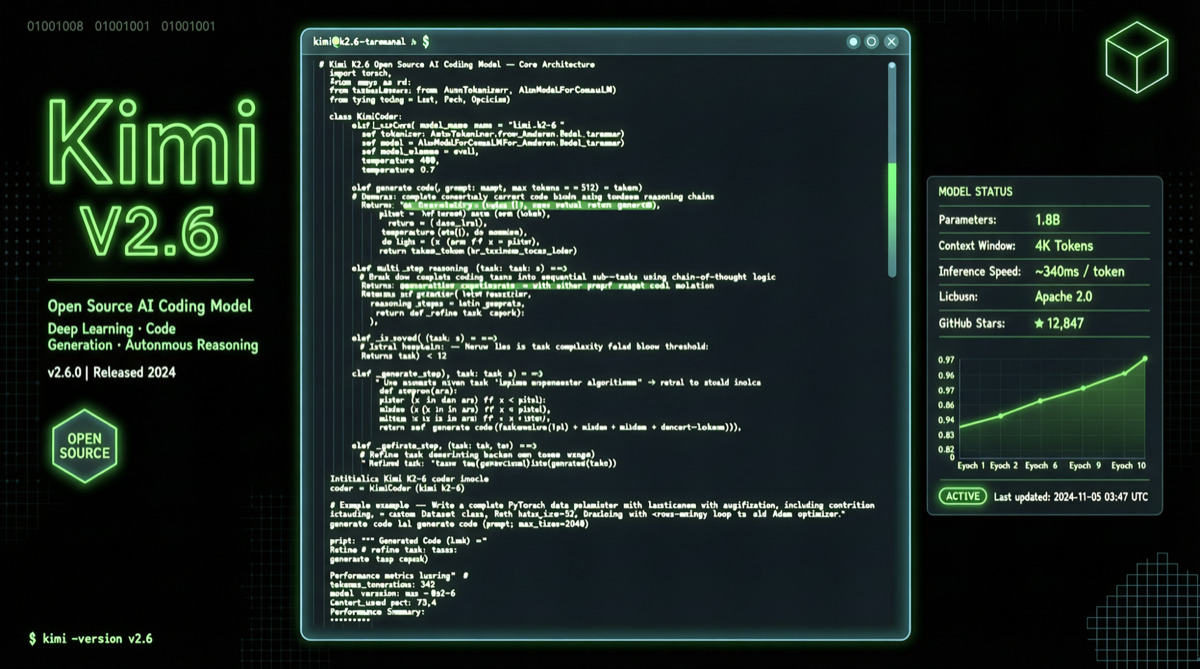
Bottom Line First
Moonshot AI released Kimi K2.6 in early May 2026—an open-weight model purpose-built for coding. Key highlights:
- Completely free, running on NVIDIA servers
- 256K context window, OpenAI-compatible API endpoint
- Image + video understanding capabilities
- Claims to surpass GPT-5.4 and Claude Opus 4.6 on SWE-bench Multilingual
This is not just another routine update from a Chinese model vendor. Kimi K2.6’s positioning is crystal clear: compete directly for Claude Code and Cursor’s user base with free + open-source + strong coding capabilities.
Data Comparison
| Dimension | Kimi K2.6 | GPT-5.5 | Claude Opus 4.6 | GPT-5.4 |
|---|---|---|---|---|
| Open Weights | ✅ Yes | ❌ No | ❌ No | ❌ No |
| Coding-Optimized | ✅ Yes | ✅ Yes | ✅ Yes | ✅ Yes |
| 256K Context | ✅ Supported | ✅ Supported | ✅ Supported | ✅ Supported |
| Image/Video Understanding | ✅ Supported | ✅ Supported | ✅ Supported | ❌ Partial |
| Free to Use | ✅ Free | ❌ Paid | ❌ Paid | ❌ Paid |
| OpenAI-Compatible API | ✅ Yes | N/A | ❌ No | N/A |
| SWE-bench Multilingual | Claims to surpass | Not disclosed | Not disclosed | Baseline |
Landscape Assessment
The “Encirclement” of Chinese Open-Source Models
Kimi K2.6 is not fighting alone. Over the past two months, Chinese model vendors have been aggressively playing cards in the open-source coding model space:
- DeepSeek: Continuous iteration of the TUI terminal coding agent, rewritten in Rust, GitHub Trending #1
- Qwen3.5 9B: Can run full 256K context on a 24GB GPU, thriving quantization ecosystem
- Qwen3.6: 27B version distilled from Opus reasoning capabilities, impressive SWE-Bench performance
- MiniMax M3: Clear iteration path from M2.7 to M3, enhanced multimodal capabilities
Common pattern: All emphasize open-source weights + coding focus + free/low-cost strategy. What was a niche approach in 2025 has become the standard playbook for Chinese models by May 2026.
The Business Logic Behind Free
Running Kimi K2.6 for free on NVIDIA servers looks like “burning money” on the surface, but the underlying logic is:
- Developer ecosystem lock-in: Once developers get accustomed to Kimi’s API format and output quality, migration costs are high
- Data flywheel: Free usage generates massive real-world coding data that feeds back into model iteration
- Commercial upsell: The free tier attracts users; the enterprise tier (private deployment, custom fine-tuning) monetizes
This directly competes with Anthropic’s strategy of locking in the Claude Code developer ecosystem first, then improving product experience over time.
Action Recommendations
Who Should Try Kimi K2.6?
| User Type | Reason | Risk |
|---|---|---|
| Individual developers | Free + OpenAI-compatible, zero cost to switch | Service availability depends on Moonshot AI’s infrastructure |
| Team tech selection | SWE-bench data benchmarks against Opus, cost-effective for coding tasks | Open weights ≠ open license, commercial use needs verification |
| Claude Code users | OpenAI-compatible means direct use in existing toolchains | Real-world experience needs personal verification; benchmarks ≠ daily use |
| Research/education | Free access to a strong coding model for comparative experiments | Stability of 256K context in extreme scenarios remains unproven |
Getting Started
- Access Kimi K2.6 via OpenRouter or Moonshot AI’s official API
- Configure in tools like Cursor/Claude Code that support OpenAI-compatible endpoints
- Compare output quality between Kimi K2.6 and your current primary model on the same tasks
- Watch for independent reproduction of SWE-bench Multilingual results by the community
Key Signals
Kimi K2.6’s release sends three important signals:
- Chinese models are no longer just “followers”: Claiming to surpass top US models on programming benchmarks is a qualitative shift
- Open-source weights have become standard: Chinese models without open weights are increasingly struggling to gain attention in developer communities
- Free pricing forces a restructuring of the pricing landscape: When a top player goes free, others must either follow or prove their paid value
Moonshot AI’s bet is that “open-source + free” can carve out a large enough niche in the coding vertical. Based on current community reaction, at the very least, it has successfully captured attention.