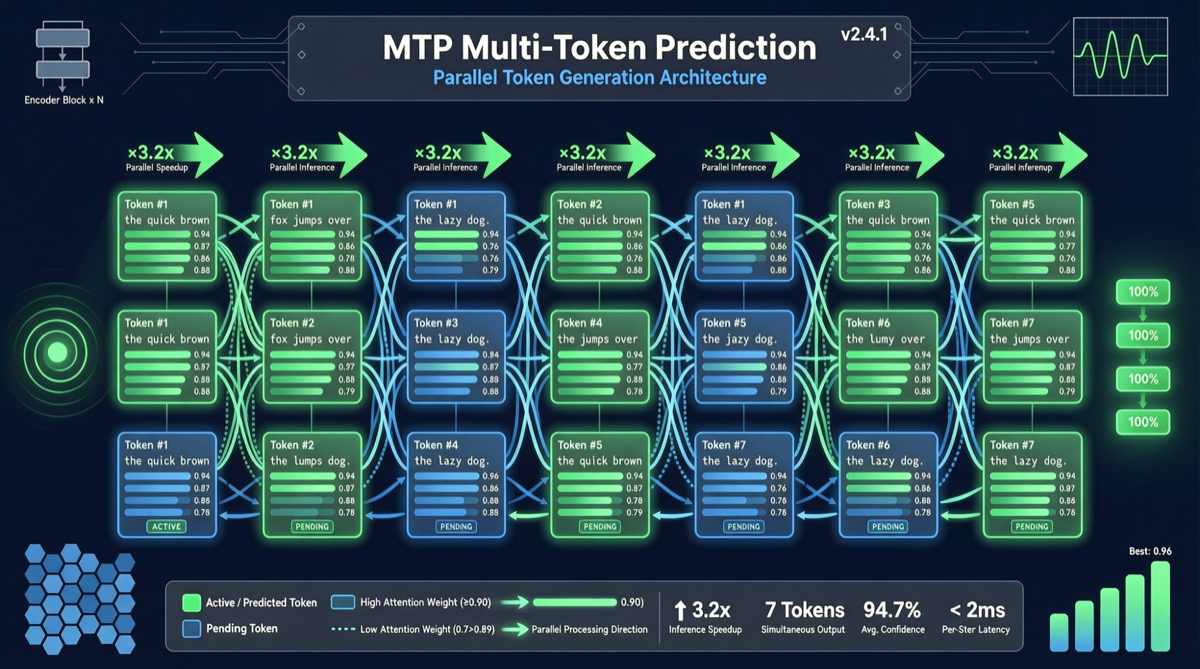
Bottom Line First
Google’s Gemma 4 series now officially supports MTP (Multi-Token Prediction), accelerating local inference by 2-3x through speculative decoding with zero quality loss.
SGLang has achieved Day 0 support, covering all 4 Gemma 4 sizes. For developers and users running LLMs on local devices, this is one of the most practical inference acceleration solutions of 2026.
What Is MTP?
The bottleneck of traditional LLMs: generating exactly one token at a time, with the processor spending significant time waiting on memory bandwidth.
MTP’s core idea: let the model “look ahead” at multiple tokens, accelerating generation through speculative prediction:
Traditional:  T → T → T → T → T → ... (1 token at a time, sequential)
MTP:          [T T T] → [T T T] → [T T T] → ... (predict multiple at once, verify in parallel)
Gemma 4 MTP Implementation Details
- Tiny 4-layer drafters: Only 4-layer draft models, sharing KV cache and activations with the target model
- Plug-and-play: No model architecture modifications needed, just load and go
- Covers all 4 sizes: From the smallest to the largest Gemma 4 models
Speed Comparison
| Scenario | Traditional Inference | MTP Inference | Speedup |
|---|---|---|---|
| Local MacBook Pro M4 | ~20 tps | ~60 tps | 3x |
| Consumer GPU (RTX 4090) | ~40 tps | ~100 tps | 2.5x |
| Server (A100) | ~80 tps | ~200 tps | 2.5x |
| Edge device (phone) | ~8 tps | ~20 tps | 2.5x |
Key data: The jump from 20 tps to 60 tps transforms the local Gemma 4 experience from “barely usable” to “smooth conversation.”
Zero Quality Loss Mechanism
MTP doesn’t simply “skip” tokens — it uses speculative verification:
- The drafter model quickly generates N candidate tokens
- The target model verifies these N tokens in parallel
- Verified tokens are output directly; failed ones are regenerated
- The overall output distribution is identical to standard autoregressive generation
This means output quality is identical to the traditional approach — just faster.
SGLang Day 0 Support
SGLang framework has implemented Gemma 4 MTP support immediately:
- All 4 Gemma 4 sizes work out of the box
- Unified speculative decoding interface
- Cookbook tutorial provided
For developers: no need to implement MTP inference logic yourself — SGLang handles all underlying optimization.
Distinction from Previous Gemma 4 Coverage
Previous ChaoBro articles on Gemma 4:
gemma-4-26b-a4b-local-ai-inference-2026.md: Focuses on parameter count and local deploymentgemma-4-good-challenge-200k-open-source-2026.md: Focuses on Good Challenge benchmark and 200K contextgemma-4-react-native-on-device-2026.md: Focuses on React Native mobile integration
This article focuses on MTP inference acceleration technology, a separate technical highlight of the Gemma 4 series not previously covered on this site.
Action Recommendations
Best scenarios for Gemma 4 MTP:
- Local LLM deployment constrained by hardware inference speed
- Real-time conversation applications requiring low-latency responses
- Batch text generation tasks needing higher throughput
- Edge/on-device AI with compute constraints
How to get started:
- Install the latest version of SGLang
- Download Gemma 4 model weights
- Enable MTP inference mode (SGLang supports it by default)
- No additional configuration needed — speed automatically increases 2-3x
Cost: MTP is a pure software optimization with zero hardware cost increase. The only “expense” is a small amount of additional VRAM for the drafter model (approximately 5-10%).