What Happened
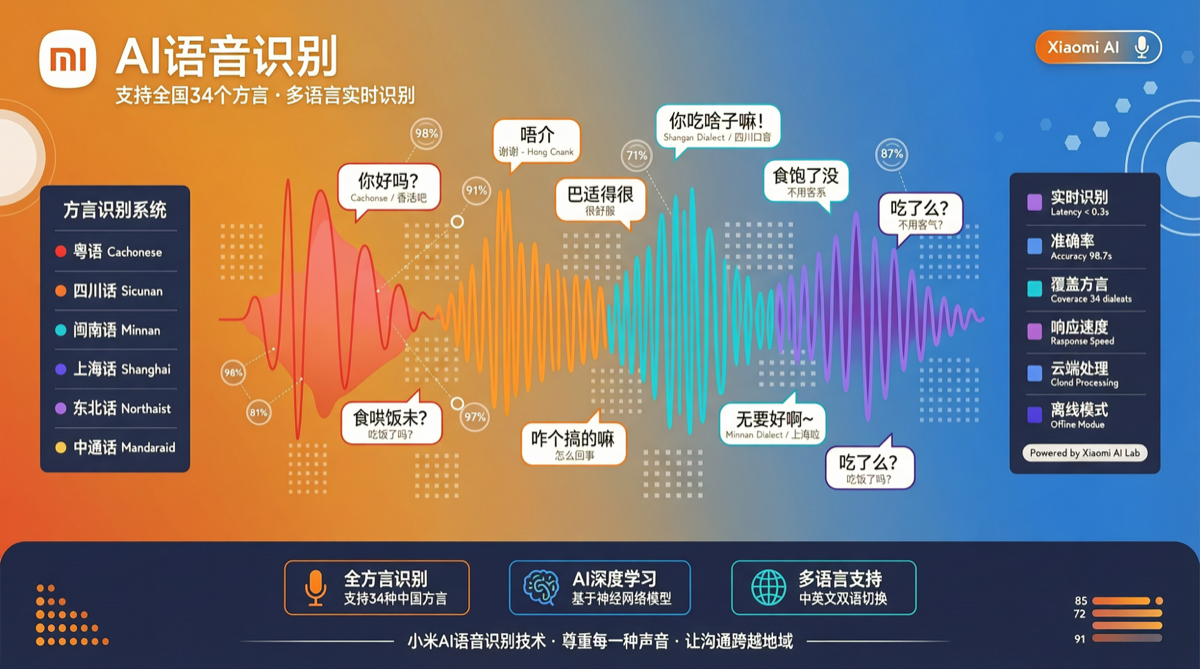
Xiaomi open-sourced MiMo-V2.5-ASR on April 30 — an open-source model focused on speech recognition (ASR). Unlike the previous MiMo-V2.5 series, this release targets a specific capability: high-quality speech-to-text with native support for multiple Chinese dialects.
| Capability | Description |
|---|---|
| Mandarin | Standard Chinese speech-to-text |
| English | Standard English speech-to-text |
| Wu | Shanghai, Suzhou dialects |
| Cantonese | Guangdong dialect |
| Minnan | Fujian, Taiwan Minnan |
| Sichuanese | Southwest Mandarin |
| Song Recognition | Voice content with music |
| Noisy Environments | Robust recognition in noisy scenes |
| Multi-Speaker | Simultaneous multi-speaker recognition |
Why Dialect Recognition Is Hard
Differences between Chinese dialects can sometimes exceed differences between European languages:
- Cantonese has 6-9 tones (vs. Mandarin’s 4), completely different tone system
- Wu retains many Middle Chinese entering tones and voiced consonants
- Minnan has vastly different phonology from Mandarin, many words lack Mandarin equivalents
Existing ASR models (including well-known open-source solutions like Whisper) typically see significant performance drops in dialect scenarios. The reason: training data is dominated by Mandarin, and dialect data scarcity and annotation costs lead most teams to give up.
Xiaomi’s advantage: MIUI/HyperOS covers hundreds of millions of Chinese users, providing natural dialect speech data sources.
Technical Highlights
1. Unified Architecture, Multi-Language/Dialect Sharing
MiMo-V2.5-ASR uses a unified multi-language/dialect model architecture, not separate models per dialect:
- One model handles all dialects, no switching needed
- Knowledge transfers between dialects (e.g., shared phonetic features between Cantonese and Minnan)
- Deployment costs dramatically reduced
2. Noise and Music Scenarios
Supporting “song recognition” is noteworthy. Speech recognition under music background is a classic ASR challenge — the acoustic encoder must separate vocals from mixed signals and recognize lyrics. MiMo-V2.5-ASR handling this indicates its acoustic feature extraction has reached a high level.
3. Multi-Speaker Recognition
Traditional ASR assumes single speaker. Multi-speaker requires:
- Speaker diarization
- Speaker switch detection
- Independent tagging per speaker
MiMo-V2.5-ASR natively supports this without third-party tools.
Comparison with Existing Open-Source ASR
| Solution | Dialect Support | Multi-Speaker | Noise Robustness | Song Recognition | License |
|---|---|---|---|---|---|
| Whisper | Limited | No | Medium | No | MIT |
| FunASR | Partial | Yes | Good | No | Apache 2.0 |
| MiMo-V2.5-ASR | 6+ dialects | Yes | Good | Yes | TBD |
Action Recommendations
If you’re a developer:
- Watch the GitHub repo for license terms (determines commercial viability)
- Test your dialect data, especially niche dialects
- Evaluate integration into existing speech pipelines
If you’re a product manager:
- Dialect ASR has clear user demand in China (hundreds of millions of dialect speakers)
- Consider dialect support in customer service, content moderation, subtitle generation
Based on Xiaomi MiMo-V2.5-ASR release info and open-source community discussion.