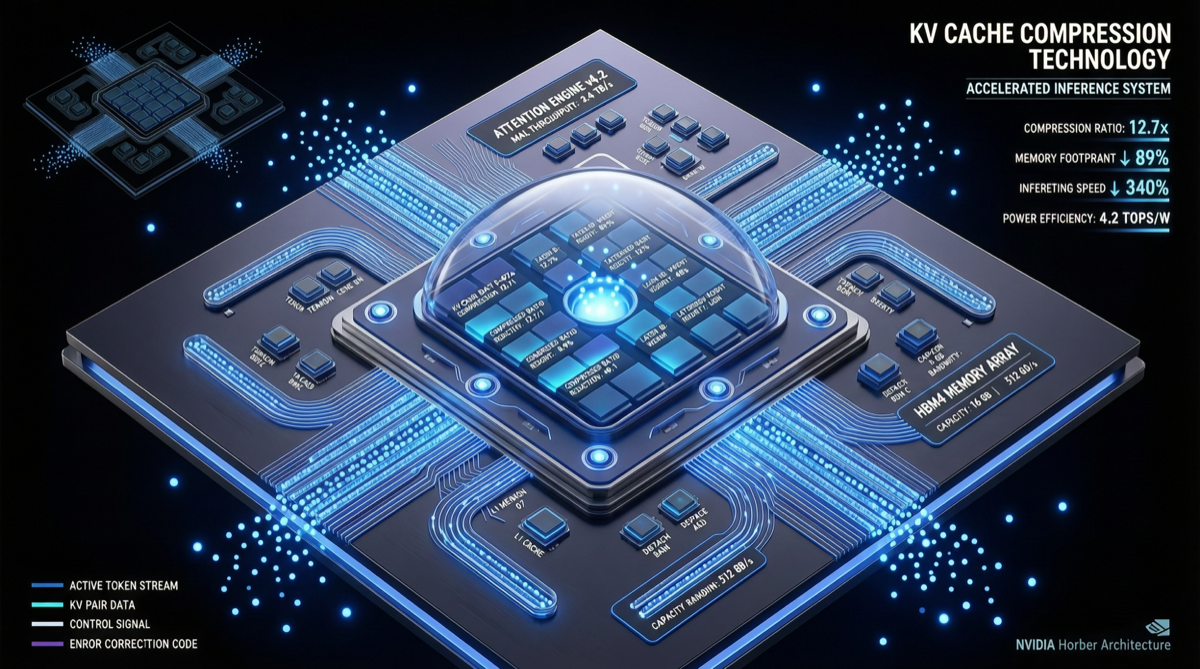
The real bottleneck in long-context LLM inference is not compute—it’s the KV Cache memory wall. When context stretches from 4K to 128K or even 1M tokens, KV Cache VRAM usage grows linearly or even super-linearly, locking most consumer GPUs out of the game.
Google Research’s TurboQuant paper, published at ICLR 2026, breaks through this wall with a “seemingly boring but incredibly effective” numerical trick.
The Core Breakthrough
TurboQuant’s approach has two steps:
- PolarQuant: Before quantization, apply a rotation transform to the KV vectors, concentrating energy into fewer dimensions. The rotated vector distribution becomes much more “quantization-friendly,” drastically reducing quantization error.
- QJL Compression (Quantized Johnson-Lindenstrauss): Combine random projection techniques to further compress dimensions while preserving inner product accuracy.
The results:
| Metric | Traditional KV Quantization | TurboQuant | Improvement |
|---|---|---|---|
| Compression ratio | ~1.5x | 4-6x | Up to 4x |
| H100 attention speedup | Baseline | 8x | 8x |
| Accuracy loss | 5-15% | <2% | Significantly lower |
| Requires retraining | Partially | No | Zero-cost migration |
The most important point: no model retraining needed. TurboQuant is a pure inference-side optimization—any existing open-source model can benefit directly.
Ecosystem Integration Progress
Just one week after publication, the community is already integrating at full speed:
- Qdrant: Integrated TurboQuant into its vector search engine, reducing KV Cache costs by 6x while maintaining retrieval accuracy
- llama.cpp: A third-party developer released a TurboQuant+ fork, running Qwen3.5-35B MoE on M5 Max at 144 tok/s decode speed with 4K context
- Swift MLX fork: macOS users can experience roughly 2.5x decode speedup
- vLLM-swift: The server-side inference framework is also following suit
The TurboQuant+ repository has already gained 6,685+ stars on GitHub, making it one of the fastest-growing projects in AI infrastructure right now.
Why This Matters
Most people imagine AI infrastructure advances as “new architectures” or “new models.” But what actually drives the industry forward are often these “boring numerical tricks.”
TurboQuant’s practical impact:
- Consumer GPUs can run long context: Tasks that previously needed an A100 for 128K context can now run on an RTX 4090
- Lower cloud inference costs: H100 instance per-request costs drop by 60-80% directly
- Unlock new use cases: Full-book context analysis, frame-by-frame long video understanding, ultra-long codebase retrieval—scenarios previously blocked by KV Cache are now feasible
Landscape Assessment
KV Cache optimization is becoming the new battleground for LLM inference. Comparing mainstream approaches:
| Approach | Compression | Accuracy Loss | Use Case |
|---|---|---|---|
| TurboQuant (Google) | 4-6x | <2% | Long-context general inference |
| Gemma 4 MTP (Google) | 3x speedup | None | Autoregressive draft acceleration |
| Unsloth GGUF | 2-4x | 1-3% | Local deployment |
| FlashAttention-3 | Memory optimization | None | Training-side optimization |
TurboQuant’s advantage is generality—it doesn’t tie to a specific model architecture, requires no additional training, and works plug-and-play.
Action Recommendations
| Scenario | Recommendation |
|---|---|
| Running long context locally | Install the TurboQuant+ llama.cpp fork; M-series chip users benefit immediately |
| Cloud inference | Watch for vLLM’s TurboQuant integration; H100/A100 instance cost-effectiveness will improve dramatically |
| Vector search | Qdrant already supports it; RAG system KV storage costs can drop 6x |
| Developers | Follow TheTom’s TurboQuant+ repository—the most complete cross-platform support |
TurboQuant isn’t a flashy new model, but it may impact your daily inference costs and speed more directly than any new model release.