What Happened
On today’s GitHub Trending leaderboard, TradingAgents topped the chart with 67,992 stars and 2,182 new stars today. This is a multi-agent LLM financial trading framework developed by TauricResearch.
In 2026, with AI agent frameworks blooming everywhere, it’s uncommon for a financial trading project to top GitHub Trending. The reason it has attracted attention is because it represents a specific and high-value scenario: letting multiple AI agents collaborate to complete real financial trading decisions.
Architecture Breakdown
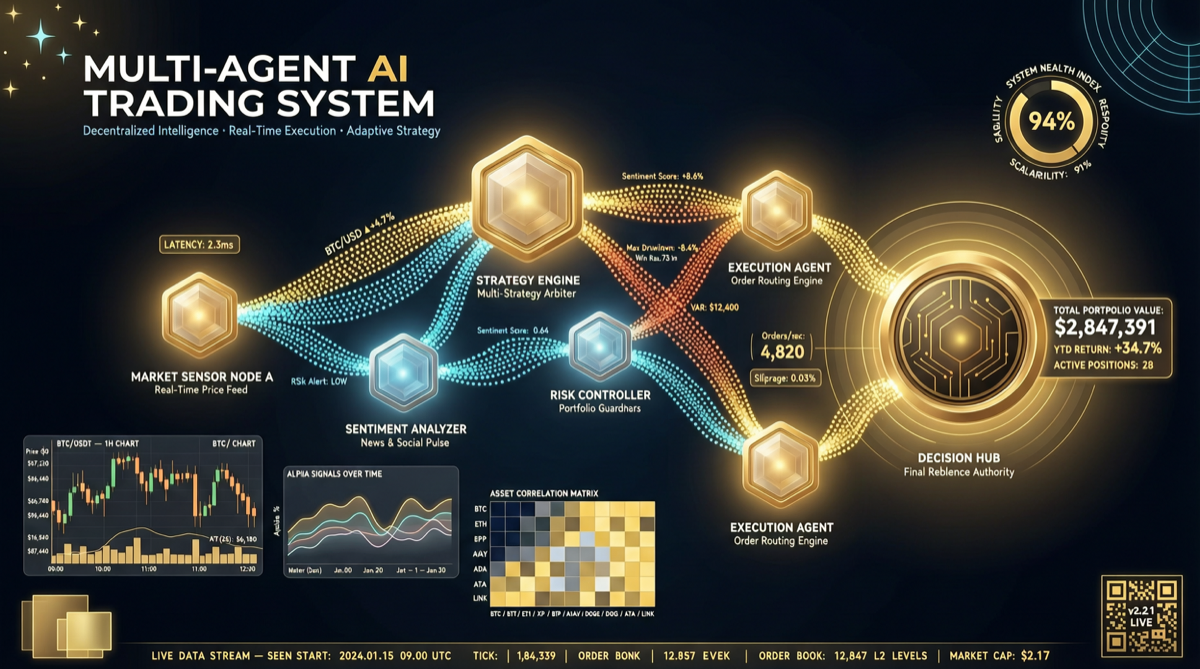
TradingAgents’ core design splits the trading process into multiple specialized agents, each playing a real role in the financial industry:
| Agent Role | Responsibility | Input | Output |
|---|---|---|---|
| Researcher | Collects market news, earnings data, macroeconomic indicators | News sources, API data | Structured information summaries |
| Technical Analyst | Analyzes candlestick charts, technical indicators, trend lines | Historical price data | Technical analysis reports |
| Fundamental Analyst | Evaluates company valuation, industry position, growth prospects | Financial statements, industry data | Fundamental analysis reports |
| Risk Manager | Evaluates position risk, stop-loss strategies, volatility | All analysis reports + current holdings | Risk rating and adjustment recommendations |
| Trader | Synthesizes all information, makes final trading decisions | Output from all agents | Buy/sell/hold decisions + position recommendations |
The brilliance of this design is: rather than having one large model “do everything,” it lets each agent focus on the analysis dimension it’s best at, and finally synthesizes through the decision agent — this is exactly how human professional investment teams operate.
Comparison with Other Solutions
| Dimension | TradingAgents | Traditional Quant Trading | Single LLM Trading |
|---|---|---|---|
| Decision process | Multi-agent collaboration, traceable | Rule engine, deterministic | Single model black box |
| Information utilization | Full structured + unstructured | Primarily structured data | Depends on prompt quality |
| Risk control | Independent risk agent, veto power | Preset rules | No built-in risk control |
| Explainability | High (each agent output is reviewable) | High | Low |
| Onboarding difficulty | Medium (requires agent and tool configuration) | High (requires quant knowledge) | Low |
Getting Started Guide
The framework is Python-based, supporting multiple LLM backends (OpenAI, Claude, local models). Quick start process:
- Environment preparation: Python 3.10+, install dependencies
pip install trading-agents - Configure LLM: Set API keys or local model path
- Define trading targets: Specify stock codes or asset classes
- Launch agent team: Run main script, observe each agent’s analysis process and final decision
- Backtest verification: Use historical data to validate strategy performance
Key tip: TradingAgents provides a decision support framework, not an auto-execution trading system. Final trading decisions and execution should still be completed by humans — this is the framework designer’s clear stance.
Landscape Assessment
TradingAgents’ success reflects two trends in AI financial applications:
- From “chatbot” to “professional agent team”: The financial domain doesn’t need an AI that “can chat about anything,” but rather a set of specialized analysis agents each with their own responsibilities
- Explainability has become a must-have: In financial trading, “why this decision was made” is more important than “what decision was made.” Multi-agent architecture naturally provides traceability of the decision chain
Risk Warning
⚠️ TradingAgents is not an investment product and does not constitute investment advice. The framework itself does not guarantee trading profits, and AI-generated trading decisions may result in losses. Users should fully understand the risks and only use funds they can afford to lose for testing.
Action Recommendations
- Quantitative researchers: Can use TradingAgents as a supplement to traditional quantitative strategies, utilizing LLMs to process unstructured data (news, earnings call transcripts, etc.)
- AI developers: The multi-agent collaboration architecture design pattern can be migrated to other domains (legal analysis, medical diagnostic assistance, etc.)
- Ordinary investors: Can use the open-source version of TradingAgents for learning and research, but should not directly use its output as a trading basis