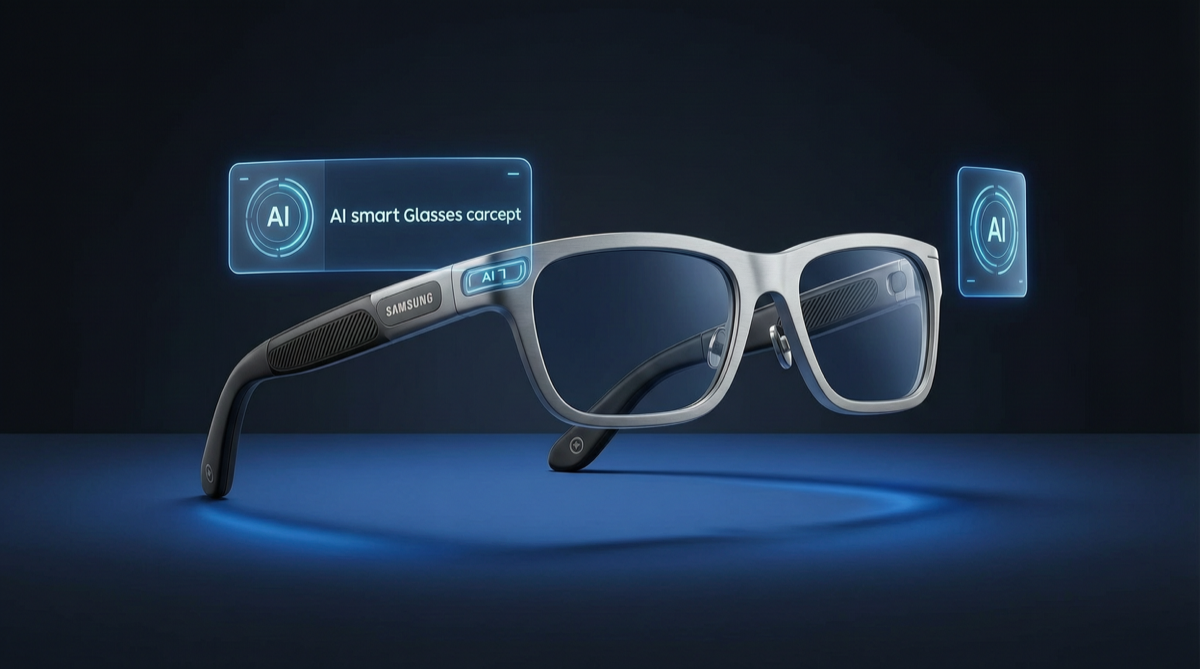
Core Conclusion
Samsung has officially confirmed its AI smart glasses development plan. Key details:
| Dimension | Information |
|---|---|
| Appearance | Ordinary glasses shape, not bulky tech goggles |
| Display | No display in current version |
| System | Android XR |
| AI | Google Gemini voice AI |
| Hardware | Dual cameras + speakers + lightweight design |
| Pricing | $379-$499 USD |
| Status | Under development, officially confirmed |
This is not a concept product — Samsung has reached the official confirmation stage, meaning mass production plans are already on the execution track.
Why This Matters
1. Pricing Determines the Market
The $379-$499 pricing range is critical:
- Below Ray-Ban Meta smart glasses (around $500+)
- Above regular glasses but far below VR headsets
- Targets the daily wear scenario, not tech experimentation
Samsung clearly does not want to make a “geek toy” — it wants a “mass consumer product.”
2. The “No Screen” Design Philosophy
The current version has no display screen, which is a conscious design choice:
- Avoids making wearers look “weird”
- Reduces power consumption and weight
- Shifts interaction focus from visual to voice + audio
This actually returns to the essence of AI: you do not need to see AI, you just need to hear it and talk to it.
3. Hardware Carrier for Gemini Voice AI
Google Gemini performs strongly in the cloud but lacks a lightweight hardware entry point. Samsung AI glasses fill this gap:
- Gemini handles environment understanding (camera input) and voice interaction
- Android XR provides the underlying framework
- Samsung handles hardware integration and channel distribution
This is Google’s “borrowing a ship to go to sea” in the wearable AI space.
Competitive Landscape
| Product | Pricing | Core Capability | Positioning |
|---|---|---|---|
| Samsung AI Glasses | $379-$499 | Gemini voice AI + dual cameras | Mass-market daily AI assistant |
| Ray-Ban Meta | $500+ | Meta AI + camera | Social + content creation |
| Apple Vision Pro | $3,499 | Spatial computing + MR | High-end productivity |
| Xreal Air | $300+ | AR display | Entertainment |
Samsung’s unique advantage: it makes AI “invisible” — looks like ordinary glasses, but AI is always accessible.
Industry Signals
Samsung AI glasses confirmation, combined with previously leaked details (Android XR + Gemini), sends several signals:
- AI hardware is moving from “show-off” to “practical”: no screen needed, no complex interaction, just always-available conversation
- Google’s AI ecosystem is completing its last puzzle piece: Pixel for phones, Android Automotive for cars, now Samsung fills the wearable gap
- Chinese-Korean hardware vendors accelerating AI integration: after Samsung, AI glasses from Xiaomi, OPPO, vivo may already be in development
Relationship with China Market
Samsung AI glasses will likely not launch in mainland China in the short term, but the industry trend will transmit:
- Huawei is already deploying AI glasses (integrated with HarmonyOS ecosystem)
- Xiaomi, OPPO, etc. will likely follow in the second half of 2026
- The core competitive point for domestic AI glasses may be which domestic large model to integrate (Tongyi, ERNIE, Kimi, DeepSeek)
Action Recommendations
- Consumers: If the $379 pricing holds, worth waiting — this may be the first “truly daily-wearable” AI glasses
- Developers: The Android XR ecosystem app development window is opening, early entry has advantages
- Investors: Samsung’s entry validates the AI wearable device track — supply chain (camera modules, audio chips, batteries) worth watching
- Domestic manufacturers: Samsung fired the first shot — differentiation opportunities for Chinese AI glasses lie in localized AI capabilities + more aggressive pricing
The “iPhone moment” for AI hardware may not be a single revolutionary device, but rather a bunch of things that look ordinary but have AI built in — glasses, watches, earphones, being AI-ized one by one. Samsung AI glasses is the first clear signal.