Key Takeaway
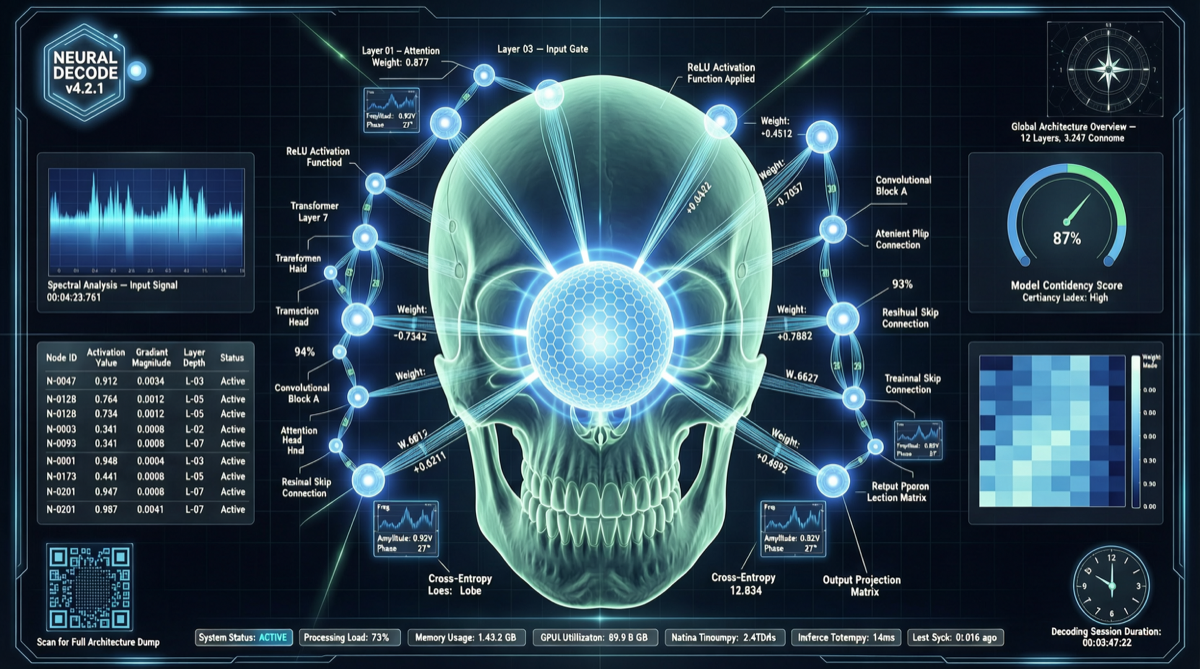
The Qwen team open-sourced Qwen-Scope on April 30 — an interpretability toolkit based on sparse autoencoders (SAE). It decomposes the “mess of numbers” inside Qwen3 and Qwen3.5 models into independent semantic direction switches, allowing researchers to “see” which language the model is speaking, which entity it mentioned, and what tone it’s using — for the first time in a human-readable way.
This has substantial implications for model safety auditing, hallucination tracing, and controlled generation.
Technical Breakdown: How SAE Gives Models an “X-Ray”
The Problem
The internal workings of large models have long been a black box. Models like Qwen3-Next, Qwen3.5, and Qwen3.6 use GDN (Gated Delta Network) linear attention layers that produce large volumes of intermediate activations during inference — numbers that are completely unreadable to humans.
Qwen-Scope’s Approach
| Component | Function | Analogy |
|---|---|---|
| Sparse Autoencoder (SAE) | Compresses high-dimensional activations into sparse low-dimensional representations | Untangling a ball of yarn into individual threads |
| Semantic Direction Switches | Each direction corresponds to an interpretable semantic feature | Light switch — on or off |
| Visualization Layer | Maps switch states to human-readable labels | Anatomical annotations on an X-ray |
After training, the SAE produces thousands of “feature directions,” each activated by specific inputs. For example:
- One direction detects “whether the model is using French”
- One detects “whether a specific person’s name was mentioned”
- One handles “formality level of tone”
- One handles “whether the model is writing code”
Known Capabilities (7 Dimensions in Initial Release)
Based on Qwen team’s public information, Qwen-Scope can identify:
- Output Language — which language the model is currently using
- Entity Recognition — which specific person, place, or organization was mentioned
- Speaking Style — formal/informal/technical/colloquial
- Task Type — coding/writing/translation/reasoning
- Sentiment Tendency — positive/neutral/negative
- Knowledge Domain — science/history/finance/law
- Safety-Related — whether sensitive topics are involved
Why This Matters
1. An “Audit Tool” for Model Safety
With tightening regulations (EU AI Act, China’s Deep Synthesis Management Regulations), model developers need to answer: “Why did your model output this?” Qwen-Scope provides an auditable path — not by guessing, but by “seeing” which internal switches were triggered.
2. Hallucination Tracing
When a model hallucinates, developers can use Qwen-Scope to trace back: which semantic direction was incorrectly activated? Was the knowledge domain switch cross-wired? Was entity recognition off? This is far more precise than blindly “adjusting temperature parameters.”
3. A New Paradigm for Controlled Generation
Instead of using prompt engineering to “guide” the model, you can directly intervene with SAE features — want formal tone? Turn on the “formal tone” switch. Want to ensure Chinese output? Lock the “Chinese output” direction. This is more reliable and efficient than prompts.
Industry Comparison
| Project | Organization | Method | Applicable Models | Status |
|---|---|---|---|---|
| Qwen-Scope | Alibaba Qwen | SAE | Qwen3/3.5 series | Open source |
| SAELab | OpenAI | SAE | GPT-4 | Research, not open |
| nnsight | Neural Magic | Intervention framework | Multiple | Open source |
| TransformerLens | Neel Nanda | Mechanistic interpretability | Small models | Open source |
Qwen-Scope’s distinction is that it directly targets industrial-scale models (70B+ parameters), not toy models. This is a significant breakthrough in the open-source community — most interpretability work only runs on small models.
Action Recommendations
If you use Qwen series models:
- Model safety audit: Deploy Qwen-Scope immediately to build traceable output mechanisms
- Hallucination debugging: Use SAE to trace root causes when hallucinations occur
- Controlled generation: Explore using feature switches instead of complex prompt engineering
If you do interpretability research:
- Qwen-Scope’s SAE training methods can be directly transferred to other model architectures
- The GDN architecture SAE adaptation approach is worth reusing
If you are evaluating interpretability tools:
- Compare OpenAI’s SAELab (not open) with nnsight’s generality
- Note SAE limitations: only explains features covered during training, cannot discover unknown features
Potential Limitations
- Only supports Qwen3/3.5 series model architecture (GDN layers)
- SAE training itself requires significant compute
- What’s interpretable is “features” not “causal chains” — knowing which switch is on doesn’t tell you why it’s on
Qwen-Scope’s open-source release marks a substantive step for Chinese models in the interpretability domain. From black box to grey box to transparency — Chinese model vendors are not absent from this journey.