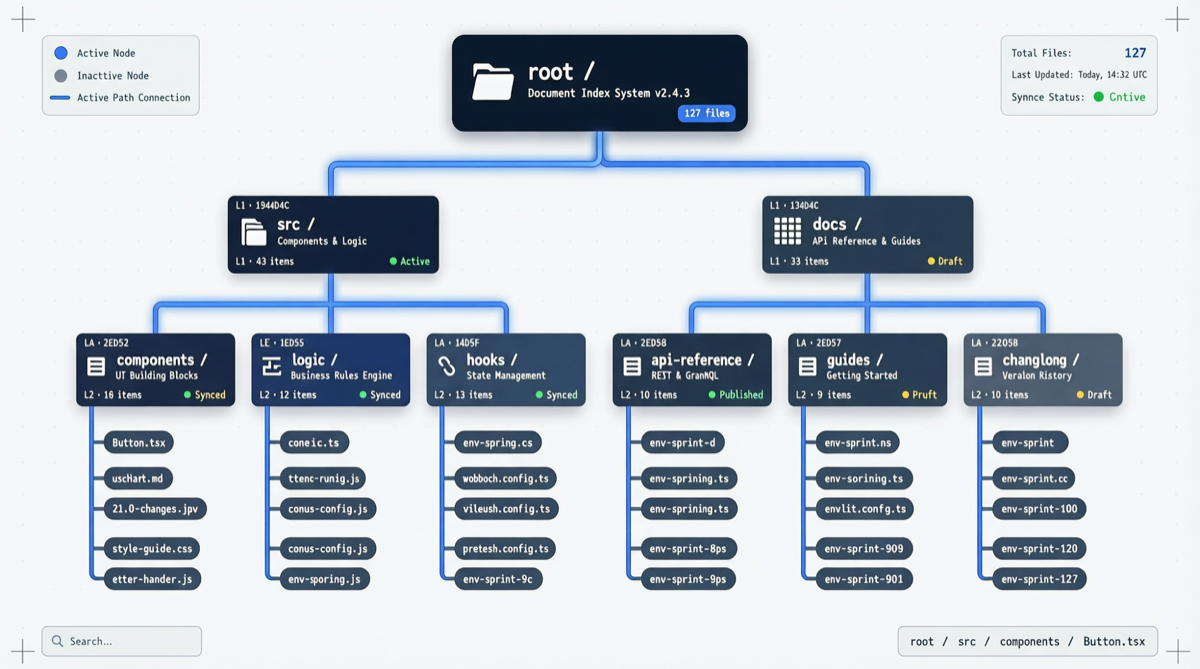
If you are still using the “chunk → embed → vector DB → similarity search” RAG pipeline, PageIndex might be the most important wake-up call of 2026.
The Pain Point
Every step in the traditional RAG pipeline loses information:
- Chunking: Cutting coherent documents into fragments, breaking contextual relationships
- Embedding: Compressing semantics into fixed-dimension vectors, losing details
- Vector DB retrieval: Recall based on cosine similarity, but “similar” does not equal “relevant”
- Context assembly: Feeding fragments into prompts, forcing the LLM to piece together complete meaning
PageIndex’s approach: Why not let the LLM browse the entire document structurally, like a human would?
The PageIndex Solution
PageIndex’s core mechanism is a document tree index:
- Build a hierarchical tree structure over documents (chapters → sections → subsections)
- The LLM starts from the root node and navigates layer by layer to relevant leaf nodes
- At each step, the LLM autonomously decides which branch to explore next
- Ultimately, it reads only the most relevant complete content segments, rather than fragmented chunks
This process completely bypasses embedding and vector search, letting the model locate information like flipping through a book’s table of contents.
Data Comparison
| Dimension | Traditional RAG | PageIndex |
|---|---|---|
| Vector DB required | Yes (Pinecone/Milvus, etc.) | No |
| Embedding model required | Yes | No |
| Chunking required | Yes | No |
| Similarity search required | Yes | No |
| FinanceBench | ~80-85% | 98.7% |
| Long document processing | Information fragmentation | Preserves hierarchical structure |
| Deployment complexity | Multi-component (embedder + vector DB + retriever) | Single component |
The 98.7% FinanceBench score surpasses all vector-retrieval-based RAG approaches. This is not a marginal improvement — it is a methodological crushing victory.
Why Now?
PageIndex’s success depends on two prerequisites that only truly matured in 2026:
- LLM context windows are large enough: 1M+ token contexts allow models to process entire document trees simultaneously
- LLM navigation capability is strong enough: Models need to make multi-step decisions on tree structures, choosing the correct branch at each step
In other words, PageIndex does not “not need LLMs” — it “needs stronger LLMs.” When models are smart enough, traditional embedding and vector search become unnecessary intermediate layers.
Getting Started
# Install
pip install pageindex

# Basic usage
from pageindex import PageIndex

# Build document index
index = PageIndex.from_documents([
    "financial_report_2026.pdf",
    "annual_summary.md"
])

# Query (LLM autonomously navigates tree structure)
result = index.query("What were the main revenue growth drivers in Q1 2026?")
Applicable Scenarios and Limitations
| Suitable for | Not suitable for |
|---|---|
| Long documents (reports, manuals over 100 pages) | Short text collections (social media posts, brief reviews) |
| Structured documents (with clear chapter hierarchy) | Unstructured text streams |
| Finance/legal scenarios requiring high precision | Real-time search requiring extremely low latency |
| Teams wanting to reduce infrastructure dependencies | Teams with mature vector DB pipelines performing well |
Three-Judge Assessment
Increment: A RAG approach that completely skips embedding + vector DB + chunking has not been validated at scale before. The 98.7% FinanceBench score is a real achievement.
Noise: Currently only detailed data on FinanceBench; performance on other benchmarks (HotpotQA, 2WikiMultihopQA) has not been published. Tree index construction costs on ultra-large document sets remain to be verified.
Signal: The X tweet with 5,775 likes and 9,809 bookmarks demonstrates strong community interest. When “RAG without vector databases” becomes a topic center, vector database vendors need to seriously reconsider their product positioning.
Sources: PageIndex GitHub | X/Twitter Discussion