What Happened
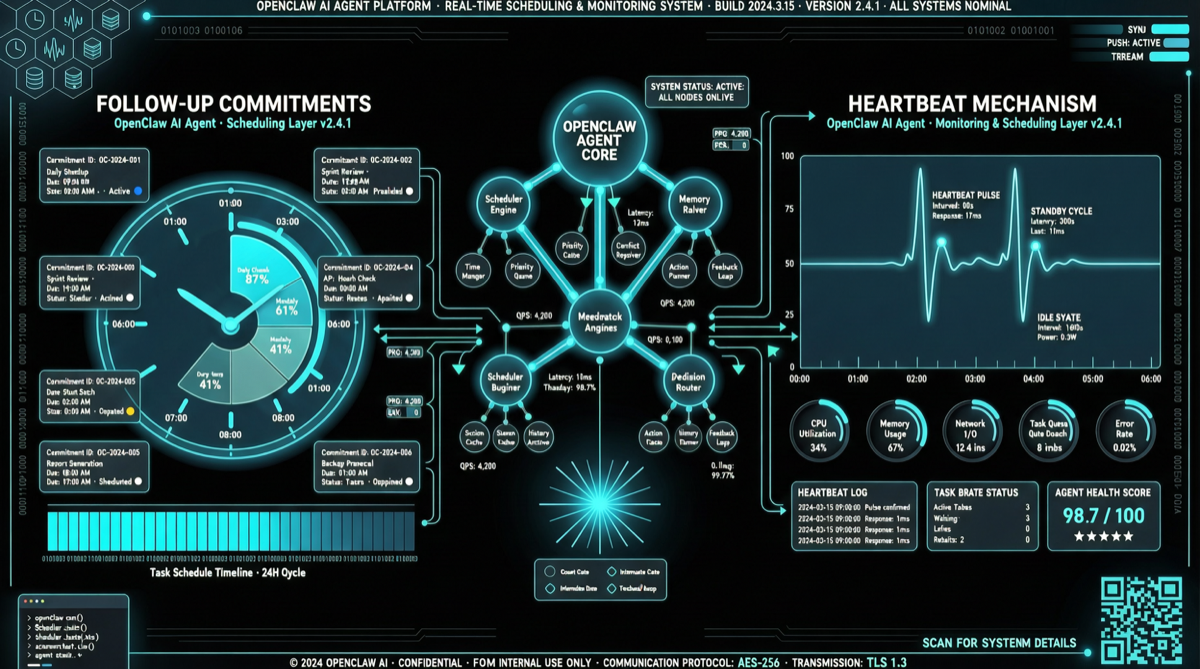
OpenClaw’s April 30 update introduced the follow-up commitments mechanism. This isn’t a simple scheduled reminder — it’s the agent’s ability to automatically infer items that need to be revisited later from the conversation context, and then proactively deliver results via the heartbeat mechanism when the commitment comes due.
Three Key Design Decisions
1. Opt-In Mechanism
Follow-ups are opt-in — users must explicitly authorize the agent to create commitments. This prevents the agent from autonomously generating a pile of useless reminders.
2. Contextual Inference
Rather than passively waiting for users to set reminders, the agent can proactively identify items needing follow-up from the conversation. For example:
“Look up the documentation for this API, I’ll check the results this afternoon.”
The agent automatically recognizes the time signal “this afternoon” and the task “look up API documentation,” creating a lightweight follow-up commitment.
3. Heartbeat Delivery
When a commitment comes due, the heartbeat mechanism pushes the result into the user’s active session — rather than creating a new session or sending a notification. This maintains workflow continuity.
Concurrent Update: More Precise Execution Control
This update also brought improvements to execution and pairing controls:
- Stricter limit configurations: Restrictive profiles now more reliably maintain their restricted state
- Tighter owner checks: Permission verification has been tightened
- Startup warnings: Risky configurations are flagged ahead of time at startup
Behavior Improvements in Busy Conversations
Another noteworthy change: when the agent is already running a task, new follow-ups can steer the current run at the next model boundary rather than creating duplicate work or waiting for the loop to finish. This solves the problem of agents being “stretched too thin” in multi-task scenarios.
Comparison with Other Agent Frameworks
| Feature | OpenClaw | Claude Code | Codex |
|---|---|---|---|
| Scheduled Follow-Ups | ✅ follow-up commitments | ❌ | ❌ |
| Contextual Inference | ✅ Automatic | ❌ Manual setup required | ❌ |
| Heartbeat Push | ✅ | ❌ | ❌ |
| Permission Tightening | ✅ In this update | ✅ Continuous improvement | ⚠️ Basic |
OpenClaw is ahead of other agent frameworks in long-term task management. This isn’t a flashy feature — it genuinely addresses a real pain point in everyday agent use: how to get the agent to remember things you said “I’ll get back to later.”
What It Means for Your Workflow
Ideal use cases:
- Research tasks: “Look up these papers for me, summarize them tomorrow”
- Code review: “Take a look at this PR, I’ll come back to review it this afternoon”
- Data monitoring: “Keep an eye on this metric, let me know if it changes”
Not recommended for:
- Tasks requiring precise time scheduling (use cron instead)
- Complex cross-device coordination (Claw Groups are better suited)
Action Items
If you’re already using OpenClaw, this update requires no additional configuration — follow-up commitments are opt-in and activate automatically upon your authorization. Start by testing in low-risk scenarios (like reminding yourself to read documentation) before using it for critical tasks.