What Happened
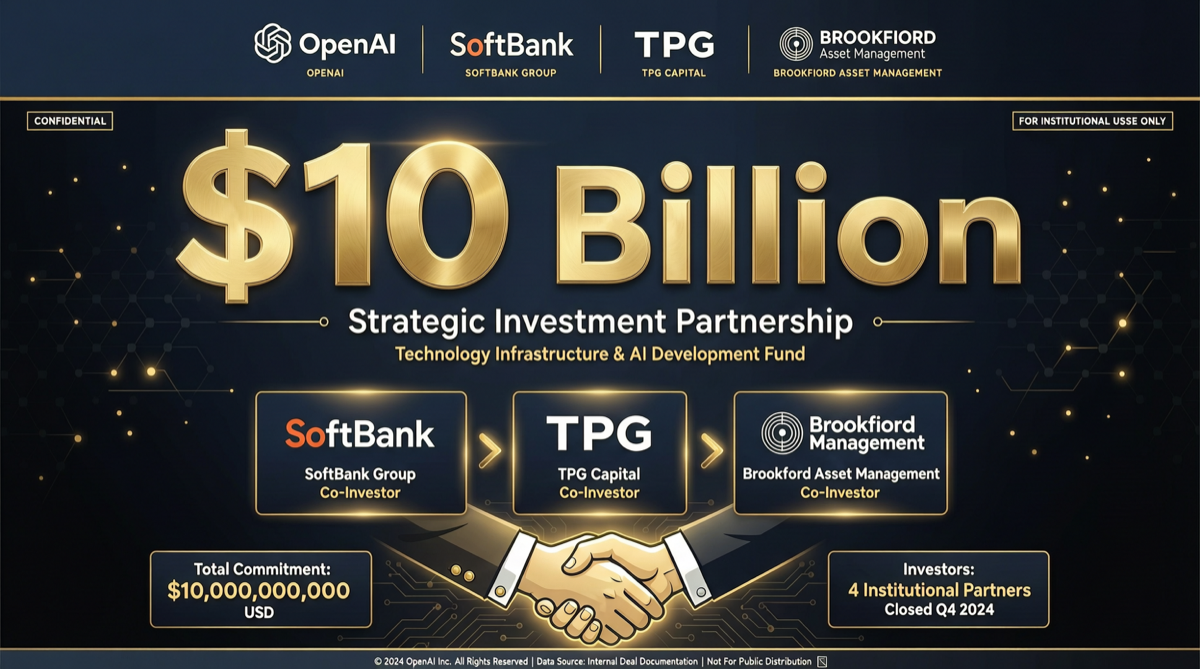
In early May 2026, OpenAI closed what may be the largest “deployment-side” financing in AI industry history:
A joint venture called “The Deployment Company” was formally established, with a target valuation of $10 billion, having raised over $4 billion from 19 investors.
The investor list reads like a who’s who of global private equity:
- TPG
- Brookfield
- Advent International
- Bain Capital
- SoftBank
- Dragoneer
The most critical number: a promised 17.5% annual guaranteed return to investors.
What This Actually Does
The core mission of The Deployment Company is not to develop new technology, but to force enterprises to adopt AI.
Specific strategy:
- Lock in 1,200 target enterprises across finance, healthcare, manufacturing, and retail
- Provide enterprise-grade deployment services for OpenAI’s full product suite (GPT-5.5, Codex, API)
- Use PE capital to provide “AI transformation subsidies” to enterprises — lowering their trial-and-error costs
- The 17.5% guaranteed return means: even if AI projects fail, investors get paid
This is essentially shifting the risk of AI adoption from enterprises onto PE firms.
Business Model Breakdown
| Role | Investment | Return |
|---|---|---|
| OpenAI | API credits + technical support | Massive API consumption + enterprise customer lock-in |
| PE investors | $4B capital | 17.5% annual guaranteed + equity appreciation |
| Target enterprises | Business cooperation | Free/low-cost AI transformation |
| The Deployment Company | Operations team | Becomes the “middleman” for enterprise AI deployment |
The inspiration for this model comes from Palantir — same playbook: enter major clients at a loss first, then achieve profitability through long-term contracts.
Anthropic’s Counter
On the same day, Anthropic announced a $1.5 billion financing round.
While far smaller than OpenAI’s $10 billion, the direction is the same: accelerate enterprise market penetration. The enterprise AI land grab is officially underway.
Investment Logic Analysis
Why Are PE Firms Willing to Guarantee 17.5%?
- AI is an irreversible trend: Even if short-term ROI is uncertain, long-term enterprises that don’t use AI will be eliminated
- OpenAI’s brand premium: GPT series has the highest public recognition, lowering enterprise adoption barriers
- Lock-in effect: Once enterprises deeply integrate OpenAI’s API, migration costs become prohibitive
Risk Factors
- The 17.5% guaranteed return is a heavy burden. If actual AI project returns fall below this number, PE firms must cover the difference from their own pockets
- Enterprise AI adoption effectiveness remains highly uncertain. Many enterprise AI projects are still stuck at the PoC stage
- Competition from Anthropic, Google, and Chinese models is intensifying; OpenAI’s monopoly position is not unassailable
Connection to Forbes AI 50
Forbes just released the 2026 AI 50 list, with total funding of $305.6 billion. OpenAI + Anthropic alone account for 80%.
The creation of The Deployment Company means this 80% of capital is shifting from “R&D” to “deployment.” The AI industry’s center of gravity is moving from “building models” to “selling models.”
Action Recommendations
- Enterprise owners: Now is the window to try OpenAI products at the lowest cost. The Deployment Company will subsidize your trial-and-error
- Investors: Watch for replicability of this model — if successful, Google and Anthropic may launch similar plans
- AI professionals: Demand for enterprise AI deployment talent will surge. Career paths from “research” to “implementation” are opening
- Competitors: Chinese model vendors (DeepSeek, Kimi) need to consider how to respond to this “capital subsidy + enterprise lock-in” strategy
$10 billion is not a small amount. OpenAI is using capital to artificially accelerate AI adoption by 5-10 years.