Bottom Line First
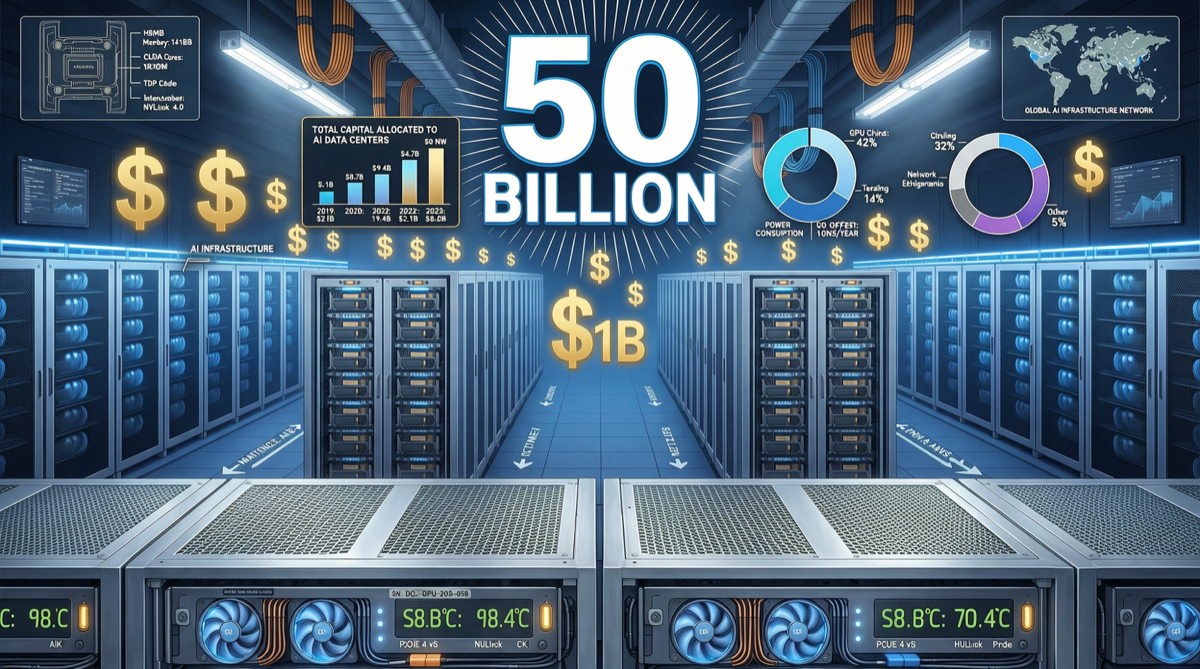
OpenAI co-founder Greg Brockman disclosed in court testimony: OpenAI’s compute spending will reach $50 billion in 2026. This represents a 1,600x increase from the $30 million spent in 2017.
This isn’t a normal budget number — it reflects the intensity of the entire AI industry’s compute arms race in 2026 and directly points to GPT-6’s expected scale.
Spending Growth Trajectory
| Year | Compute Spending | Growth Multiplier | Key Event |
|---|---|---|---|
| 2017 | $30M | Baseline | OpenAI early days |
| 2020 | ~$500M | ~17x | GPT-3 training |
| 2023 | ~$5B | ~167x | ChatGPT explosion |
| 2025 | ~$20B | ~667x | GPT-4o / GPT-5 series |
| 2026 | $50B | 1,667x | GPT-5.5 / GPT-6 parallel |
This growth rate means OpenAI is consuming compute resources at a scale of tens of billions of dollars per quarter.
Where Is the Money Going?
NVIDIA GPU Procurement
- Direct beneficiary: NVIDIA data center GPUs (H200 / B200 / Blackwell Ultra series)
- Scale estimate: At $30,000-$40,000 per card, the majority of $50B will procure tens of thousands of top-tier GPUs
Cloud Infrastructure
- Microsoft Azure: OpenAI’s core cloud partner, hosting training and inference infrastructure
- Amazon AWS: Another pillar of the Stargate data center
- Broadcom (AVGO): Custom AI chip (ASIC) design
Stargate Data Center
- GPT-6 has completed pre-training at the Stargate data center, entering safety alignment phase
- Stargate is OpenAI’s hundreds-of-billions-dollar investment in dedicated AI training infrastructure
- The $50B spending includes Stargate’s operation and maintenance costs
Industry Impact
1. GPT-6 Scale Implications
GPT-6 public metrics:
- Mathematical reasoning: 92.5%
- Code generation pass rate: 96.8%
- 83% of occupational tasks reach human expert level
A $50 billion compute investment means GPT-6’s training scale could be 10-50x larger than GPT-4.
2. Compute Cost as a Moat
When compute spending reaches the $50 billion level, compute itself becomes the moat. New entrants cannot match this scale of infrastructure investment in the short term.
3. Beneficiary Chain
| Beneficiary | Logic |
|---|---|
| NVIDIA (NVDA) | Continued GPU demand explosion |
| Microsoft (MSFT) | Azure compute leasing + equity stake |
| Amazon (AMZN) | Cloud infrastructure expansion |
| Broadcom (AVGO) | Custom AI chips |
| Micron (MU) | HBM memory supply shortage |
Action Recommendations
- Investors: $50B compute spending confirms the continued growth logic of AI infrastructure. NVIDIA, Microsoft, and Micron are direct beneficiaries
- Developers: OpenAI model API prices may remain stable in the short term (economies of scale reduce costs), but access thresholds for premium models may increase
- Competitors: Chinese model providers (DeepSeek, Kimi, Qwen) achieving near-parity at 1/3 the cost will gain differentiated advantage in the compute arms race