Key Takeaways
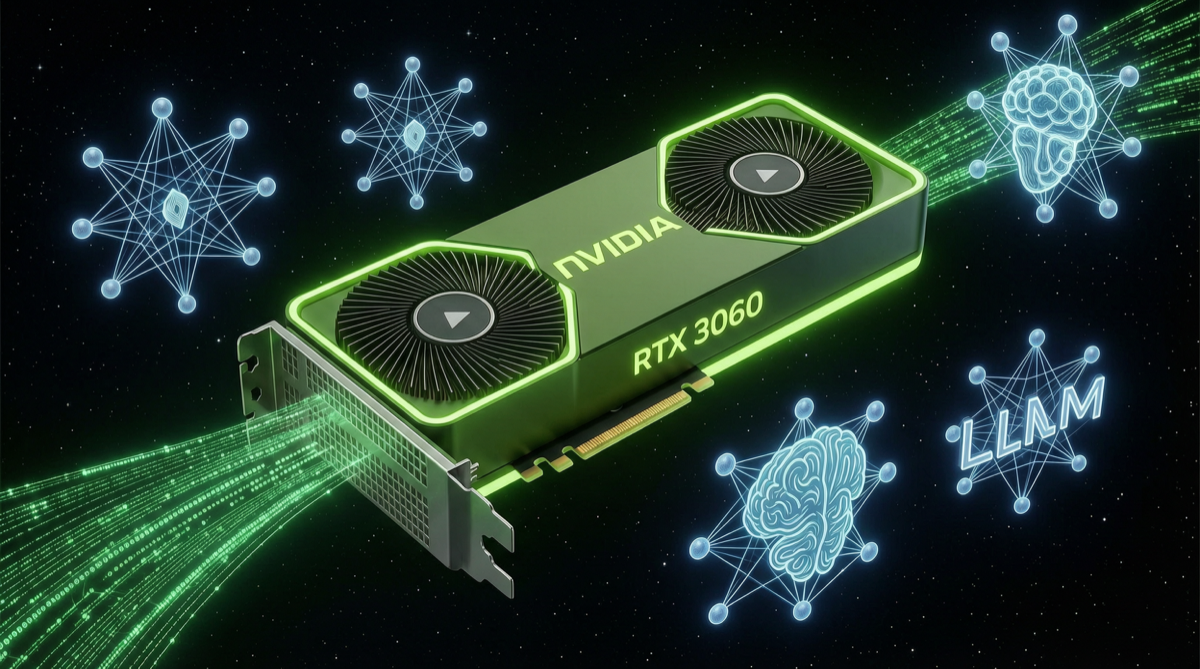
Supply chain reports confirm: NVIDIA is restarting production of the RTX 3060 12GB, with supply expected to resume in June 2026. Partners including ASUS, MSI, Colorful, and GALAX have begun receiving GPU orders. In 2026, as MoE architectures drastically reduce local LLM VRAM requirements, this 12GB “budget GPU” is set to reclaim its position as the cost-performance champion for local AI inference.
What Happened
A post about the RTX 3060 revival caught significant attention in the AI community (1,174 likes, 73 retweets, 117 bookmarks):
“NVIDIA is reviving the 2021 GeForce RTX 3060 12GB for a 2026 return. Production is restarting. GPU supply expected to resume in June 2026, with add-in-card partners ASUS, MSI, Colorful, and GALAX receiving orders.”
Why Now?
The RTX 3060 12GB launched in 2021 and was effectively discontinued by 2024. NVIDIA’s decision to revive it now has clear market logic:
- MoE models lower VRAM barriers: Qwen3.6-35B-A3B (35B parameters, 3B active) runs on just 8GB VRAM — the RTX 3060’s 12GB is more than sufficient
- Consumer GPU supply shortage: RTX 40/50 series prices remain elevated, sustained demand for affordable AI inference GPUs
- Local inference market explosion: Privacy compliance, offline usage, zero API costs drive local LLM deployment growth
Why It Matters
1. Local LLM Hardware Barriers Are Dropping
Reviewing local LLM hardware requirements over the past two years:
| Time | Typical Model | Recommended VRAM | Corresponding GPU | Price (approx.) |
|---|---|---|---|---|
| 2024 | Llama 3 70B | 48GB+ | RTX 4090 × 2 | $3,000+ |
| 2025 | Qwen3.5 14B | 16GB | RTX 4070 | $500 |
| 2026 | Qwen3.6-35B-A3B (MoE) | 8GB | RTX 3060 12GB | $200 |
The key breakthrough of MoE architecture lies in the decoupling of “total parameters” from “active parameters.” Qwen3.6-35B-A3B has 35 billion parameters but only activates 3 billion per inference — combined with KV cache quantization (q8_0) and DDR5 memory offloading, 12GB VRAM is more than enough for smooth operation.
2. Expected RTX 3060 12GB Performance for Local LLMs
Based on existing community test data:
| Model | Configuration | Expected RTX 3060 12GB Performance |
|---|---|---|
| Qwen3.6-35B-A3B | MoE offload + KV q8_0 | ~20-30 tok/s @ 16K context |
| Qwen3.5-9B | Full load | ~30-45 tok/s |
| Llama 3.2 3B | Full load | ~50-70 tok/s |
| DeepSeek V4 Flash | API call | N/A (no GPU needed) |
For daily coding assistance, document processing, and RAG Q&A scenarios, 20-30 tok/s is already fully sufficient — you won’t be waiting long for AI responses.
3. Market Signal: Affordable AI Hardware Becomes a Strategic Priority
NVIDIA reviving a 5-year-old GPU is extremely rare in its product history. This sends a clear signal: the consumer AI inference market has grown large enough for NVIDIA to revisit its low-end product line.
This also echoes industry-wide trends:
- Apple M4 Mac Mini ($599) running local LLMs receives praise
- Various “local AI PC” concepts emerge
- Developers increasingly care about “what models can my device run”
Landscape Assessment
The RTX 3060 12GB revival will create ripple effects on two levels:
Hardware level: Second-hand market prices may temporarily rise, but will stabilize as new card supply resumes. For users wanting to enter local AI, this is the best timing.
Software level: Model developers will have more incentive to optimize performance in low-VRAM scenarios — because the user base is expanding. Qwen3.6’s MoE architecture is just the beginning; more models optimized for 12GB/16GB VRAM will emerge.
Action Recommendations
- Looking to buy a GPU for local AI: Wait for June RTX 3060 12GB new card supply — better value than second-hand RTX 4060
- Already own an RTX 3060 12GB: Upgrade to the latest Ollama/MLX and try Qwen3.6 MoE models
- Developers: Test your models on low-VRAM devices — 12GB is becoming the new “standard configuration”
- Enterprise IT procurement: For scenarios needing local LLM deployment without GPU clusters, the RTX 3060 12GB may be the most economical solution