Key Takeaway
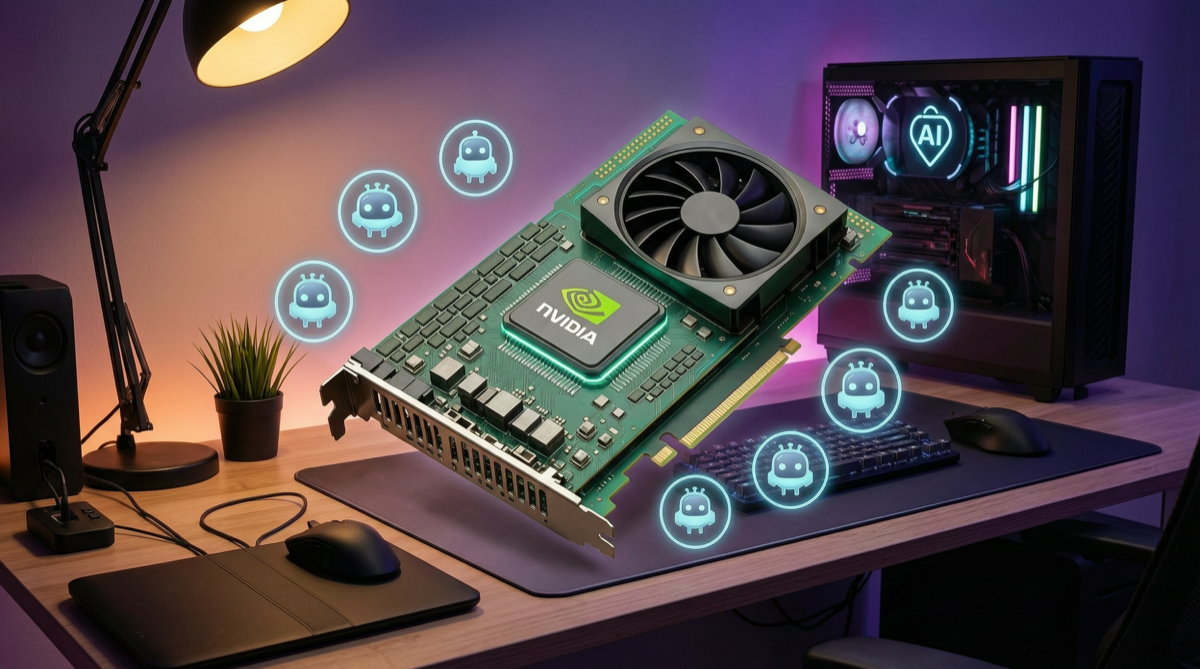
While the industry piles up cluster scale, Nvidia GB10 takes a different path: a single desktop GPU, 74W power, 436 tokens/s throughput, enough to run 10 35B parameter AI Agents on a personal desktop. This is not a “downgraded” datacenter chip—it’s a new paradigm for edge inference that returns computing sovereignty from cloud providers to every developer.
What Happened
GB10 is Nvidia’s chip for desktop inference scenarios, recently generating extensive community testing discussions. Core data points:
| Metric | Value | Significance |
|---|---|---|
| Power | 74W | Equivalent to a high-wattage bulb, runs on standard outlet |
| Throughput | 436 tokens/s | Sufficient for real-time conversation and Agent workflows |
| Parallel Agents | 10 (35B models) | Single-card multi-Agent scenarios become reality |
| Form Factor | Desktop | No server room, no cluster, no cloud bills |
Lisa Su (AMD CEO) recently stated “we’re in year two of a 10-year AI cycle”—but GB10 reveals an even earlier trend: the democratization of inference. Training still requires ten-thousand-card clusters, but inference is moving from “only big tech can afford it” to “every desktop can run it.”
Why It Matters
1. The Economic Equation: Cloud Inference vs Local Inference
Estimating for 100K API calls daily:
| Approach | Monthly Cost | Latency | Data Privacy |
|---|---|---|---|
| Cloud API (GPT-4/Claude) | $500-2000+ | Network-dependent | Data leaves premises |
| GB10 Local Deploy | ~$5-10 electricity | Millisecond-level | Fully local |
| Cloud GPU Instance (A100) | $2000-5000 | Instance-dependent | Provider-dependent |
GB10’s value proposition is clear: for scenarios requiring continuous Agent workflows, local inference TCO pays back within weeks.
2. New Possibilities for Agent Architecture
10 Agents running in parallel on a single card means:
- Multi-role collaboration: One Agent for code review, one for doc generation, one for testing—all local, no API queuing
- Data stays in-domain: Financial, healthcare, legal sensitive scenarios can run multi-Agent workflows without any external network
- Zero-cost experimentation: Developers can freely adjust prompts, switch models, test different Agent orchestration without paying per call
3. Impact on Industry Landscape
The trend GB10 represents is reshaping AI infrastructure market across dimensions:
- Cloud provider inference business: Lightweight inference scenarios will migrate massively to local
- Chip competition: Chinese SunRise and other inference chip startups raised over 1B RMB, showing inference chip track is a global hotspot
- SK Hynix memory strategy: Korean analyst KIS notes “HBM and DRAM capacity is the key variable determining GPU utilization”—inference chip rise will drive memory demand
Action Recommendations for Developers
- Define your scenario: GB10 suits continuous Agent workflows, not sporadic large-scale training
- Model selection: 35B parameter count is the current sweet spot for desktop inference (Qwen 3.6-27B, Kimi K2.6 32B active versions both fit well)
- Framework pairing: vLLM, Ollama and other inference frameworks are accelerating optimization for desktop hardware
- Hybrid architecture: Heavy inference on cloud, daily Agent workflows local—this is the most pragmatic architecture of 2026
Cross-Verified Sources
- X/Twitter: GB10 74W/436 tokens/s testing discussion (3700+ views)
- X/Twitter: Lisa Su on 10-year AI cycle (32K+ views)
- X/Twitter: SunRise inference chip funding news
- X/Twitter: KIS analysis on HBM/DRAM and GPU utilization (11K+ views)