What Happened
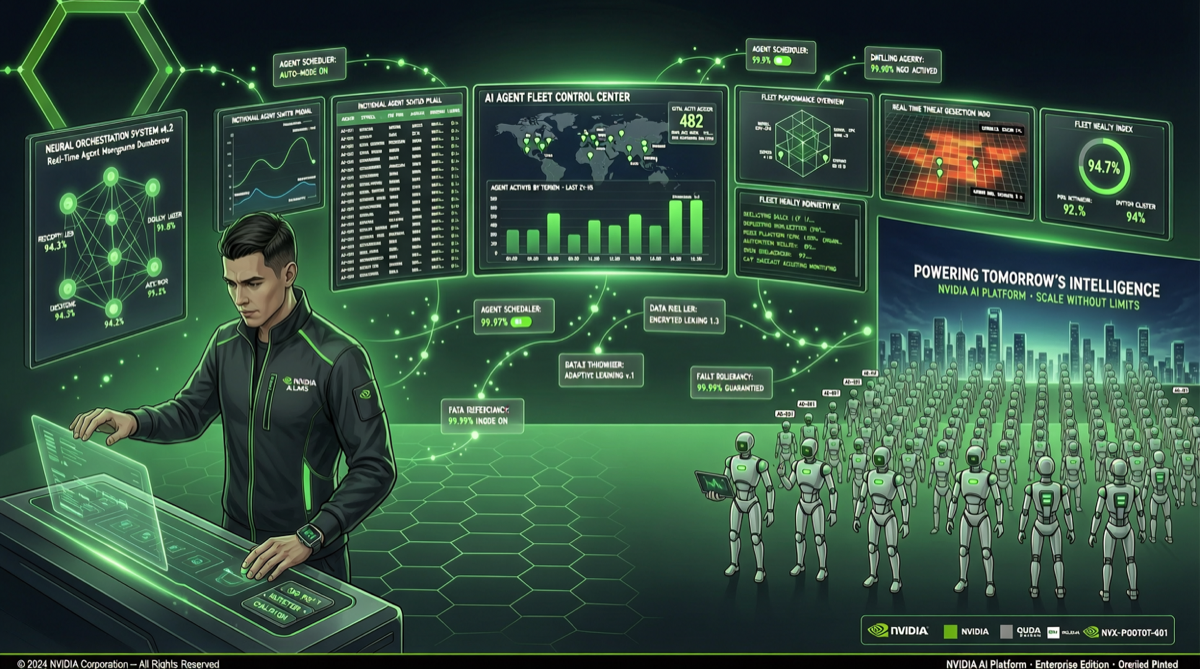
NVIDIA CEO Jensen Huang made a specific prediction in his latest public remarks: every engineer will manage hundreds of AI agents in the future. This is not a vague vision, but a concrete forecast about engineering practice within the next 1-2 years.
Three parallel threads in the same week corroborate this trend:
- DeepMind published the Agentic Harness paper, proposing an engineerable, auditable, and scalable agent framework
- Anthropic announced the Code with Claude developer conference (May 6, San Francisco), shifting from “how to use Claude” to “how to build multi-agent workflows”
- Alibaba’s latest research points to the leap of agents from simple tool invocation to autonomous task execution
Why “Hundreds”
Huang’s magnitude estimate rests on three layers of logic:
1. Task Granularity Fragmentation
A medium-complexity software engineering task (e.g., “refactor the payment module”) can be broken down into:
- Code Analysis Agent × 3 (understand dependencies, identify risks, generate solutions)
- Testing Agent × 2 (unit tests, integration tests)
- Documentation Agent × 1
- Deployment Agent × 1
That’s 7 agents for a single task. An engineer handling 5-10 similar tasks per week would manage 50-100 agent instances—a reasonable estimate.
2. Accelerating Specialization
| Agent Type | Typical Capability | Maturity |
|---|---|---|
| Coding Agent | SWE-Bench 75%+ | Production-ready |
| Testing Agent | Auto-generate + execute | Production-ready |
| Security Agent | Code audit / vulnerability scanning | Pilot phase |
| Ops Agent | Fault diagnosis / self-healing | Pilot phase |
| Data Agent | ETL / cleaning / labeling | Early |
Each track is independently accelerating, ultimately converging on the norm of “each engineer managing multiple specialized agents.”
3. Cost Curve Support
DeepSeek V4 Pro drove frontier model API prices down to $1.74/1M input tokens, reducing the cost of running one agent per task from dollars to cents. Cost is no longer the bottleneck limiting agent count.
Tool Stack Is Ready
Changes in GitHub Trending this week confirm infrastructure maturity:
- TradingAgents (65,301 ★, +11,252 this week): Multi-agent financial trading framework
- ruflo (20,714 ★): Claude agent orchestration platform, supporting multi-agent swarms
- Hermes Agent v0.12.0: New Kanban multi-agent collaboration system, agents as independent OS processes running in parallel
- OpenClaw 2026.5.2: xAI Grok 4.3 support, optimized Gateway + Agent hot paths
These projects tackle the same problem from different angles: how to make multiple agents work together reliably.
Action Recommendations
| Stage | Suitable For | Specific Actions |
|---|---|---|
| 1 Agent | Individual developers | Replace some coding work with Claude Code / Cursor |
| 2-5 Agents | Small teams | Introduce Hermes Kanban or OpenClaw for simple workflows |
| 10+ Agents | Medium teams | Evaluate orchestration platforms like ruflo, establish agent governance norms |
| 100+ Agents | Large enterprises | Watch enterprise solutions like NVIDIA Agentic Harness |
Huang’s prediction is not a forecast—it’s a happening reality. The key question is: how many agents can your current toolchain manage?