Core Takeaway
Top image generation models are getting stronger, but ordinary people still can’t create the images in their heads even with the best models.
The problem isn’t the model — it’s the workflow. Models like GPT-Image-2 are already powerful, but between “one sentence” and “professional-grade image” there’s still a massive gap of prompt engineering, style management, batch consistency, and toolchain integration. Handing this pipeline to a multi-agent collaborative system is the key to turning image generation models into real productivity tools.
What’s Happening
Blogger “袋鼠帝” (Kangaroo Emperor) has open-sourced an image generation Skill based on GPT-Image-2 + Hermes Multi-Agent, transforming the traditional “human writes prompts → manually generates → reprocesses” model into an automated pipeline.
The most直观 result of this workflow: users only need to say “make a Mario-like game,” and the system automatically has GPT-Image-2 generate characters, scenes, and UI assets, then uses Codex to wire up jumping, collision, and interaction logic — assembling a playable game demo from scratch.
No need to learn complex prompt writing or copy-paste between tools.
Architecture Breakdown: Three-Layer Division
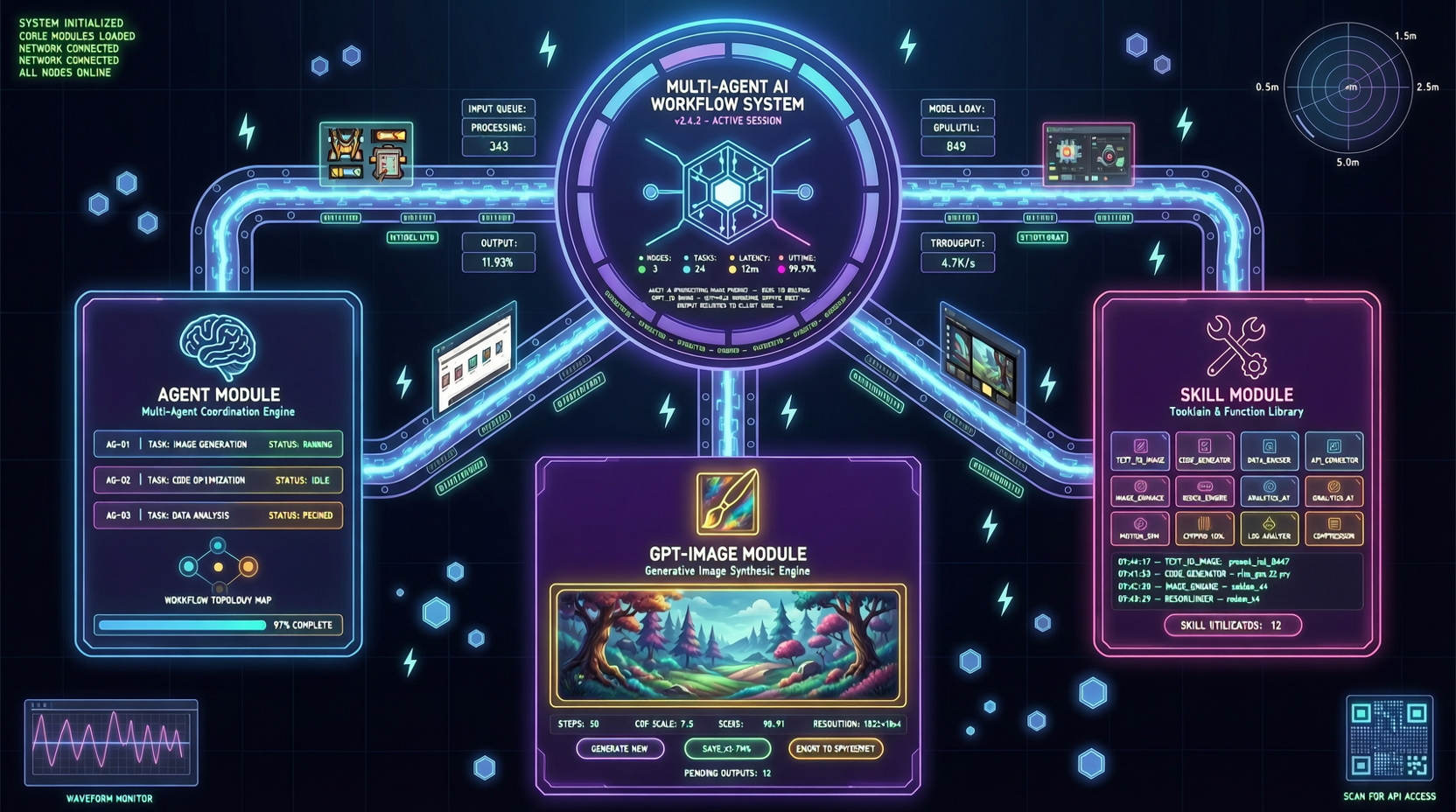
The core of this workflow is a three-layer architecture, each with distinct responsibilities:
Layer 1: Agent (The Brain)
Responsible for understanding the user’s natural language intent, decomposing tasks, and arranging execution order. Determines whether the task is poster design, character design, game assets, or brand materials. Acts as a project manager, translating vague requirements into executable design specifications.
Layer 2: Skill (The Hands)
Codifies proven methodologies: Prompt compilation, style management, size specifications, batch templates, and review logic. Like a “cookbook,” successfully completed projects accumulate in a case library, so the next time a similar need arises, the system calls and reuses the recipe instead of starting from scratch.
Layer 3: GPT-Image-2 (The Engine)
Responsible for generating high-quality images from the professional instructions prepared by the previous layers. The model doesn’t need to understand user intent — it only needs to execute standardized, high-quality generation tasks.
Foundation: Hermes Multi-Agent Collaboration
To make the各环节 work together seamlessly, the bottom layer uses the Hermes Multi-Agent Collaboration System. The drawing agent, design agent, refinement agent, quality review agent, and coding agent each do their own work and automatically hand off to the next when done. This assembly-line collaboration model compresses work that previously required designers, product managers, and developers into one person + one system.
Real-World Cases
The author tested this workflow across multiple typical scenarios:
E-commerce Product Image Automation
Upload product description text → Agent extracts visual keywords → Skill calls templates → GPT-Image-2 outputs product main images conforming to platform specifications. Supports batch processing, style consistency, and zero retouching.
Marketing Poster One-Click Generation
Input event theme and brand colors → Agent plans composition strategy → Skill injects brand style prompts → GPT-Image-2 generates high-quality posters. Non-designers can produce professional-grade materials.
Interior Design Renderings
Input room dimensions, preferred style (e.g., “Nordic minimal,” “New Chinese”), and budget keywords → Agent decomposes design elements → Skill generates professional interior design prompts → Outputs multiple style renderings for selection.
UI Wireframe to High-Fidelity Visual Mockup
Upload hand-drawn wireframes or low-fidelity prototype screenshots → Agent identifies page structure and interaction logic → Skill injects brand visual specifications (color values, font styles, corner radius) → Generates high-fidelity UI visuals close to real products. Supports Apple style, hand-drawn style, and multiple visual languages.
Industry Significance
This Skill’s value isn’t “yet another AI drawing tool” — it addresses three core pain points of AI image generation:
- High prompt threshold: Ordinary people can’t write precise, paper-level prompts. The Agent translates plain language into professional design requirements.
- Fragmented workflow: The割裂 process of copywriting → keywords → generation → download → design software is unified into an automated pipeline.
- Batch generation difficulties: Character consistency and style uniformity are systematically solved through the case library and Skill templates.
This aligns with the Harness Engineering trend discussed earlier — model capability is just the foundation. The execution system, workflow, and collaboration mechanisms wrapped around the model are what determine whether AI truly becomes productive.
For designers, e-commerce operators, and independent developers, this workflow offers a path where “one person is an entire design team.” Combined with GPT-5.5’s prototype development capability, full-chain automation from design to code is becoming reality.