Core Point
An Anthropic engineer pointed out in the community: most people are only scratching the surface of MCP.
Most developers’ understanding of MCP stops at:
“Connect an MCP Server → Call a function → Get a result”
This “tool-calling” pattern is just the shallowest layer of MCP’s capabilities. MCP’s true value goes far beyond this.
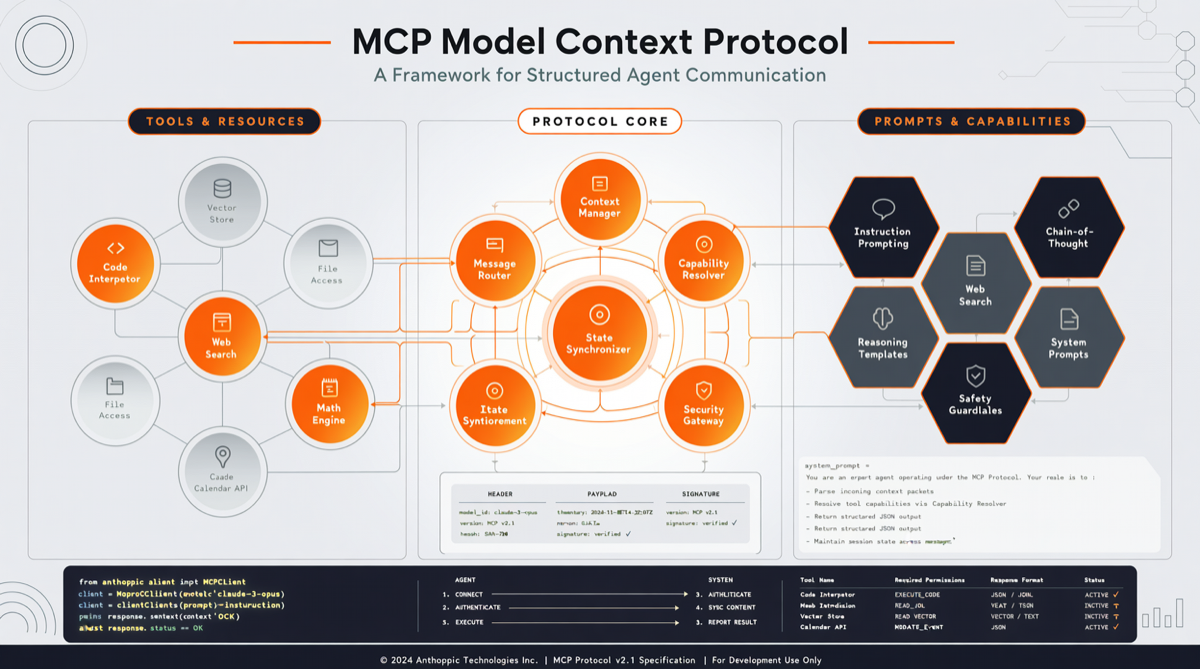
MCP’s Three-Layer Capability Model
Layer 1: Tool Calling (Where Most People Stop)
Agent → MCP Server → Call Tool → Return ResultThis is how 90% of developers currently use MCP. Connect an MCP Server, call a function, get a result. Useful, but far from enough.
Layer 2: Resource Subscription and Streaming
MCP supports the concept of Resources, not just Tools:
- Static Resources: Files, database records, configuration information
- Dynamic Resources: Real-time data streams, logs, monitoring metrics
- Resource Subscriptions: Agents can subscribe to resource changes instead of querying each time
This means agents don’t need to poll repeatedly — they passively receive updates, which is critical for long-running agent scenarios.
Layer 3: Context Management and Dynamic Discovery
MCP’s deeper capabilities:
- Prompt Injection: MCP Servers can inject system-level prompts into agents, informing them of available capabilities and usage constraints
- Dynamic Discovery: Agents dynamically discover new tools and capabilities at runtime, rather than pre-defining them
- Multi-Server Coordination: Multiple MCP Servers can share context and resources
Overlooked High-Value Usage Patterns
| Usage Pattern | Current Adoption | Value Level |
|---|---|---|
| Basic Tool Calling | 90%+ | Basic |
| Resource Streaming Subscription | ~15% | High |
| Dynamic Tool Discovery | ~10% | Extremely High |
| Multi-Server Context Sharing | ~5% | Extremely High |
| Prompt Injection and Self-Description | ~20% | High |
Practical Example: MCP Is Not Just “Check the Weather”
Suppose you have a database query MCP Server:
Basic Usage: Agent calls query_database function, passes SQL, returns results.
Advanced Usage:
- MCP Server injects prompts informing the agent about database schema, indexes, and query limits
- Agent subscribes to change events on specific tables, automatically notified when data updates
- MCP Server automatically selects optimal execution strategy based on query complexity
- Multiple MCP Servers share query cache to avoid redundant computation
Action Recommendations
- Existing MCP users: Check whether your MCP Server has Resources and Prompts enabled, not just Tools
- MCP Server developers: Consider adding resource subscription capabilities so agents can “wait passively” instead of “poll actively”
- Agent framework users: Follow OpenClaw, Hermes, and other frameworks’ support for MCP resource subscription and dynamic discovery
- Architecture designers: Treat MCP as the universal communication layer between agents and external systems, not just a simple function calling interface
Summary
MCP is evolving from a “tool-calling protocol” to an “agent-system communication infrastructure.” Understanding and adopting its deeper capabilities early will build a significant advantage in agent application architecture.