Core Signal
An open-source project called llm_wiki is rapidly gaining traction on GitHub — accumulating 4.6k Stars in just a few weeks, becoming one of the most watched open-source tools in the AI + personal knowledge management space.
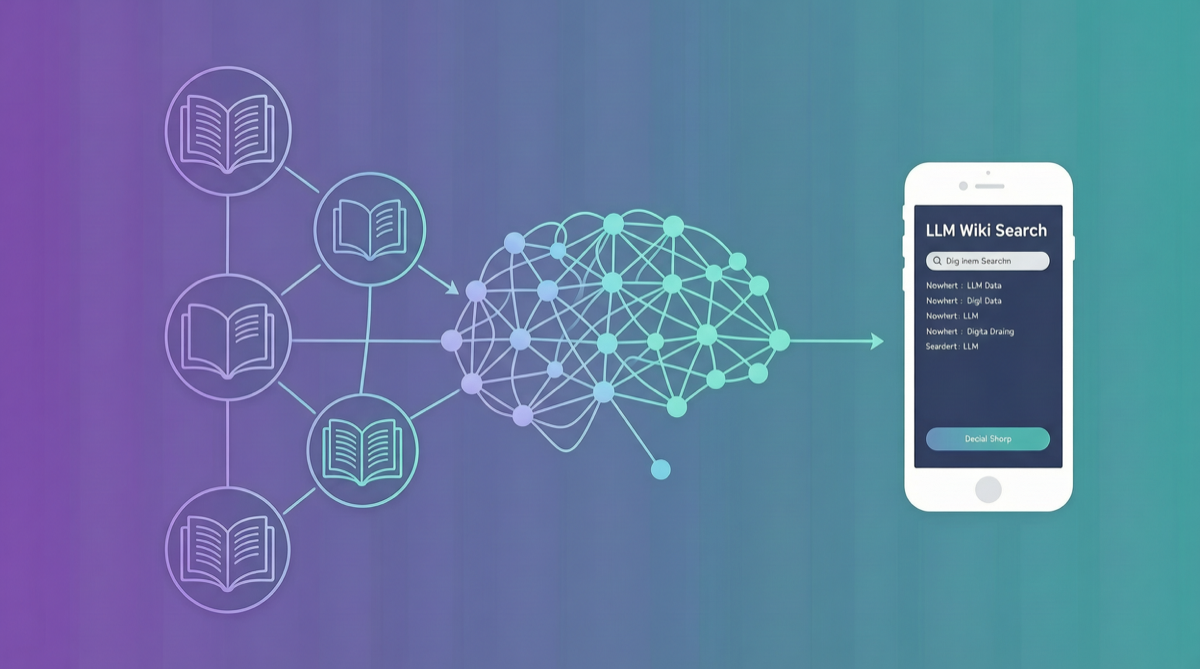
Its core innovation is direct but far-reaching: changing the paradigm of personal knowledge base usage — instead of searching raw documents for every query, let the LLM pre-process to generate knowledge indexes and summaries, with Agents working directly on the index layer.
This is the first large-scale realization of the “ideal personal knowledge base form” envisioned by AI pioneer Andrej Karpathy in early 2025.
Karpathy’s Vision vs Real-World Implementation
Karpathy once described his ideal personal AI knowledge base:
Not RAG — not searching through documents every time you ask a question. But a continuously running Agent that understands your entire knowledge base, can make connections between knowledge, and proactively reminds you of relevant information.
llm_wiki’s implementation approach is highly aligned with this:
Traditional RAG Workflow
User query → Vector search raw documents → Return relevant passages → LLM generates answerLLM Wiki Workflow
Document ingestion → LLM pre-processes to generate index/summary/connections → User query → Agent retrieves on index layer → Generates answerThe key difference is pre-processing. Traditional RAG searches from raw documents in real-time every time, while LLM Wiki uses LLMs to understand, summarize, and connect documents in advance, forming a “knowledge layer.”
Why This Design Matters
1. Exponentially Faster Search Speed
Raw documents may contain tens or hundreds of thousands of words. Every real-time search means processing large amounts of vectors and text. The index layer is typically only 5-10% of the original document volume, making search an order of magnitude faster.
2. Significantly Improved Answer Quality
Since the LLM has already “read” and understood the document content during pre-processing, the generated index contains semantic understanding and knowledge connections. When users ask questions, the Agent doesn’t need to understand documents from scratch — it works on an already-understood knowledge base.
3. Proactive Knowledge Discovery
This is the most valuable aspect. llm_wiki’s Agent can not only answer when you ask, but also proactively discover connections between knowledge. For example:
- When you record a new meeting note, the Agent might remind you: “This decision relates to a project from three months ago, want to connect them?”
- When you search for a technical concept, the Agent shows its evolution trajectory in your knowledge base
Not Just a Tool, A New Knowledge Management Philosophy
llm_wiki’s emergence marks a larger trend: personal knowledge management is shifting from “passive storage” to “active understanding.”
Past: You Manage Knowledge
- You create folders, add tags, write summaries
- Knowledge is static, sleeping
- Searching is an active “digging” behavior
Present: Agent Manages Knowledge With You
- Agent understands your knowledge, makes connections, generates summaries
- Knowledge is alive, can “think”
- Agent proactively pushes valuable information to you
This transformation is as significant as the leap from “file system” to “search engine.”
Ecosystem Position: Where It Fits in the Tool Map
llm_wiki is not replacing Obsidian, Notion, or Logseq — it adds an AI Agent layer on top of these tools:
┌─────────────────────────────┐
│     AI Agent (llm_wiki)     │  ← Knowledge understanding, connections, proactive push
├─────────────────────────────┤
│  Obsidian / Notion / Others  │  ← Knowledge editing, organization, display
├─────────────────────────────┤
│       File System / Cloud     │  ← Knowledge storage
└─────────────────────────────┘
This means you can continue using your preferred note-taking tool while gaining AI Agent knowledge understanding capabilities.
Compatibility: Full Support for Claude Code, Codex, Gemini
A design highlight of llm_wiki is its model-agnostic nature — it doesn’t lock you into any specific LLM provider:
- Claude Code: Deep integration, supports complex reasoning tasks
- Codex: Ideal for code-related knowledge management
- Gemini: Multimodal knowledge processing advantage
- Pi: Lightweight daily knowledge interaction
Built-in Git management means knowledge base version control and collaboration mirror the code repository experience:
- Every knowledge change has version records
- Branching, merging, and Code Review like code
- Agent-Git integration makes knowledge evolution traceable
Market Timing: Why Now
llm_wiki’s virality is not accidental. Several factors converged at the same time:
1. Dramatic Model Cost Reduction
LLM pre-processing consumes tokens. In early 2025, doing a full index of a 1-million-word personal knowledge base could cost hundreds of dollars in API fees. By May 2026, the same costs just a few dollars — because Chinese models (Ling-2.6-Flash, DeepSeek V4) have pushed token costs to extremely low levels.
2. Maturation of Agent Frameworks
The maturation of CrewAI, LangGraph, AutoGen, and other agent frameworks makes building complex knowledge agent workflows feasible. llm_wiki likely leverages these frameworks’ capabilities.
3. Explosion of Personal AI Agent Demand
With the popularization of personal AI agent tools like OpenClaw and Hermes Agent, more people are asking: my Agent needs knowledge. llm_wiki fills exactly this gap.
Competitor Comparison
| Tool | Core Philosophy | Advantage | Limitation |
|---|---|---|---|
| llm_wiki | Pre-processing index + Agent | Fast search, high quality, proactive connections | Requires pre-processing time |
| Obsidian + AI plugins | Native notes + AI assistance | Mature ecosystem, rich plugins | Search still RAG-based |
| Notion AI | Cloud notes + AI | Easy collaboration, friendly UI | Locked into Notion ecosystem |
| Traditional RAG | Real-time retrieval | No pre-processing, plug-and-play | Slow, unstable quality |
Practical Advice: How to Get Started
If you’re a heavy user of personal knowledge bases, here’s the recommended onboarding path:
- Start small: Pick your most important knowledge domain (e.g., work notes or study notes) and use llm_wiki to build a pre-processed index
- Observe the effect: Compare traditional search vs Agent search answer quality
- Gradually expand: Once satisfied, gradually migrate other knowledge bases
- Use complementarily: llm_wiki for knowledge understanding and search, Obsidian/Notion for editing and organization — they complement each other
The Bigger Trend: Knowledge Agentization
llm_wiki is just the beginning. The larger trend is: all knowledge management tools are moving toward Agentization.
- Ant Group is already exploring using Ling models for knowledge agent scenarios
- Domestic products like “XiaoLongMao” are providing knowledge management Web UIs for OpenClaw and Hermes
- Multiple startups are building “digital employees” for enterprises, with core capabilities in knowledge understanding and reasoning
Personal knowledge bases are the outpost of this transformation. When everyone has an AI Agent that understands all their knowledge, the way knowledge is produced, organized, and consumed will be completely reshaped.
Summary
llm_wiki’s virality is not because it has revolutionary technology — its core approach (pre-processing index + Agent retrieval) is not technically complex.
Its significance lies in: being the first to transform Karpathy’s envisioned knowledge base form into a usable, open-source, large-scale user-validated product.
4.6k Stars is just the beginning. When more people experience the difference between “knowledge actively comes to you” vs “you search through knowledge,” this sector’s growth rate may exceed everyone’s expectations.
The Agent-native inflection point for personal knowledge management has arrived.