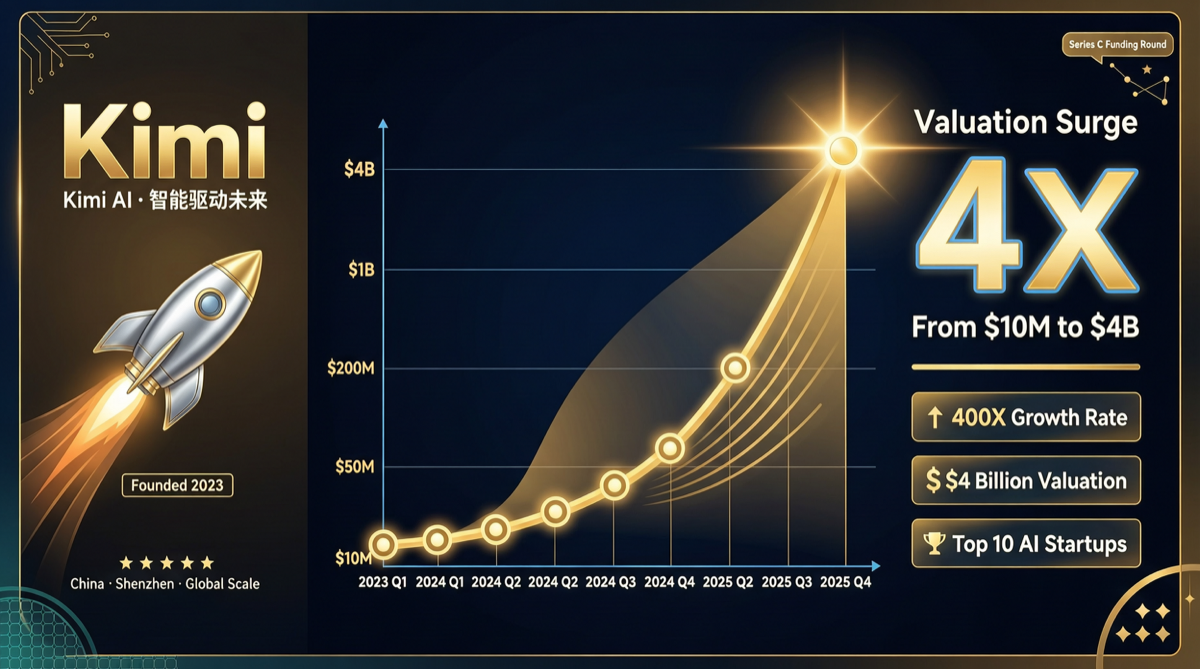
What Happened: The 4x Valuation Surge
Moonshot AI has experienced an unusual capital repricing over the past three months—its valuation quadrupled. In the AI industry, a jump of this magnitude typically occurs in one of two scenarios: a generational technological breakthrough, or a fundamental shift in capital market confidence in a sector. Kimi’s case leans closer to the latter, but is reinforced by the former.
Kimi K2.6 Technical Signals
Kimi K2.6 demonstrates competitiveness across multiple dimensions:
- SWE-bench: Leads among open-weight models, coding capability approaching Claude level
- LiveBench: Beats Opus, validating real-time reasoning ability
- Design Arena: Champion in design tasks
- Agent Swarm: Multi-agent orchestration capability in production
K2.6 is not a simple iteration—it’s a comprehensive upgrade under a MoE architecture with trillion-scale total parameters and controlled activation parameters. This means Kimi has significantly pushed its capability ceiling while maintaining inference efficiency.
Capital Logic: Why Now?
Three drivers behind the 4x valuation surge:
1. Domestic Substitution Window
As OpenAI and Anthropic products become restricted or overpriced in China, Kimi naturally becomes the alternative for enterprises and developers. This window won’t last forever, but it’s enough for Moonshot to build a user base and brand recognition.
2. Open Source Strategy Leverage
Kimi K2.6’s decision to open-source weights means:
- The research community can directly use and validate model capabilities
- Developers can build downstream applications on top of Kimi
- Brand awareness rapidly spreads through technical communities like GitHub and Hugging Face
Open source isn’t “free”—it’s a customer acquisition and ecosystem-building strategy. By open-sourcing K2.6, Moonshot leverages technical community word-of-mouth to offset marketing budget limitations.
3. Domestic AI Policy Dividends
The Chinese government’s sustained investment and policy support in AI creates a favorable environment for domestic AI companies. From computing power subsidies to talent programs to industry application promotion, policy certainty gives capital confidence.
Competitive Landscape: Kimi vs Domestic Peers
| Dimension | Kimi K2.6 | DeepSeek V4 | Qwen 3.6 | GLM 5.1 |
|---|---|---|---|---|
| Architecture | MoE Trillion-scale | MoE 284B | 27B/110B | Multi-size |
| Code Capability | SWE-bench leader | Strong | Medium | Medium |
| Multimodal | Text-primary | Visual primitives | Image 2.0 Pro | Multimodal |
| Open Source | Weight open-sourced | Partially open | Fully open | Partially open |
| Agent Capability | Swarm support | Agent integration | Terminal Agent | Agent framework |
Kimi’s advantage lies in coding ability and agent orchestration; its weakness is multimodal. DeepSeek’s visual reasoning is a differentiating advantage; Qwen’s fully open-source strategy has the broadest ecosystem.
Judgment and Recommendations
For Developers: Kimi K2.6’s open-source weights mean you can deploy or fine-tune locally. If you need code generation or agent orchestration capabilities, it’s worth testing.
For Enterprises: If Claude’s cost of access in China is too high, Kimi is a viable alternative. But note its multimodal capabilities are still under construction—pure text/code scenarios are more mature.
For Investors: A 4x valuation increase already prices in significant optimism. The next phase of valuation drivers will depend on commercialization progress—API revenue, enterprise customer count, ecosystem partners. The valuation premium from technological breakthroughs will gradually dissipate; commercial capability is the long-term support.