Bottom Line First
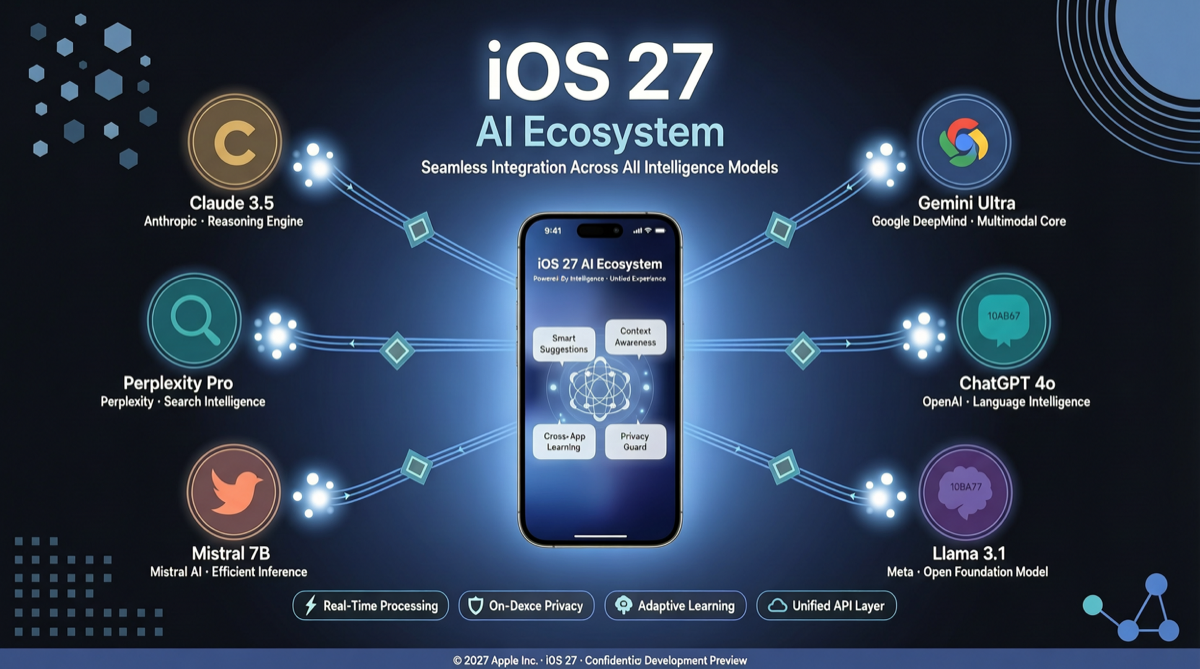
Apple is testing an AI Extensions system for iOS 27—users will no longer be locked into Apple Intelligence, but can freely choose third-party models like Claude and Gemini to power Siri, Writing Tools, and Image Playground. This signals Apple’s shift from a “self-built AIclosed loop” to an “AI ecosystem platform,” where mobile AI competition will move from model capability to ecosystem integration.
What Happened
According to multiple tech media reports on May 5, Apple is internally testing a key feature: through iOS 27’s extension system, users can designate third-party AI services as the default engine for Apple Intelligence features.
Specific capability coverage:
- Siri conversations: Users can choose Claude or Gemini as the underlying conversation model
- Writing Tools: AI writing assistance in Mail, Messages, and Notes
- Image Playground: AI image generation
- Cross-platform support: iOS 27, iPadOS 27, and macOS 27 launching simultaneously
Integration partners under testing: Google (Gemini) and Anthropic (Claude) are Apple’s primary testing partners.
Why This Pivot Matters
1. A Fundamental Shift in Apple’s AI Strategy
For the past two years, Apple’s AI strategy was “vertical integration”: from chips (Neural Engine) to models (Apple Intelligence) to applications (Siri, Writing Tools), the entire stack was self-developed. But Apple Intelligence’s actual performance has consistently lagged behind industry-leading models, with growing user complaints.
Opening up to third-party models is effectively an admission that “self-built models aren’t the only answer”—Apple is choosing to be the platform for AI rather than the model itself. This follows the same logic as the App Store: the platform doesn’t need to build every app, it just needs to establish the rules and distribution channels.
2. Competitive Impact on OpenAI, Anthropic, and Google
| Impact Dimension | OpenAI (ChatGPT) | Anthropic (Claude) | Google (Gemini) |
|---|---|---|---|
| Existing Integration | ChatGPT is already the default iOS AI option | Under testing | Under testing |
| Incremental Value | Already has default status, limited marginal gain | Gains system-level entry, major positive | Gains system-level entry, synergizes with Google ecosystem |
| Risk | Loses “sole default” exclusivity | Must compete directly with Gemini for user choice | Must compete directly with Claude for user choice |
Key signal: While OpenAI is already the default AI option on iOS, iOS 27’s openness means it no longer has exclusivity. Anthropic and Google will gain equal system-level entry points—this is the mobile distribution channel they’ve been waiting for.
3. A Window for Chinese Models
Current testing partners are concentrated among US companies. But if Apple establishes a standard interface for “AI Extensions,” Chinese models (Qwen, Kimi, DeepSeek) could theoretically connect. The question is: under geopolitical pressure, will Apple be willing to integrate Chinese models?
What This Means for Developers and Users
If you’re a user:
- No longer need to leave Apple’s ecosystem to use Claude or Gemini
- Can switch models based on context: Claude for coding, Gemini for long documents, Apple Intelligence for on-device inference
- Privacy and data flow need rethinking—which company’s servers will your data go to?
If you’re a developer:
- AI Extension APIs will create new integration opportunities, similar to the early days of SiriKit
- Multi-model routing will become the standard architecture for mobile apps
- The “model selection interface” itself may become a new UX design category
If you’re a model provider:
- Mobile distribution channels expand from “standalone apps” to “system-level integration”
- Cost control must become more aggressive—users will directly compare price and performance in system settings
- Privacy compliance (especially EU DMA and US state-level regulations) will become an entry barrier
Landscape Assessment
iOS 27’s AI openness is a watershed moment for mobile AI. It will elevate competition from “who has the best AI model” to “whose AI ecosystem is more complete.” Apple made a pragmatic decision: rather than catching up at the model layer, lead at the platform layer.
But this also means AI model competition will become more direct and transparent—users can switch with one tap in system settings, with zero migration cost. Model providers will face each other head-on for the first time on the same stage, with no app download numbers or brand loyalty as a buffer.
Next watchpoint: At WWDC 2026 (June), Apple will officially announce the technical details of the AI Extension API and the first batch of partner names.