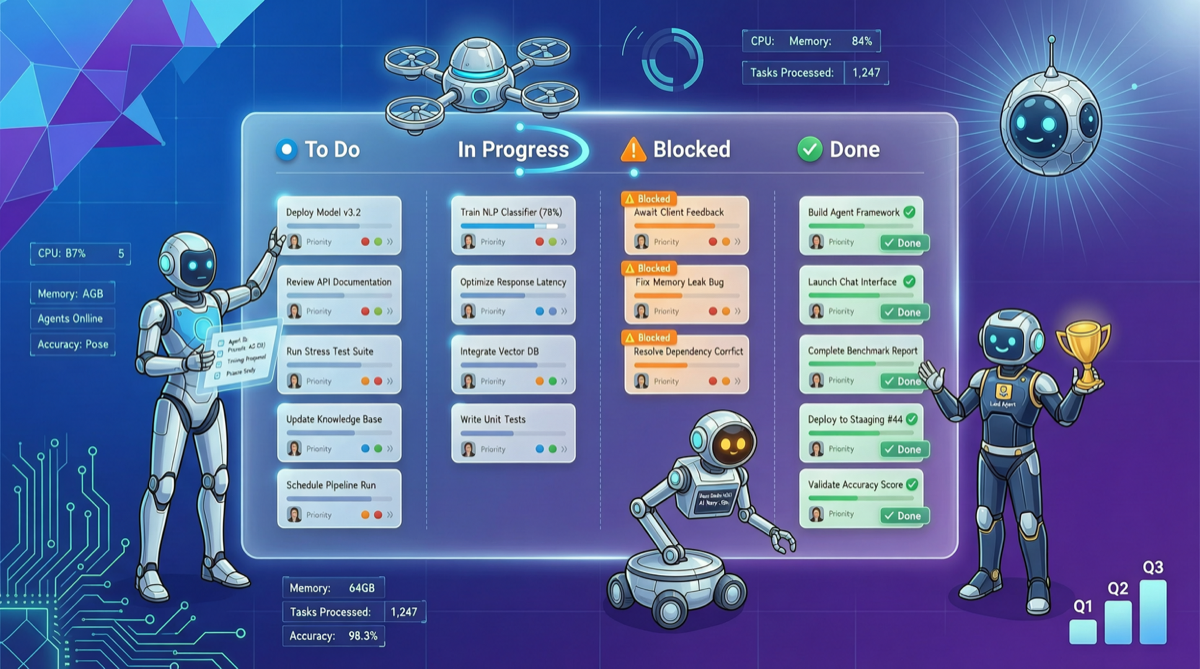
Core Conclusion
Hermes Agent v0.12.0’s Kanban multi-agent collaboration feature went viral on social media: the launch tweet gained 1.25 million views, 5,411 likes, 439 retweets, and 4,010 bookmarks within 24 hours.
This is not an ordinary version update—it defines a new paradigm for AI Agent interaction.
How Kanban Multi-Agent Works
Essential Difference from Traditional Sub-Agent
Most AI platforms’ “multi-agent” is actually single Agent + sub-task delegation (Sub-Agent) mode: the main Agent breaks down tasks, assigns them to sub-agents, and waits for results. Sub-agents cannot communicate directly with each other.
Hermes’ Kanban adopts a true multi-agent Orchestrator model:
| Comparison Dimension | Sub-Agent Model | Hermes Kanban |
|---|---|---|
| Architecture | Master-slave hierarchy | Distributed peer-to-peer |
| Inter-agent communication | Routed through main Agent | Direct collaboration through board |
| Task claiming | Assigned by main Agent | Agents claim autonomously |
| Parallelism | Limited by main Agent scheduling | True parallel, automatic load balancing |
| Blocked handling | Wait for main Agent intervention | Automatic handoff to other Agents |
Workflow
[Orchestrator]
     │
     ▼
┌─────────────────────────────┐
│         Kanban Board         │
│  ┌─────────┬──────────────┐ │
│  │ To Do   │ In Progress  │ │
│  │ [Task A]│ [Task B]     │ │
│  │ [Task C]│ [Task D]     │ │
│  └─────────┴──────────────┘ │
│                             │
│  ┌────────────────────────┐ │
│  │      Blocked           │ │
│  │ [Task E → needs review]│ │
│  └────────────────────────┘ │
└─────────────────────────────┘
     ▲           ▲           ▲
     │           │           │
[Agent 1] [Agent 2] [Agent 3]- Tasks on Board: Orchestrator breaks down tasks and places them on the Kanban board’s “To Do” column
- Autonomous Claiming: Idle agents claim tasks from the board, moving them to “In Progress”
- Parallel Execution: Multiple agents handle different tasks simultaneously, without interference
- Blocked Handoff: When an agent encounters a block (e.g., waiting for external API), the task automatically returns to the board, and other agents can take over
- Progress Visualization: Users monitor all agents’ work status through a single board interface
Why Did It Go Viral?
Data Comparison: 2026 AI Project Tweet Popularity
| Project | Views | Likes | Bookmarks | Core Selling Point |
|---|---|---|---|---|
| Hermes Kanban | 1,255,953 | 5,411 | 4,010 | Free multi-agent collaboration |
| Hermes Desktop App | 92,136 | 814 | 1,127 | AI Agent desktop workspace |
| Other multi-agent projects | <10,000 | <500 | <200 | Various strengths |
Hermes Kanban’s engagement data is 10-50x that of similar projects. Core reasons:
- Free: Unlike multi-agent platforms requiring paid subscriptions, Hermes is completely free
- Truly distributed: Not a disguised Sub-Agent, but genuine multi-agent peer collaboration
- Out of the box: Integrated directly in v0.12.0, no additional configuration needed
- Visual: The Kanban interface makes complex multi-agent collaboration intuitive
Community Reaction
The Thai developer community’s response was particularly enthusiastic, with users explicitly noting: “This is not Sub-Agent, this is true Multi-Agent — the Orchestrator dispatches and distributes to Agents.” This precise understanding of technical details shows the community’s rapidly maturing understanding of Agent architecture.
Practical Application Scenarios
Scenario One: Content Production Pipeline
To Do: [Research] → [Outline] → [Writing] → [Review] → [Publish]Multiple agents handle research, writing, and review stages respectively, flowing through the Kanban board, with human intervention only at key nodes (such as review).
Scenario Two: Code Refactoring Project
To Do: [Analyze Dependencies] → [Module Split] → [Write Tests] → [Refactor Code]Analysis agent completes dependency analysis first, coding agent claims module splitting task, testing agent writes test cases in parallel.
Scenario Three: SEO Content Matrix
This is the scenario already validated in the existing article “hermes-kanban-swarms-seo-workflow-2026” — multiple agents collaborating to complete keyword research, content writing, and metadata optimization.
Comparison with Other Solutions
| Solution | Architecture | Price | Learning Curve | Use Cases |
|---|---|---|---|---|
| Hermes Kanban | Distributed peer-to-peer | Free | Low | General multi-agent collaboration |
| Ruflo | Claude-specific orchestration | Free open source | Medium | Claude ecosystem heavy users |
| n8n + MCP | Workflow orchestration | Free | High | Enterprise automation |
| LangChain/CrewAI | Programming framework | Free | High | Developer customization |
Action Recommendations
| Role | Recommendation |
|---|---|
| AI Agent Explorers | Upgrade to v0.12.0 immediately, experience Kanban multi-agent collaboration |
| Content Creators | Build content production pipelines with Kanban, efficiency gains are significant |
| Developers | Study the Orchestrator model implementation details, compare with Sub-Agent architecture |
| Enterprise Decision Makers | Evaluate the feasibility of using Hermes Kanban for internal automation processes |
Hermes Agent v0.12.0’s Kanban feature proved one thing with 1.25M views: free, open, truly distributed multi-agent collaboration is the capability developers crave the most.