What Happened
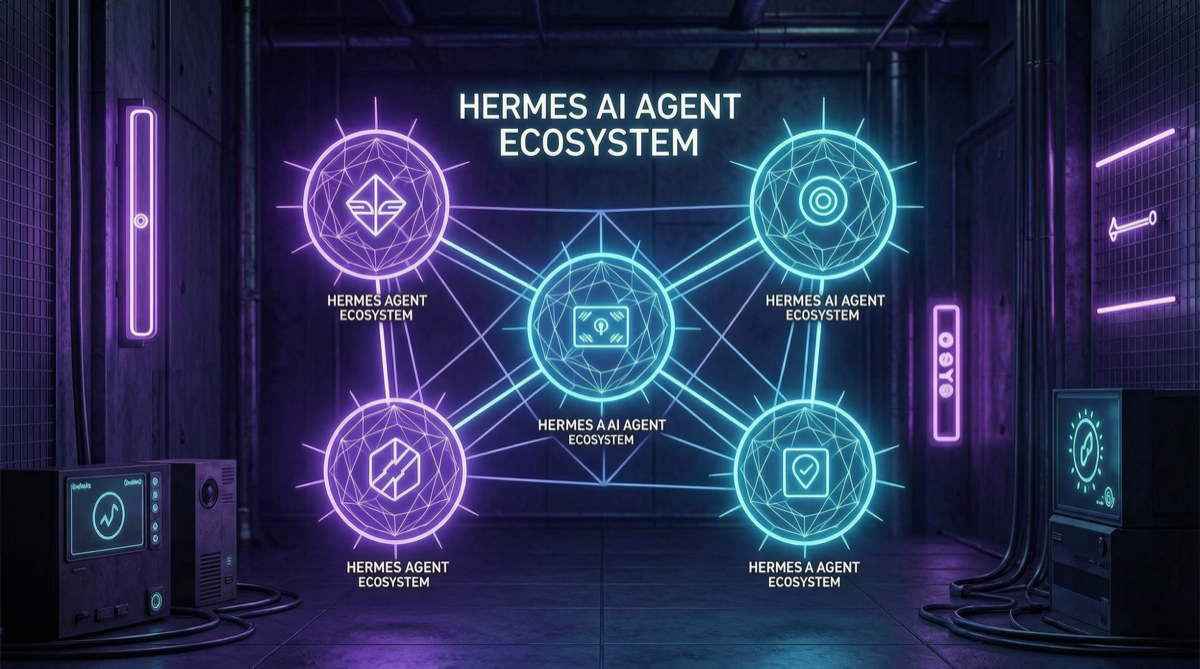
After Hermes Agent released its Multi-Agent Kanban feature in late April, the developer community produced 5 entirely new and non-overlapping extension tools within just one week, transforming Hermes from a command-line Agent into a next-generation Agent platform with visualization, self-reflection, and command center capabilities.
These community contributions aren’t just UI skins — they architecturally extend Hermes’ capability boundaries.
Panorama of 5 Evolutions
1. Web Command Center
Brings Hermes’ multi-Agent orchestration capabilities to the browser. Users can:
- Visually view all Agent task statuses
- Drag and drop to adjust task priorities on the Kanban board
- Monitor inter-Agent message passing in real-time
Use case: Agent project management requiring multi-person collaboration
2. Meta-Reflection Skill Pack
Adds self-reflection capability to Hermes. After executing tasks, Agents:
- Automatically evaluate the gap between results and expectations
- Generate improvement suggestions and update their own strategies
- Store reflection results in long-term memory
Key difference: This isn’t a regular Subagent, but a true Multi-Agent reflection architecture — an Orchestrator coordinates multiple Agents to evaluate in parallel, then a Reflection Agent synthesizes conclusions.
3. Complete Workspace
Integrates Hermes’ file system, Git operations, terminal execution, and other capabilities into a unified workspace:
- Project-level context auto-management
- Multi-task parallel execution isolation
- Workspace snapshots and rollback
Use case: Developers handling large codebases
4. Full-Featured Dashboard
Enterprise-grade dashboard providing:
- Agent usage statistics (token consumption, task completion rate, response time)
- Cost analysis and budget control
- Team Agent usage leaderboard
Use case: Team managers needing to monitor Agent efficiency and costs
5. Consciousness Monitoring HUD
The most “cyberpunk” one — real-time monitoring of Hermes Agent’s “consciousness state”:
- Current task focus heatmap
- Agent decision confidence real-time curves
- Multi-Agent collaboration relationship graph
Use case: Researchers and advanced users needing deep understanding of Agent decision-making
Why This Matters
Community-Driven vs Official Development
All 5 tools come from community contributions, not the official team. This demonstrates that Hermes’ architectural openness and extensibility are mature enough for third-party developers to build complex applications on top.
Compared to OpenClaw’s “official all-in-one” model, Hermes takes a “lean core + thriving community” approach. Which path is better remains to be seen, but the speed and diversity of community-driven development is truly remarkable.
The Inflection Point for Agent Visualization
For a long time, visualization has been a pain point for Agent frameworks. Most frameworks offer only basic command-line output or rudimentary log interfaces. Hermes’ community’s 5 tools are pushing Agent visualization from “usable” to “good.”
| Tool | Problem Solved | Visualization Depth |
|---|---|---|
| Web Command Center | Multi-Agent collaboration management | Task level |
| Meta-Reflection | Agent self-improvement | Decision level |
| Workspace | Project context management | File level |
| Dashboard | Team efficiency monitoring | Statistical level |
| Consciousness HUD | Agent internal state | Cognitive level |
How to Get Started
- Base environment: Install Hermes Agent (GitHub stars have surpassed 127K)
- Choose extensions: Select one or more of the 5 tools above based on your needs
- Configure integration: Most tools connect via skill/plugin mechanisms with simple configuration
- Custom development: Reference these tools’ architectures to build your own extensions
Landscape Assessment
Hermes Agent is evolving from “an Agent framework” into “an Agent ecosystem.” When the community can spontaneously produce 5 high-quality extension tools in a single week, it shows this ecosystem has developed the capacity for self-sustaining growth.
For teams currently selecting an Agent framework, Hermes’ community activity is now an undeniable competitive advantage.