Deal Overview
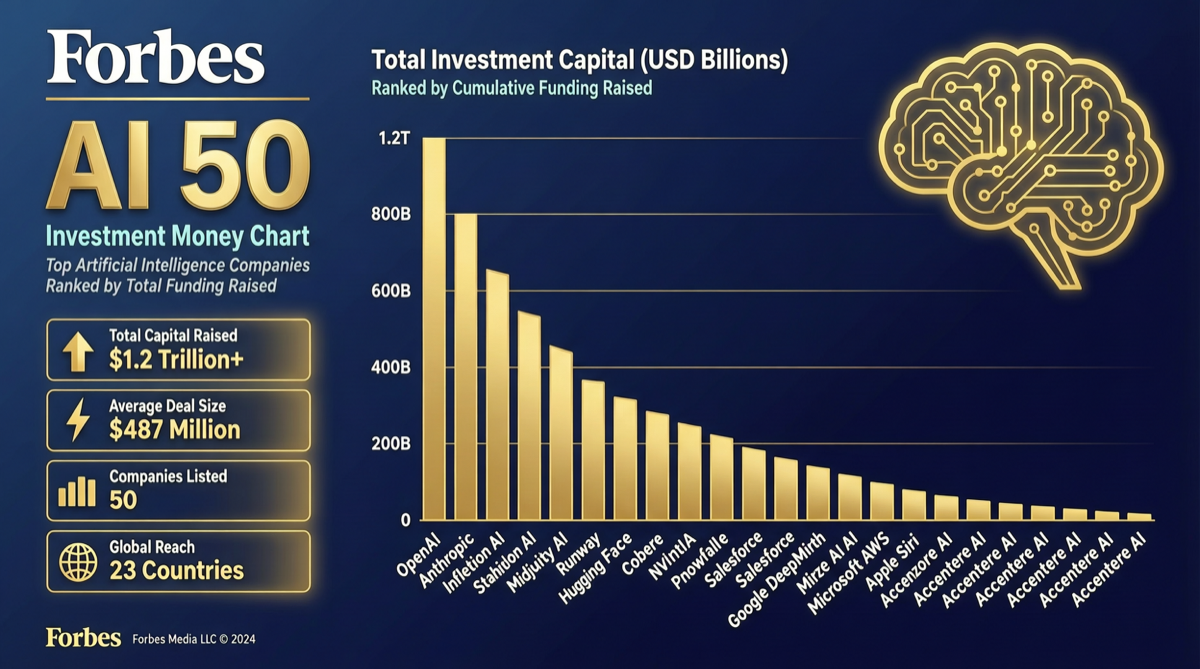
Forbes released its 2026 AI 50 list, with 50 selected companies raising a combined $305.6 billion. The headline number is staggering, but the structural changes in fund distribution are what deserve analysis.
Funding Concentration
| Tier | Companies | Share of Forbes AI 50 Total Funding |
|---|---|---|
| Model Layer Giants | OpenAI + Anthropic | ~80% |
| Vertical Application Layer | Cursor / Harvey / Abridge / Gamma et al. | ~15% |
| Infrastructure Layer | Vector databases / MLOps / Data platforms | ~5% |
While OpenAI and Anthropic’s funding share is eye-catching, this reflects the capital threshold for model training, not the concentration of market demand. What truly determines AI commercialization is the monetization capability of the application layer.
Vertical Applications Worth Watching
Cursor: $29 Billion Valuation Coding Workflow
Cursor currently holds the highest valuation among vertical applications in the Forbes AI 50. Its core logic is not “AI-assisted coding,” but redefining the coding workflow — deeply embedding AI into developers’ daily operations, rather than treating it as an add-on feature.
Gamma: $100M ARR Content Generation
Gamma has reportedly achieved $100 million in annual recurring revenue (ARR). At a stage when most AI applications are still exploring business models, this is an important benchmark — proving that AI-native applications can achieve scale revenue.
Harvey: Legal Operations
Harvey focuses on AI applications in the legal services sector. The legal industry’s high ticket prices and strong willingness to pay make it an ideal entry point for vertical AI applications.
Abridge: Clinical Healthcare
Abridge applies AI to clinical documentation and healthcare workflows. The compliance barriers in healthcare actually become a moat — once entered, switching costs are extremely high.
Investment Logic
Crunchbase data shows that global startup funding in April 2026 reached $56 billion, double the same period last year. But fund distribution is extremely uneven — two companies took nearly half of all funding.
Insights for entrepreneurs and investors:
| Role | Recommendation |
|---|---|
| Entrepreneurs | Avoid the base model layer (capital threshold is too high); choose vertical industries for deep cultivation. High ticket price + strong pain point = better commercialization prospects |
| Investors | Focus on AI applications with validated ARR (like Gamma), not still-burning model layers. $100M ARR is an important scale threshold |
| Enterprise procurement | AI tools are moving from “optional” to “essential.” ROI for tools like Cursor and Gamma has been validated in industry reports |
Landscape Assessment
Big Tech’s AI infrastructure spending reached $830 billion in 2026 (Google $175-190B, Microsoft $150-190B, Amazon $200B, Meta $120-135B), projected to hit $1.15 trillion in 2027. This means:
- Compute infrastructure is not a bottleneck: Massive investment from giants ensures the underlying cost of AI applications will continue to decline
- Application layer competition will intensify: As infrastructure matures, the decisive factor becomes product experience and industry understanding
- Verticalization is the only path: General AI assistants are monopolized by giants; the opportunity for startups lies in deep industry specialization