What Happened
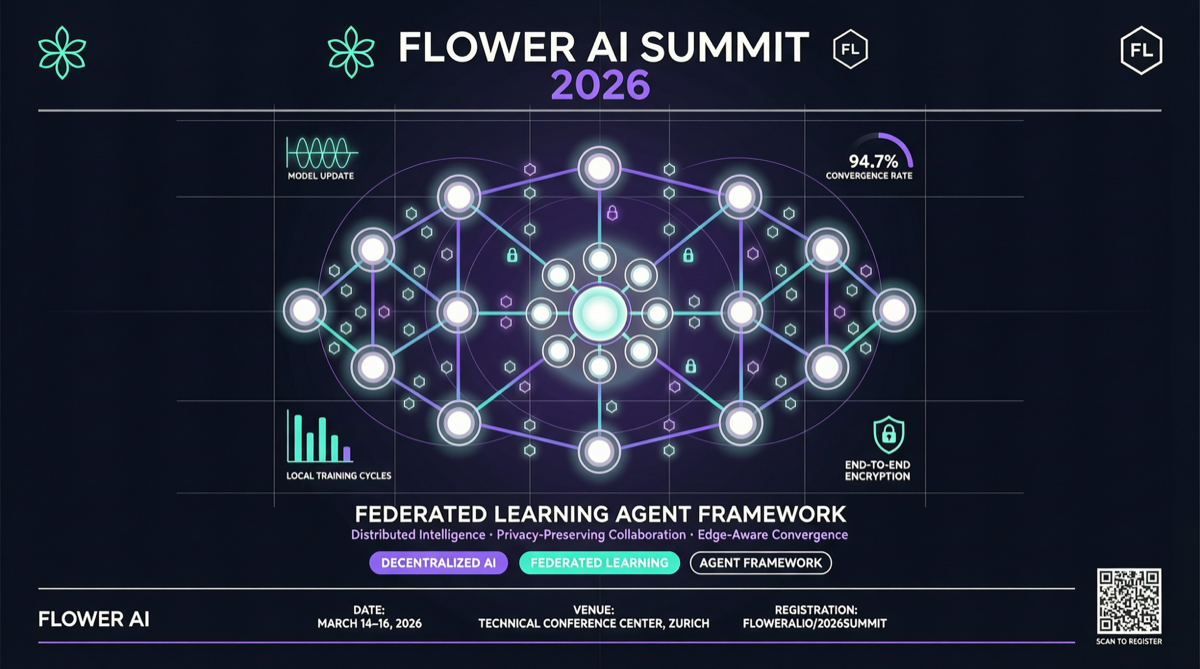
At Flower AI Summit 2026, Charles Beauville, founder of Flower Labs, officially launched Flower Agents and Project Kaya, and proposed a core framework for judging agent quality:
A good agent needs three conditions: Context, Access, and Control.
- Context: The agent must understand the background and goals of the task
- Access: The agent must be able to obtain the data and tools needed to complete the task
- Control: The agent must be able to execute operations and influence outcomes
This seems simple, but it is precisely the systematic thinking that most current agent frameworks lack.
What is Flower Agents
Flower is known for its federated learning framework — enabling models to train distributedly without data leaving local environments. Flower Agents is a natural extension of this philosophy:
| Feature | Description |
|---|---|
| Distributed Agent Orchestration | Multiple agents can work independently on different data sources, with results aggregated |
| Privacy-First | Data does not need to be centralized, complying with GDPR and other privacy regulations |
| Cross-Organization Collaboration | Multiple organizations can collaborate on training agents without sharing raw data |
| LLM Integration | Supports mainstream large models as the reasoning engine for agents |
Positioning of Project Kaya
Project Kaya is another key project for Flower in the agent space, focused on:
- Agent Skill Management: Defining, composing, and reusing agent skill modules
- Domain Expert Participation in Feedback Loops: Enabling human experts to directly participate in the agent improvement process
- Parallel Execution for Improved Accuracy and Scope: Multiple agents processing different sub-tasks in parallel, with results aggregated
Beauville emphasized in his speech: Domain experts working directly in feedback loops is key to improving agent quality. This echoes findings from the Madrigal team — parallel processing not only improves accuracy but also expands agent capabilities while reducing latency.
Why It Matters
1. The Intersection of Federated Learning and Agents
Most current agent frameworks (including Hermes, OpenClaw, LangChain) assume agents can access centralized data. But in industries with extremely high data privacy requirements like finance, healthcare, and government, this assumption does not hold.
The value of Flower Agents is that it enables agents to work in scenarios with dispersed data. This is particularly important for:
- Cross-hospital medical AI collaborative diagnosis
- Cross-bank financial risk control agents
- Multi-national enterprise compliance review
2. The Practical Value of the “Context-Access-Control” Framework
Beauville’s three-element framework can serve as a checklist for evaluating and selecting agent frameworks:
| Element | Question | Common Pitfalls |
|---|---|---|
| Context | Does the agent really understand the task? | Over-relying on prompts, lacking domain knowledge injection |
| Access | Can the agent get the data it needs? | Incomplete toolchain, insufficient API permissions |
| Control | Can the agent truly execute operations? | Can only “suggest” not “execute”, requiring manual approval |
Many agent projects fail because they only solve one or two of these elements.
How to Use It
If you are in finance or healthcare:
- Flower’s federated learning architecture is naturally suited for data-sensitive scenarios
- Explore cross-organization analytical collaboration using agents without sharing raw data
- Project Kaya’s skill management system can help define industry-standard agent capability modules
If you are building multi-agent systems:
- Beauville’s three-element framework can serve as a checklist for agent design
- Findings on parallel execution can inform architecture decisions
- The pattern of domain experts participating in feedback loops can improve agent quality
If you are evaluating agent frameworks:
- Use the “Context-Access-Control” framework to evaluate candidates
- Note the trade-offs each framework makes across the three dimensions
- Don’t just look at feature lists; look at actual execution capability
Landscape Assessment
The Flower AI Summit delivered an important signal: the future of agents is not just stronger models, but better architecture.
While frameworks like Hermes and OpenClaw pursue feature richness, Flower has chosen a differentiated route — entering from data privacy and distributed architecture. This is not a “which is better” question, but a “what scenario suits what solution” question.
For most individual developers and small-to-medium enterprises, Hermes or OpenClaw may be more suitable. But for finance, healthcare, and government industries, Flower’s privacy-first architecture may be a hard requirement.
Project Kaya’s proposal of “domain experts participating in feedback loops” is also worth the attention of all agent developers — improving agent quality requires not just better models, but better human-machine collaboration mechanisms.