Bottom Line First
Dify is already a mature LLM application development platform in 2026, but in the core scenarios of agent frameworks — multi-agent collaboration, autonomous decision chains, complex workflow orchestration — it still lags behind LangChain and CrewAI. Dify’s real advantage is not in “Agent,” but in “low-code application building.” It is not a replacement for LangChain; it is a tool in another dimension.
The Pain Point: Why Do You Need Dify?
Most development teams face three core pain points when building LLM applications:
- Prompt engineering is hard to manage: Prompts are scattered across code, version control is chaotic
- RAG pipelines are repeatedly rebuilt: Every project requires document splitting, vector retrieval, and answer generation from scratch
- Model switching is costly: Switching from GPT to Claude or Qwen requires significant code changes
Dify addresses exactly these problems. Its core capabilities:
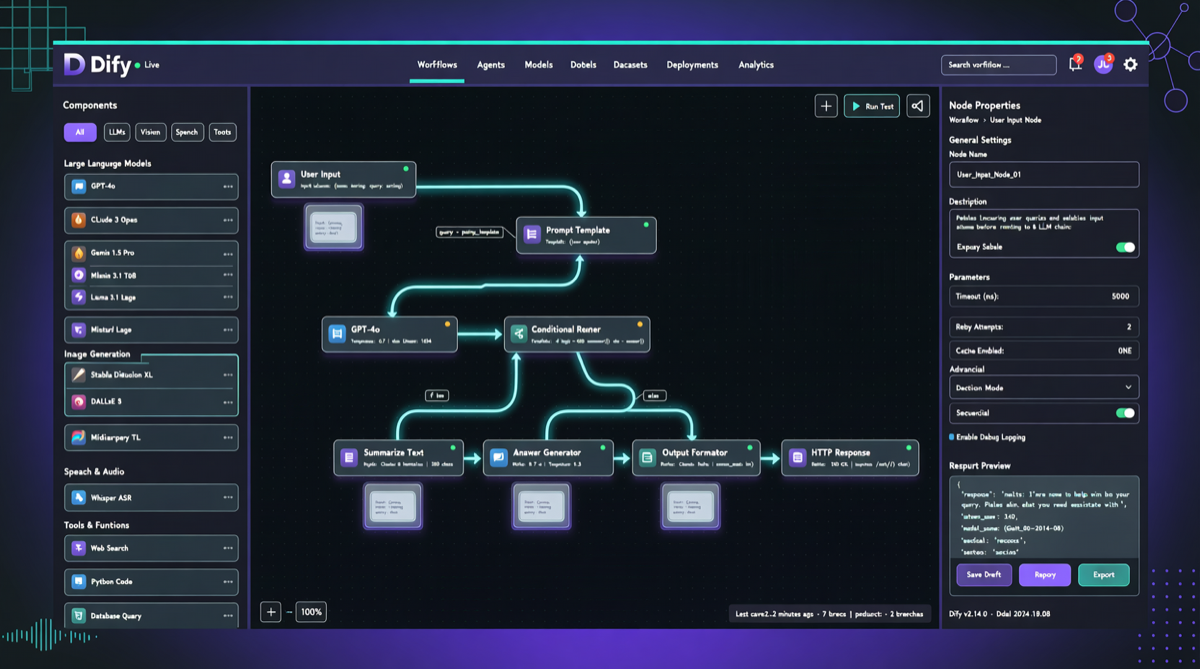
- Visual workflow editor
- Built-in RAG Pipeline (document upload → splitting → indexing → retrieval → generation)
- One-click model switching (supports 50+ model providers)
- Auto-generated APIs and one-click deployment
Solution Architecture
┌─────────────────────────────────────────┐
│              Dify Platform               │
├─────────┬──────────┬──────────┬─────────┤
│ App      │ Workflow │ Knowledge│ Monitor │
│ Builder  │ (Visual) │ Base(RAG)│ (Logs)  │
├─────────┴──────────┴──────────┴─────────┤
│           Model Abstraction Layer         │
│  OpenAI │ Claude │ Qwen │ DeepSeek │ ... │
├─────────────────────────────────────────┤
│           Deployment Layer                │
│  Cloud │ Self-host │ Docker │ K8s       │
└─────────────────────────────────────────┘
Comparison with LangChain / CrewAI
| Dimension | Dify | LangChain | CrewAI |
|---|---|---|---|
| Development Method | Low-code visual | Pure code (Python/JS) | Pure code (Python) |
| Agent Orchestration | Basic (sequential/branching) | Powerful (graph structure) | Powerful (role collaboration) |
| RAG Capability | Built-in and mature | Requires assembly | Not supported |
| Deployment Difficulty | Very low (one-click) | Medium | Medium |
| Learning Curve | Low | High | Medium |
| Community Ecosystem | Medium | Very large | Large |
| Suitable Scenarios | Rapid prototyping / enterprise apps | Complex agent systems | Multi-agent collaboration |
Key Difference: LangChain and CrewAI are frameworks for developers; Dify is a platform for product managers and business personnel. This is not a question of superiority, but of positioning.
Dify’s Challenges in 2026
1. Insufficient Agent Capabilities
Current agent orchestration stays at the “if A then B else C” level, lacking:
- Autonomous task decomposition
- Multi-agent negotiation mechanisms
- Dynamic planning for tool calling
2. Model Abstraction Layer Being Eroded
More and more development platforms (like OpenClaw, Codex Skills) directly bind to specific models, eroding Dify’s “multi-model switching” advantage.
3. Commercialization Pressure
Dify’s company, LangGenius, completed Series B funding in 2025 and now faces revenue growth pressure. Restrictions on the free version’s features may impact community growth.
Getting Started
If you need to quickly build an LLM application (like customer service Q&A, document assistant), Dify is the fastest option to get started:
# Docker one-click deployment
docker compose up -d

# Visit http://localhost:3000 to start building
Five minutes can complete the full process from document upload to API deployment. This is Dify’s biggest killer feature.
But if you need to build complex autonomous agent systems (like multi-step decision-making, tool call chains, inter-agent collaboration), use LangChain or CrewAI directly.
Landscape Judgment
Dify will not become “the LangChain of the Agent era” because it never intended to. What Dify wants to be is “the WordPress of the LLM era” — enabling people who don’t know code to build AI applications.
Whether this path can succeed depends on two variables:
- Can Dify provide sufficiently powerful advanced features while maintaining a low barrier to entry?
- Is the enterprise market willing to pay for low-code AI platforms?
So far, Dify has firmly established itself in the SMB market. The next key question is whether it can penetrate large enterprises — this requires stronger security compliance capabilities and customized support.