Core Judgment
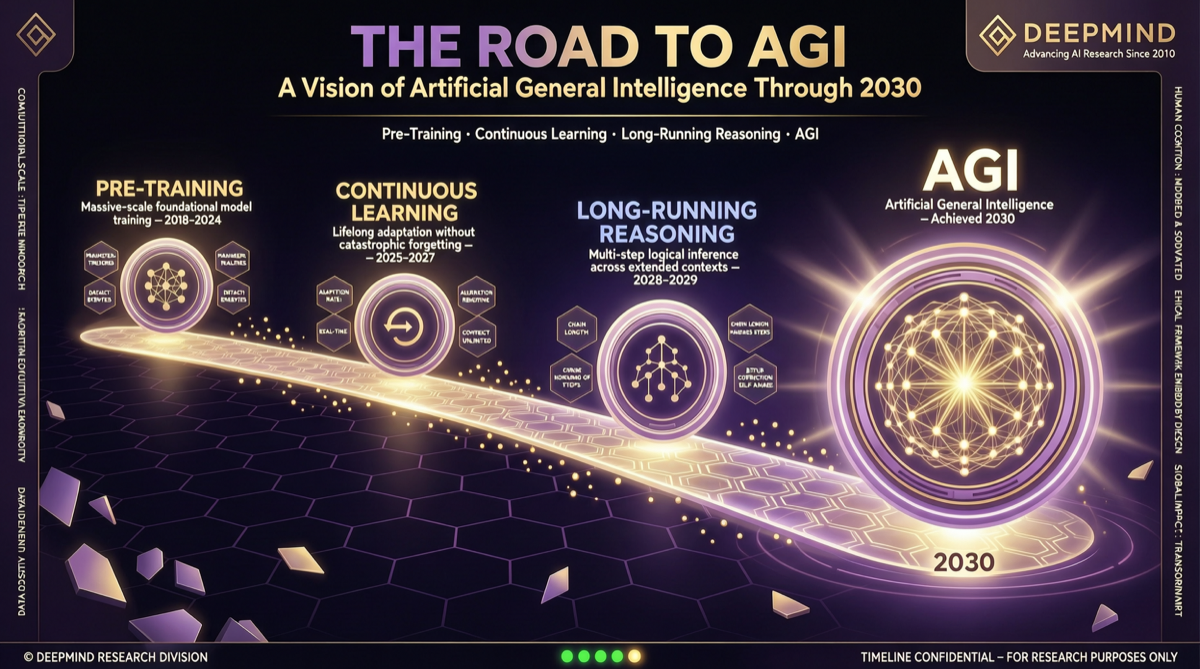
DeepMind founder and CEO Demis Hassabis gave his most specific public AGI timeline prediction to date at a Y Combinator talk: around 2030.
But he simultaneously delivered a more critical judgment: the “large-scale pre-training + RLHF” paradigm that the current frontier model industry relies on is far from enough to achieve AGI. Two core capabilities must be added — continual learning and long-horizon reasoning.
This isn’t a typical “AI big shot prediction.” Hassabis is the creator of AlphaGo and AlphaFold, co-founder of DeepMind. His AGI judgment comes from the actual experience of building the world’s most advanced AI systems.
Three Key Arguments
1. Pre-training + RLHF Is Just the Starting Point
All current frontier models (GPT-5.5, Claude Opus 4.7, Gemini 3.1 Pro) are built on the same paradigm:
Large-scale pre-training → Instruction tuning → RLHF alignment → ProductHassabis’s judgment is clear: this paradigm has a ceiling. Pre-training is “one-time” — the model’s knowledge is frozen after training completes. RLHF can only optimize within the distribution of training data, it cannot give the model capabilities it never saw during training.
Analogy: It’s like giving a student a textbook, having them memorize all the knowledge points, then using test-taking strategies (RLHF) to make them perform better. But true intelligence isn’t “memorized.”
2. Continual Learning Is the Necessary Path
The core of continual learning: the model can continue learning new knowledge and skills after deployment, without needing to be retrained from scratch.
| Capability | Current Models | AGI Needs |
|---|---|---|
| Knowledge updates | Requires retraining or RAG | Real-time learning of new information |
| Skill acquisition | Requires fine-tuning or prompt engineering | Autonomous mastery of new tasks |
| Error correction | Requires human-labeled data for retraining | Self-improvement from interactions |
| Experience accumulation | Each conversation is “new” | Cross-session accumulation of experience and insights |
Hassabis hinted that DeepMind has already invested significant resources in the continual learning direction. AlphaFold’s success is essentially a “continual learning” case — continuously learning from protein structure data, continuously improving prediction accuracy.
3. Long-Horizon Reasoning Is the Bottleneck
Current models excel at “short-horizon reasoning” — answering a question, generating code, summarizing an article. But on tasks requiring multi-step reasoning, cross-domain knowledge integration, and long-term planning, performance drops significantly.
Hassabis gave an example: having an AI system plan a scientific research project from 0 to 1 — proposing hypotheses, designing experiments, analyzing results, iterating hypotheses. This requires:
- Cross-step dependency: Each step’s decisions depend on the results of previous steps
- Uncertainty management: Experiments may fail, hypotheses may be falsified
- Resource allocation: Making optimal decisions under limited time and compute resources
- Self-correction: Adjusting direction after finding errors, not continuing down the wrong path
These capabilities are precisely what current models lack most.
Comparison with Other AGI Predictions
| Person/Organization | AGI Prediction | Core Path |
|---|---|---|
| Demis Hassabis (DeepMind) | Around 2030 | Continual learning + long-horizon reasoning |
| Dario Amodei (Anthropic) | 2026-2027 | Scaling + alignment |
| Sam Altman (OpenAI) | No specific time given | Scaling + Agent |
| Yann LeCun (Meta) | At least 10+ years | New architecture (non-LLM) |
Hassabis’s 2030 prediction sits between Amodei’s optimism and LeCun’s pessimism, but he gave a more specific “missing capabilities” list — not simply saying “need more data/compute,” but explicitly pointing out what kind of capability breakthroughs are needed.
Implications for the Industry
For Model Companies
Scaling Law (increasing model size) dividends are marginally decreasing. The next breakthrough isn’t in “bigger,” but in “better at learning.”
DeepMind has already experimented with some continual learning approaches in the Gemini series. If Hassabis’s judgment is correct, then the next “generational” model breakthrough will come from continual learning capability breakthroughs, not parameter growth.
For Developers
If you’re building AI applications, consider this trend: future models will be better at “learning from use.” This means:
- The interaction data your application accumulates will become valuable resources for training the next generation of models
- Agents that can continuously learn and self-improve will become mainstream
- “One-time deployed” AI applications will be replaced by “continuously evolving” AI applications
For Investors
Hassabis’s speech hints at an investment direction: continual learning infrastructure. Including:
- Online Learning platforms
- Model continual fine-tuning tools
- Long-horizon reasoning benchmarks and evaluation systems
Bottom Line
AGI isn’t “bigger models” — it’s “systems that learn better.” Hassabis’s 2030 prediction and continual learning thesis point the AI industry toward a direction more worth watching than Scaling Law.