Bottom Line
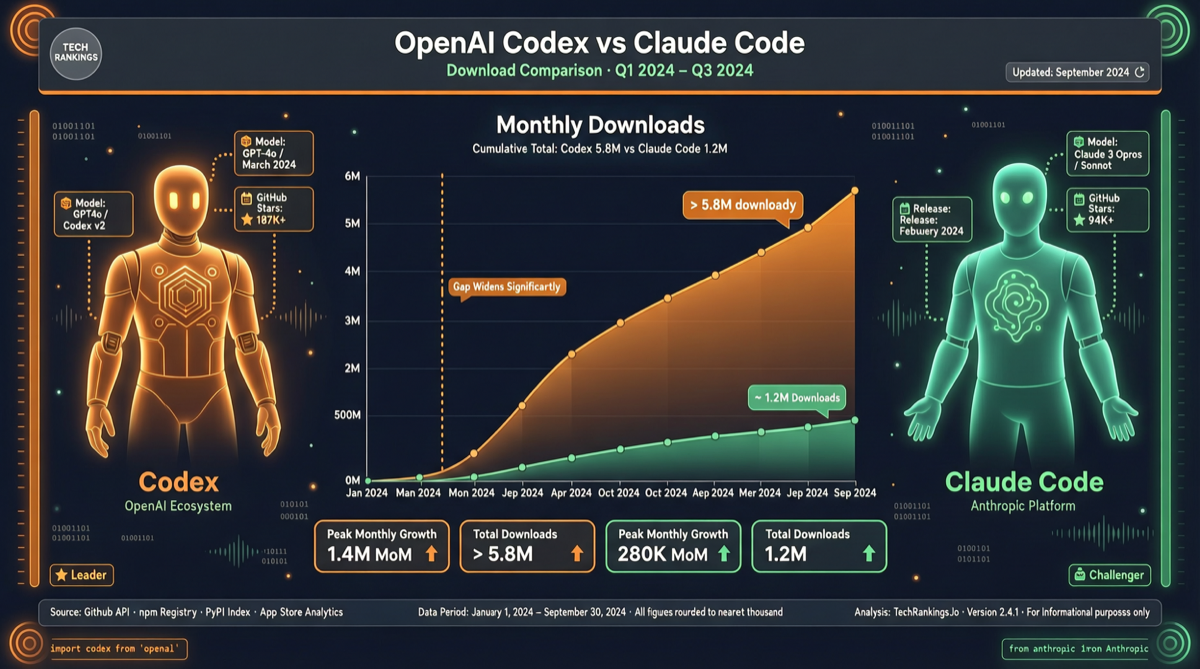
April 30, 2026 marks a fork point worth recording: OpenAI Codex’s npm weekly download volume crossed Claude Code’s. By early May, Codex reached 46 million weekly downloads versus Claude Code’s 491K — a gap of nearly 100x.
This is not a competition about which model is smarter. It’s a head-on collision between two ecosystem strategies.
Data Comparison
Download Trend
| Time Point | Codex Weekly Downloads | Claude Code Weekly Downloads | Gap Multiple |
|---|---|---|---|
| Early April 2026 | ~5 million | ~3 million | ~1.7x |
| April 16, 2026 | ~10 million | ~2.8 million (inflection point) | ~3.6x |
| April 30, 2026 | ~25 million | ~1.5 million (crossing point) | ~16.7x |
| Early May 2026 | ~46 million | ~491K | ~93.7x |
Key timeline:
- April 16: Claude 4.7 released, but Claude Code growth turns downward
- April 30: Codex crosses Claude Code downloads, just 6 days after GPT-5.5 launch
- Early May: Gap widens to nearly 100x
Test Dimensions: Two Ecosystem Strategies
OpenAI’s Play: Free + Integration + Migration
- Free strategy: Codex is free for developers, lowering the barrier to try
- Deep integration: Seamless integration with the ChatGPT ecosystem
- Migrate to Codex: One-click import of complete configurations from Claude Code, Cursor, and other tools
- Agent configs, rules, skills
- MCP server settings
- Hooks and subagents
- All session history from the last 30 days
- Auto-mapping: Scans user-level and project-level configs, automatically converts compatible content
Anthropic’s Play: Lock ecosystem first, improve product later
- Claude Code first: Lock in developers through coding tools
- Skills ecosystem: Build long-term moats with standardized Skill definitions
- Product matrix expansion: Claude Cowork, Claude Design, Claude Finance…
Sam Altman personally replied: “codex is free for developers” — the weight of this statement is not about being free itself, but about OpenAI’s willingness to trade free access for ecosystem scale.
Selection Advice
When to Choose Codex?
| Scenario | Reason |
|---|---|
| Individual developers | Free + ChatGPT integration, zero cost |
| Existing ChatGPT subscribers | Seamless connection with existing ecosystem |
| Need quick migration | Migrate tool supports one-click import from Claude Code/Cursor |
| Team collaboration | Free lowers the barrier for full-team adoption |
When to Choose Claude Code?
| Scenario | Reason |
|---|---|
| Deep Claude ecosystem users | Skills standard integrates more tightly with Claude natively |
| Code quality focus | Claude’s reputation in code review and refactoring remains leading |
| Enterprise compliance requirements | Anthropic’s enterprise security commitments are more mature |
When to Use Cursor?
Cursor occupies a unique position — it doesn’t rely on a single model and can use GPT-5.5, Claude, Gemini, and multiple backends simultaneously. During the phase where “multi-model strategy” remains effective, Cursor’s flexibility is actually an advantage.
Landscape Assessment
The essence of this competition is the battle for developer mindshare:
- OpenAI: Uses free scale and migration tools to “siphon” users from other tools
- Anthropic: Uses Skills standards and vertical product lines to “cultivate” developer workflows deeply
- Cursor/others: “Survives in the cracks” with multi-model flexibility and IDE experience
The April 30 crossing point is not the endpoint, but the starting point of a new round of competition. Key variables going forward:
- How long can Codex’s free strategy last?
- Can Claude Skills form strong enough ecosystem lock-in?
- Will multi-model IDEs emerge as the ultimate winner?
For developers, the recommendation at this stage is: don’t bind to a single tool too early. Codex’s free window, Claude Skills’ standardization dividend, Cursor’s multi-model flexibility — all three can be leveraged simultaneously. Make long-term choices once the ecosystem landscape becomes clearer.