Core Data
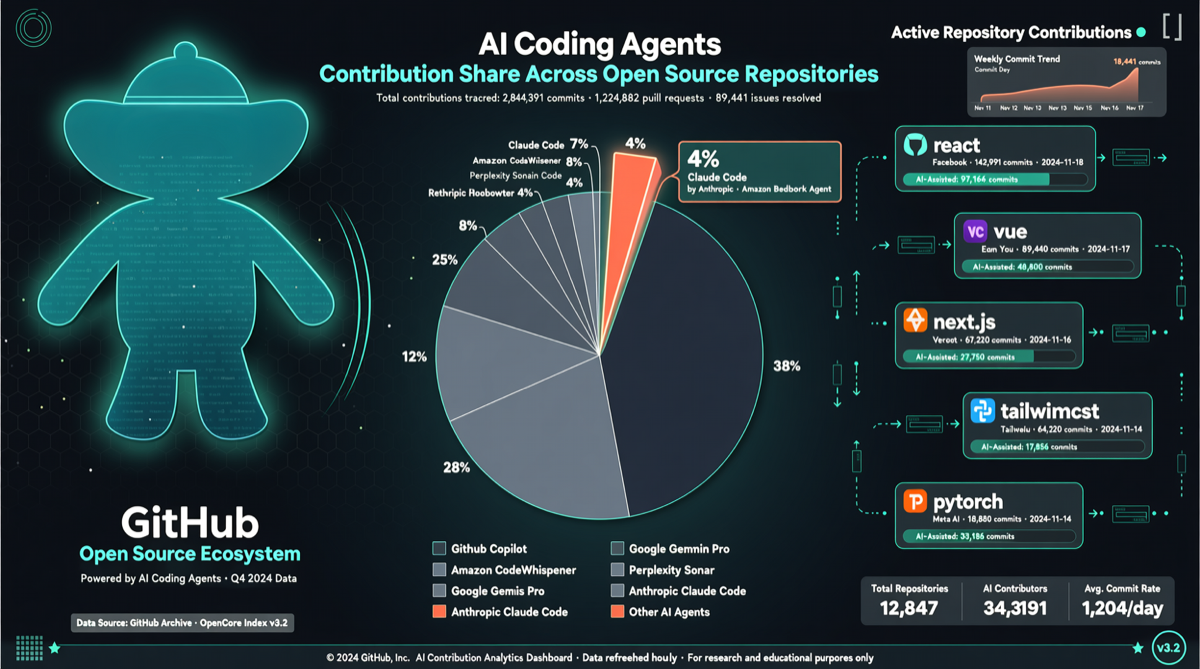
Based on analysis by developers in the X community and cross-validated against GitHub’s public commit data, Claude Code currently contributes 4% of GitHub’s public commits. At the current growth curve, this ratio is projected to reach 20% by the end of 2026.
This is not a lab number — it’s the real-world result of millions of developers using it daily.
What the Numbers Mean
4% may not sound like much, but in GitHub’s context it represents a historic inflection point:
- GitHub processes over 1 million public commits per day
- 4% means over 40,000 commits per day are independently completed by Claude Code
- This exceeds the total contribution of the vast majority of open-source projects
Even more critical is the growth rate. In the 8 months from GPT-5 to GPT-5.5, OpenAI compressed its model release cycle from 97 days to 49 days. Anthropic released 28 new features in Q1 2026 alone. Claude Code’s Opus 4.6 Agent Teams architecture gives it parallel multi-sub-agent execution capability — making it currently the most autonomous programming agent available.
The IDE Endgame: A Thin Shell
One developer’s observation was spot-on: “The IDE hasn’t disappeared at all — it has become a thin shell around the model.”
This means:
- The value of editors is declining: Syntax highlighting, auto-completion, code snippets — these traditional IDE core features are now done faster and better by AI
- The terminal is making a comeback: More and more developers are using Claude Code directly in the terminal, with the IDE retaining only the most basic editing functions
- A new interaction paradigm: Describe requirements in natural language → Agent understands and executes → Human reviews the diff → Commit — this is becoming the standard workflow
Competitive Landscape
| Tool | Architecture Features | Market Share Trend |
|---|---|---|
| Claude Code | Opus 4.6 Agent Teams, most autonomous | Fastest growing |
| Codex CLI | Rust implementation, sandbox-safe execution, open source | Steady growth |
| GitHub Copilot | Highest integration, enterprise market leader | Leading but growth slowing |
| Cursor | Editor + Agent unified experience | Top choice for individual developers |
| Gemini CLI | Local + Gemma open source support | Emerging |
By March 2026, almost all major tech companies have entered the CLI coding agent space, growing from 8 products at the end of 2025 to 15+. But Claude Code’s 4% market share demonstrates: quantity of tools does not equal quality of tools.
Impact on Developers
Short term:
- Code review ability becomes a core competency — how fast and accurately you review determines how much AI output you can handle
- Surging demand for diff review tools (such as dirac’s small-step diff approach)
- Entry-level programming jobs for junior developers are being replaced faster
Medium term:
- The efficiency gap between “AI-native developers” and “traditional developers” will widen to 10x or more
- Team sizes may shrink — one person + Claude Code ≈ the output of 3-5 people in the past
- Software engineering education shifts focus from “how to write code” to “how to review and guide AI”
Long term:
- When 20% of GitHub commits come from Claude Code, open-source code quality standards and review processes may need redesign
- “Pure human code” may become a label or quality indicator
Action Recommendations
- Start using Claude Code now:
curl -fsSL https://claude.sh/install.sh | sh - Invest in review skills: Learn how to quickly review AI-generated code — one of the most valuable skills for the next 2-3 years
- Follow diff tools: Small-step diff strategies (like dirac) can significantly reduce review costs
- Build agent workflows: Don’t just use Claude Code as a code generator — treat it as a “virtual colleague” you can assign tasks to