What Happened
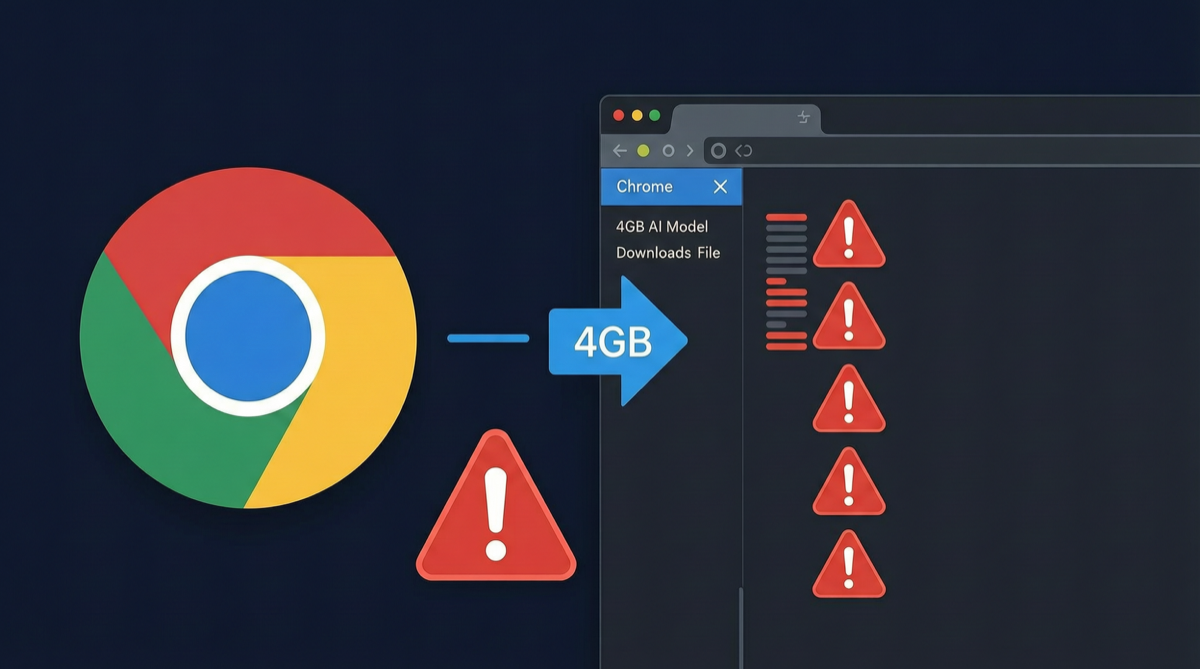
If your disk space mysteriously dropped by 4GB recently, it is not malware — it is Chrome browser installing an AI model.
Multiple security researchers and users discovered in early May 2026:
Google Chrome is silently downloading a 4GB Gemini Nano AI model on user devices, saved as weights.bin in the Chrome user profile directory under OptGuideOnDeviceModel/.
The key problems:
- No popup notification
- No “do you want to install” confirmation dialog
- No obvious opt-out/disable option
- Automatically re-downloads after manual deletion
Typical path on Mac:
~/Library/Application Support/Google/Chrome/Default/OptGuideOnDeviceModel/weights.binWhat Is It For?
Gemini Nano is Google’s on-device AI model. It does not rely on cloud servers — it runs directly on the user’s computer.
Known current uses:
- Chrome’s “OptGuide” feature (optimizing browser experience)
- Possibly smart autofill, webpage summarization, translation enhancement
- Preparing local inference for future AI features
In theory, on-device AI has some benefits:
- Better privacy: Data does not need to be sent to the cloud
- Faster speed: Local inference without network latency
- Works offline: Available without internet
But the issue is not “whether on-device AI is good” — it is “do you have the right to choose or not.”
Points of Controversy
1. User Consent
One user comment resonated widely:
“Normal browser update: asks permission → shows changelog → downloads in background → you notice nothing → life goes on.
Google Chrome update: silently installs 4GB AI model → no consent dialog → no opt-out button → no notification → you do not even know it exists.”
4GB is not a small number. For users with 128GB or 256GB SSDs, this is a non-trivial storage occupation.
2. Automatic Re-download
Even more unsettling: even if you manually delete the file, Chrome will automatically re-download it on the next update or launch.
This goes beyond “feature push” territory and approaches what users would consider “malware-like behavior.”
3. Environmental Cost
A 4GB model silently pushed to 3 billion+ Chrome users worldwide.
- 3 billion × 4GB = 12,000 TB (12 PB) of total download volume
- The bandwidth consumption and carbon emissions from data centers are massive
- And most users do not even know what they downloaded
Comparison with Industry Practice
| Company | On-device AI Push Method | User Consent |
|---|---|---|
| Apple (Apple Intelligence) | Explicit prompt during iOS 18.1 update | Requires user confirmation |
| Microsoft (Copilot+) | Optional in Windows 11 settings | Can be skipped |
| Google (Chrome + Gemini Nano) | Background silent download | No notification |
Apple and Microsoft both chose to let users make the choice. Google chose to decide for users.
How to Check and Delete
If you want to check whether it was installed on your Mac:
ls -lh ~/Library/Application\ Support/Google/Chrome/*/OptGuideOnDeviceModel/Deletion method:
rm -rf ~/Library/Application\ Support/Google/Chrome/*/OptGuideOnDeviceModel/But as noted, it may automatically come back.
Landscape Assessment
This incident reflects a deeper trend: AI companies are shifting from “users actively using AI” to “stuffing AI into products users already use.”
- Google stuffs Gemini Nano into Chrome
- Apple stuffs Apple Intelligence into iOS
- Microsoft stuffs Copilot into Windows
The difference: Apple and Microsoft at least superficially gave users the right to choose. Google chose the most aggressive path.
Action Recommendations
- Users with limited disk space: Immediately check Chrome config directory, manually delete
OptGuideOnDeviceModel - Privacy-sensitive users: Consider using Firefox or other browsers that are more transparent about on-device AI pushes
- Enterprise IT administrators: Restrict Chrome’s auto-download behavior in group policies
- Regular users: Watch for “AI features” options in Chrome settings — Google may add toggles in future versions
The 4GB silent model installation is fundamentally a user autonomy vs. product vision issue. Google believes “on-device AI is the future, users will need it eventually,” but users believe “my device, my choice.”
This debate will not end soon.