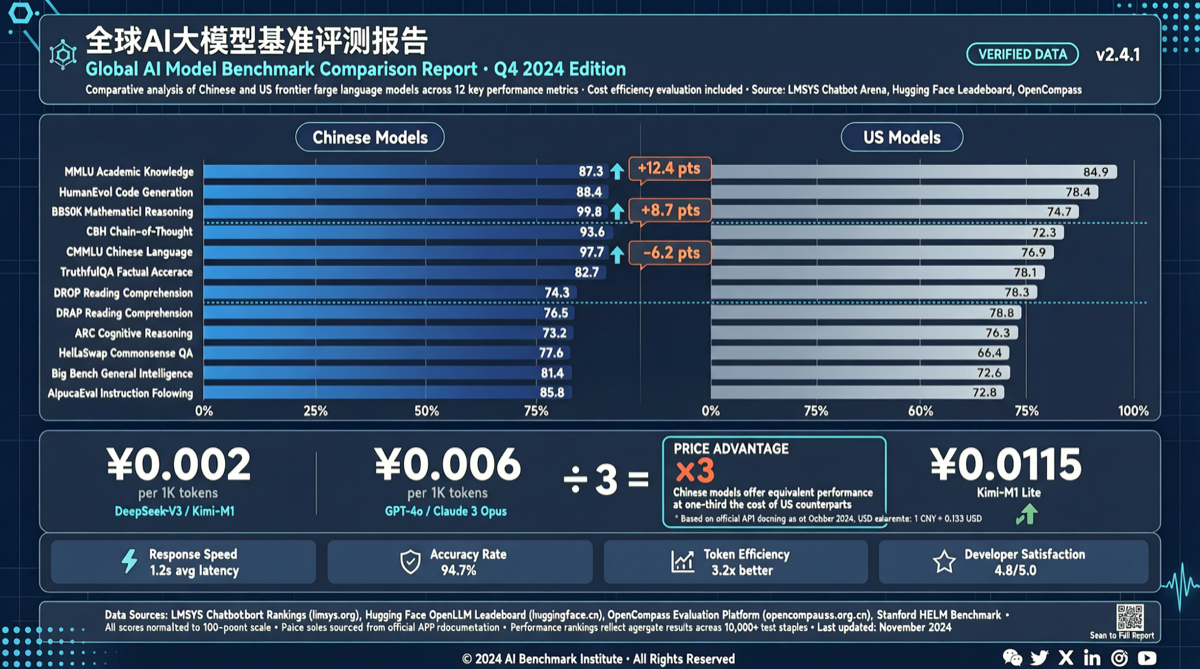
Core Conclusion
The latest State of AI monthly report (May 2026) delivers a number that should make Silicon Valley engineers sit up straight: DeepSeek V4 and Kimi K2.6 have matched GPT-5.5 and Claude Opus 4.7 on SWE-Bench Pro, at approximately one-third the API cost per million tokens.
This is no longer a “bang for your buck” story — it’s a “equal performance, crushing price” signal.
Data Comparison
| Model | SWE-Bench Pro | Input Price ($/M tokens) | Output Price ($/M tokens) | Architecture |
|---|---|---|---|---|
| GPT-5.5 | 67.2% | $10.00 | $40.00 | Dense MoE |
| Claude Opus 4.7 | 66.8% | $15.00 | $75.00 | Dense MoE |
| DeepSeek V4 | 67.0% | $2.50 | $8.00 | MoE (32B active) |
| Kimi K2.6 | 66.5% | $3.00 | $10.00 | MoE (32B active, 1T total) |
Key details:
- SWE-Bench Pro is currently the strictest coding benchmark, covering real issue-fixing tasks across languages and repositories
- DeepSeek V4 and Kimi K2.6 both use MoE (Mixture of Experts) architecture, activating only ~32 billion parameters per token during inference — far less than their total parameter counts
- Pricing data based on official API rates (May 2026)
Why This Signal Matters More Than Benchmark Scores
For the past two years, the AI conversation has revolved around “who’s smarter.” This report suggests a more fundamental trend: intelligence is shifting from a scarce resource to infrastructure.
Several cross-validated signals:
- Frontier model cyberattack capabilities are doubling every 4 months (UK AISI data), meaning model capability iteration far outpaces price adjustments
- Chinese labs lead on SWE-Bench Multilingual as well — Kimi K2.6 outperforms Claude Sonnet 4.6 on multilingual coding tasks
- Open-weight models are closing the gap with closed-source ones — Kimi K2.6’s weights are public, and DeepSeek V4’s weights are open-source too
Landscape Assessment
This trend means different things for different roles:
| Role | Signal | Action |
|---|---|---|
| Independent developer | Coding Agent cost barrier dropped to $5/month | Deploy Ollama + Hermes Agent on a VPS, run coding tasks locally |
| Enterprise CTO | Chinese open-source model performance/cost ratio can no longer be ignored | Introduce DeepSeek/Kimi as fallback for GPT-5.5 in internal toolchains |
| Model vendors | Closed-source pricing window is narrowing | Must build new moats in Agent workflows, multimodal capabilities, enterprise security |
Uncertainties to Note
- SWE-Bench Pro is strict, but it’s still a benchmark. Real-world performance may vary based on codebase complexity, context length requirements, and other factors
- Chinese models’ ecosystem tooling (IDE integration, MCP servers, plugins) is still catching up
- US export controls on AI technology may affect global accessibility of these models
Bottom line: When DeepSeek V4 and Kimi K2.6 match GPT-5.5 on coding capability at one-third the price, the question “which model to pick” is shifting from “who’s smarter” to “who’s more cost-effective.”