TL;DR
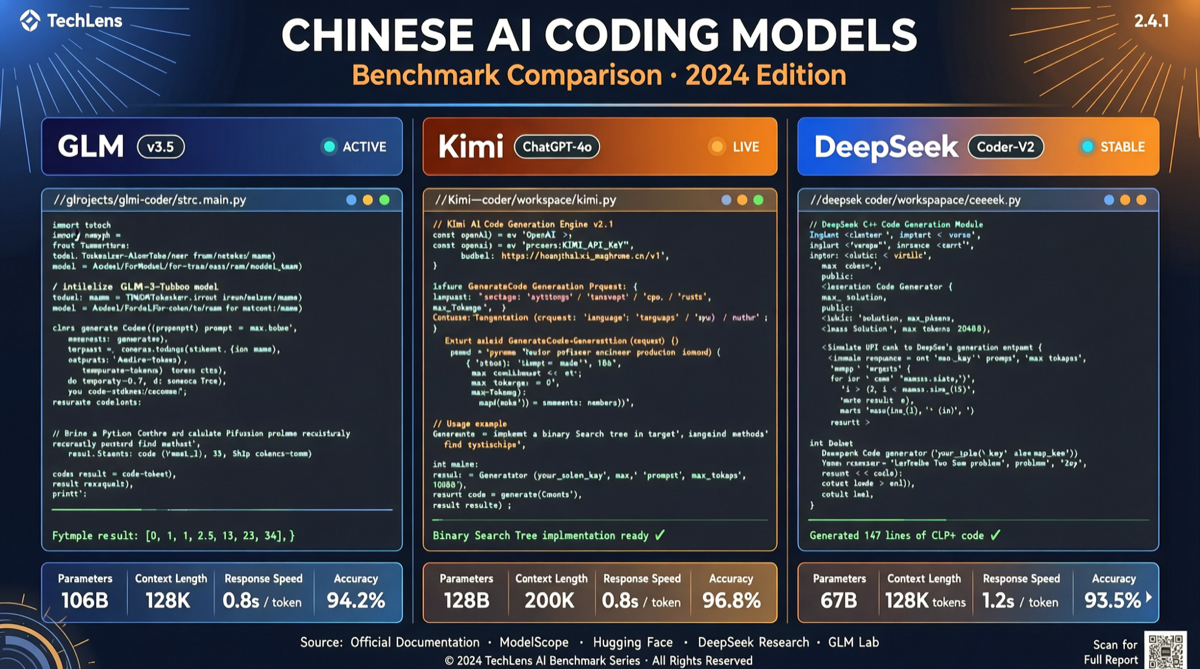
After multiple rounds of community testing, Chinese coding models have formed clear tiers:
| Tier | Model | Positioning | Monthly Cost (ref) |
|---|---|---|---|
| Entry Passed | GLM-5.1 ≈ Kimi K2.6 | Near-Claude level, can handle medium-scale coding independently | ¥100-200 |
| Entry Edge | DeepSeek V4 Pro | Complex tasks need human intervention, but cost-effective | ¥50-100 |
| Entry Not Passed | MiniMax Mimo V2.5 Pro > Qwen 3.6 Plus | Suitable for assistive coding only | ¥30-80 |
Data source: Developer community feedback from real usage in Claude Code, cross-validated across multiple independent test reports from April 25-28.
Key finding: GLM-5.1 and Kimi K2.6 have crossed the “Entry tier” threshold, meaning they can independently handle most medium-complexity coding tasks — no longer just Claude supplements.
Benchmark Breakdown
1. Code Generation & Completion
GLM-5.1 and Kimi K2.6 perform most stably in code completion accuracy. One developer’s experience connecting three models in Claude Code:
“The feel is Kimi 2.6 > Deepseek V4 Pro > Kimi 2.5. Just started V4 Pro, and it’s already close to Kimi 2.6.”
The key isn’t single-generation quality, but context retention across conversations. GLM-5.1 excels at multi-file refactoring — it remembers variable naming conventions from 20 turns ago, a first among Chinese models.
2. Debug Capability
DeepSeek V4 Pro’s debugging ability is underrated. While its code generation slightly trails Kimi K2.6, V4 Pro’s reasoning chain when locating bug root causes is more complete — it explains why something is wrong before offering a fix.
GLM-5.1’s debug style is more “veteran programmer”: directly points to the problem line with a brief explanation. Efficient, but not beginner-friendly.
3. Toolchain Integration
This is the short board for Chinese models. While GLM-5.1 and Kimi K2.6 can connect via API in Claude Code, they lack native skill/plugin support. The Nuwa.skill framework has been directly integrated into Tencent, Kimi, and Zhipu’s agent products as default skills, but in third-party environments like Claude Code, skill performance varies.
Landscape Assessment
Chinese coding models are at an inflection point — moving from “usable” to “good”:
- Zhipu GLM: GLM-5.1’s Coding Plan is seeing ¥469/month plans sold out. Users are willing to pay for near-Claude experiences.
- Moonshot Kimi: K2.6 continues Kimi’s long-context advantage, performing best in large codebase scenarios.
- DeepSeek: V4 Pro takes the cost-effective route. If you run many coding sessions daily, V4 Pro has the lowest per-token cost.
A notable signal: The community ranking GLM-5.1 ≈ Kimi K2.6 > DeepSeek V4 Pro > Qwen 3.6 Max Preview aligns with usage trends on OpenRouter.
Selection Guide
| Your Scenario | Recommendation | Reason |
|---|---|---|
| Main development, seeking stability | Kimi K2.6 | Long-context advantage, large-project friendly |
| Zhipu ecosystem user | GLM-5.1 | Complete Coding Plan ecosystem, highest community activity |
| Budget-conscious, high-frequency use | DeepSeek V4 Pro | Lowest per-unit cost, strong debugging |
| Assistive coding, not dependent | Qwen 3.6 Plus | Daily completion sufficient, good Alibaba ecosystem integration |
Don’t ignore this: Even though GLM-5.1 and Kimi K2.6 passed the Entry line, they still trail Claude Opus 4.7 by 1-2 steps in complex architecture design and cross-language migration. If your project has low error tolerance, Claude remains the go-to — but Chinese models are sufficient for 70% of daily coding work.