What Happened
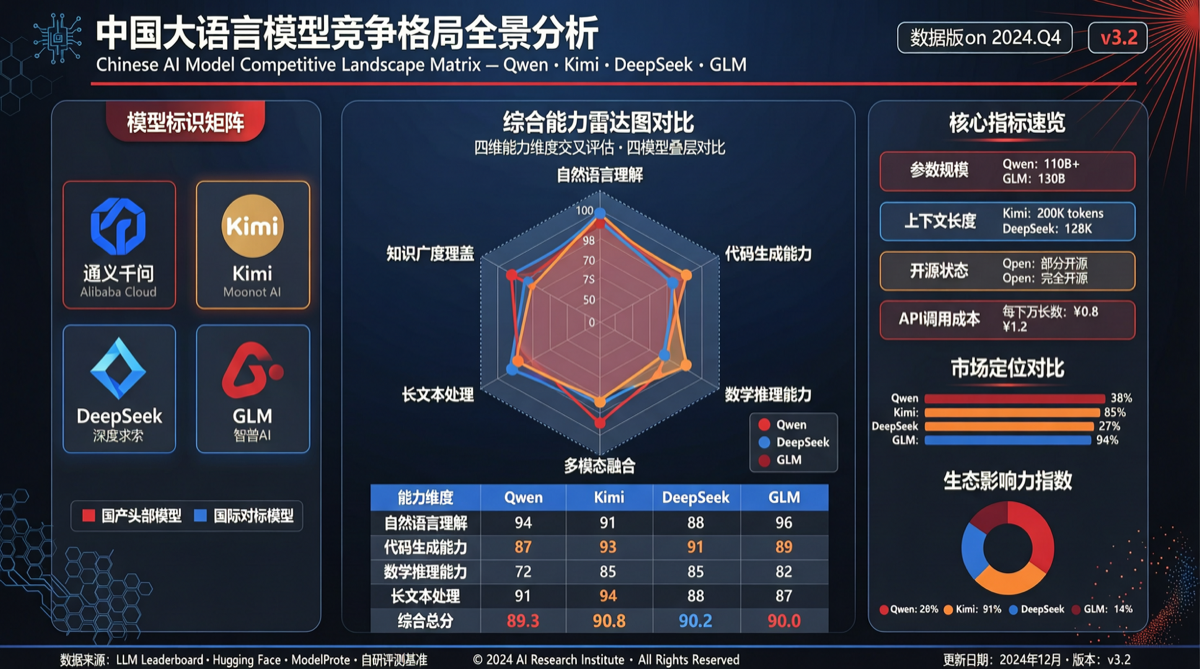
The Chinese AI model camp in May 2026 is experiencing a critical transition from a “single catch-up narrative” to a “differentiated competitive landscape.” Multiple independent signals point to the same conclusion: Chinese models are no longer GPT’s “cheap alternatives” — they have established their own competitive advantages across different dimensions.
Model Positioning Matrix
| Model | Core Advantage | Pricing Strategy | Typical Scenario | Competition Target |
|---|---|---|---|---|
| Qwen3.6-Plus | Cost-effectiveness + open-source ecosystem | ~1/5 of Claude Opus price | 80% of daily Agent workloads | Claude Sonnet |
| Kimi K2.6 | Design and creative capabilities | Mid-tier pricing | Arena Design champion-level performance | GPT-4o |
| GLM-5.1 | Coding capability | Premium pricing | Coding Arena surpasses GPT-5.5 High | GPT-5.5 |
| DeepSeek V4 Pro | Specific benchmark performance | High cost-effectiveness | FoodTruck Bench exceeds GPT-5.2 | GPT-5.2 |
| MiniMax M3 | Upcoming release, positioning TBD | TBD | TBD | Claude Sonnet 4.8 |
Key Transition Signals
Signal One: GLM-5.1 Coding Capability Surpasses GPT-5.5 High
Zhipu GLM-5.1 surpassed GPT-5.5 High on the Coding Arena leaderboard — a landmark event. It means Chinese models in the coding domain have transitioned from “chasers” to “leaders.” For teams primarily using AI for programming, GLM-5.1 is no longer a “good enough” alternative but a first choice in certain scenarios.
Signal Two: Qwen3.6-Plus Agent Cost-Effectiveness
Community benchmarking shows Qwen3.6-Plus handles 80% of daily Agent workloads at roughly one-fifth the price of Claude Opus. Its technical architecture — hybrid sparse MoE + native 1M context + built-in tool routing — is specifically optimized for Agent scenarios.
For teams running large volumes of Agent workflows, this is a significantly cost-effective choice.
Signal Three: Kimi K2.6 Creative Advantage
Moonshot Kimi K2.6 demonstrates champion-level performance on the Arena Design leaderboard. This reflects Chinese models’ differentiation in non-coding capabilities — Kimi’s performance in visual understanding, creative design, and content generation is surpassing some American models.
Signal Four: DeepSeek V4 Pro Vertical Benchmark Advantage
DeepSeek V4 Pro’s performance on FoodTruck Bench and other specific benchmarks exceeded GPT-5.2. This reveals a trend: in vertical scenarios, Chinese models may perform better than general-purpose models.
Architectural Differences: Why Chinese Models Are Differentiating
The differentiation of Chinese models is not accidental — it’s the result of architectural choices and training strategies:
| Model | Architecture Features | Differentiation Source |
|---|---|---|
| Qwen3.6 | Hybrid sparse MoE + 1M context | Deeply optimized for Agent scenarios, outstanding tool call efficiency |
| Kimi K2.6 | Inherits DeepSeek V3 design + Moonshot Muon optimizer | Enhanced multimodal and creative capabilities |
| GLM-5.1 | Large-scale coding data training | Outstanding coding-specific capabilities |
| DeepSeek V4 | Reasoning chain optimization + visual primitives | Reasoning and visual understanding capabilities |
Landscape Assessment
The Chinese model camp is forming a differentiated advantage matrix, rather than pursuing “comprehensive overtaking” in a single direction. This is actually more beneficial for developer model selection — choose different models for different tasks, rather than relying on one dominant player.
This landscape’s impact on American models is not about “one Chinese model comprehensively defeating GPT” but rather “each Chinese model is more suitable than GPT in specific scenarios.” When enterprises can choose the optimal model based on task type, the “default option” status of American models is weakened.
Actionable Recommendations
- Model selection strategy: Abandon the “use one model for everything” approach. Select the most suitable model for different task types (coding, creative, Agent, reasoning) for better cost-effectiveness.
- Qwen3.6-Plus is suitable for: Teams running large-scale Agent workflows, cost-sensitive deployment scenarios, teams needing open-source model customization.
- GLM-5.1 is suitable for: Teams with programming as the primary use case, scenarios requiring coding capability exceeding GPT-5.5.
- Kimi K2.6 is suitable for: Creative content generation, visual understanding, design assistance scenarios.
- DeepSeek V4 Pro is suitable for: Scenarios requiring high cost-effectiveness reasoning capability, deep applications in specific vertical domains.
- Watch MiniMax M3: Upcoming release may fill the gap in Chinese models’ conversational and general-purpose capabilities.