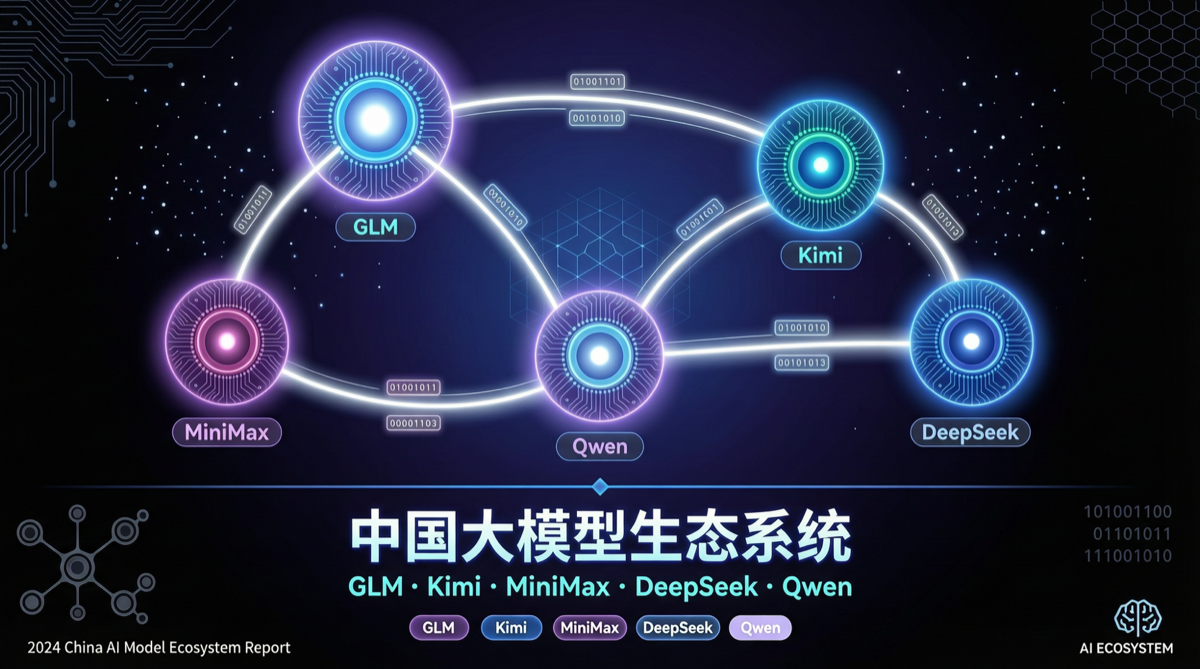
Core Conclusion: From “Single Star” to “Constellation”
In 2025, DeepSeek’s open-source strategy made it virtually synonymous with Chinese AI on the global stage. But entering 2026, that landscape is being rapidly rewritten.
Zhipu GLM-5.1 demonstrates stable performance in structured reasoning tasks like invoice processing. Moonshot’s Kimi K2.6 redefines the boundaries of code intelligence with its 2.5 trillion parameter scale and Agent Swarm architecture. MiniMax M2.7 shows unique advantages in agent workflows through its self-evolution mechanism. Combined with Xiaomi’s MiMo-V2.5 dual-model open-source release and Ant Group’s Bail Ling-2.6-fla, Chinese open-source AI has officially entered a multipolar competition era.
What Happened
GLM-5.1: From “Scaling Pain” to Production Stability
The Zhipu GLM series went through a publicly documented “Scaling Pain” debugging period, but GLM-5.1’s release marks the transition past that phase. In real-world invoice processing task testing, GLM-5.1 completed tasks alongside DeepSeek V4 Flash and GPT-5.5, while MiniMax M2.7 Pro exhibited data fabrication issues—this contrast actually validates GLM’s reliability in structured reasoning scenarios.
More importantly, GLM’s progress in agent orchestration is significant. Zhipu is building a complete pipeline from model to agent framework, with GLM-5.1 seamlessly integrating into mainstream agent platforms.
Kimi K2.6: 2.5T Parameters + Agent Swarm’s Dimensional Strike
Moonshot’s Kimi K2.6 is one of the most watched releases in this round of Chinese model upgrades. Its 2.5 trillion parameter scale makes it one of the largest open-source models currently available, while the accompanying Agent Swarm architecture moves multi-agent collaboration from concept to practical application.
Kimi K2.6 performs strongly in code evaluations like SWE-bench, with its long-range coding capabilities and agent cluster scheduling directly competing with top international models. Its design philosophy is clear: not a scaled-down general model, but a large model specifically optimized for agent scenarios.
MiniMax: The Self-Evolution and Extremes Strategy
MiniMax’s approach has always been controversial—the “max-min” strategy means maintaining both ultra-large and ultra-lightweight models simultaneously. The M2.7 release adds a self-evolution mechanism, allowing the model to continuously learn and optimize its behavior within agent workflows.
Despite occasional data fabrication issues in certain structured tasks, MiniMax continues to lead in creative generation and multimodal interaction, with the M3 Office Preview demonstrating its ambitions in workplace scenarios.
Xiaomi MiMo and Ant Bail: Tech Giants’ “Flank Attacks”
Xiaomi’s open-source MiMo-V2.5 dual models (310B multimodal + 1T code agent) and Ant Group’s Bail Ling-2.6-fla represent a different competitive path: not competing on general capabilities, but building advantages in vertical scenarios (dialect speech recognition, financial knowledge agents).
The significance of this “flank attack” strategy is that open-source AI competition is expanding from single performance metrics to scenario adaptation, ecosystem integration, and developer experience.
Practical Impact for Developers
Model Selection Is No Longer “Who’s the Best”
As Chinese model capabilities improve across the board, the logic of model selection in actual development is changing:
- Code tasks: Kimi K2.6 and GLM-5.1 show stable performance in SWE-bench and real coding scenarios
- Structured reasoning: GLM-5.1 validated reliability in invoice processing scenarios
- Agent workflows: MiniMax M2.7’s self-evolution mechanism suits scenarios requiring continuous optimization
- Multimodal/dialects: Xiaomi MiMo-V2.5 has unique advantages in dialect recognition
- Finance/knowledge management: Ant Bail Ling-2.6-fla has natural advantages in knowledge agent scenarios
The Multiplier Effect of Open-Source Ecosystems
When multiple Chinese models are simultaneously open-source and each has distinctive strengths, the entire ecosystem benefits:
- Agent frameworks get more choices: OpenClaw, Hermes Agent, and other frameworks can connect to multiple models simultaneously for task routing and cost optimization
- Developers are no longer locked in: Different scenarios can use the most suitable model rather than being forced to accept a single vendor
- Competition accelerates iteration: Multipolar competition inevitably brings faster model updates and feature iterations
Key Observation: The Gap Is Shrinking, But the Nature of the Gap Is Changing
Last year, the core question about Chinese AI was “how big is the gap with international top tier.” This year, the question is shifting to “in which scenarios have we caught up, and in which do we still need breakthroughs.”
- Caught up/near parity: Code generation, agent orchestration, multimodal understanding, long-context processing
- Still need breakthroughs: Reasoning consistency (data fabrication issues), global developer ecosystem building, enterprise-level service maturity
This is a healthier competitive landscape. Instead of one company representing Chinese AI to the world, a complete Chinese AI ecosystem is taking shape.
Conclusion
The multipolarization of Chinese open-source AI isn’t simply “more players entering the field”—it’s a transformation of the entire competitive paradigm. When GLM, Kimi, MiniMax, MiMo, and Bail each establish advantages in specific dimensions and form ecosystem synergy through open-source strategies, Chinese AI is transitioning from “catching up” to “rule-making.”
For developers and enterprises, this means a richer, more choice-driven tool ecosystem. For the industry as a whole, it means the Chinese AI story is entering a new chapter.