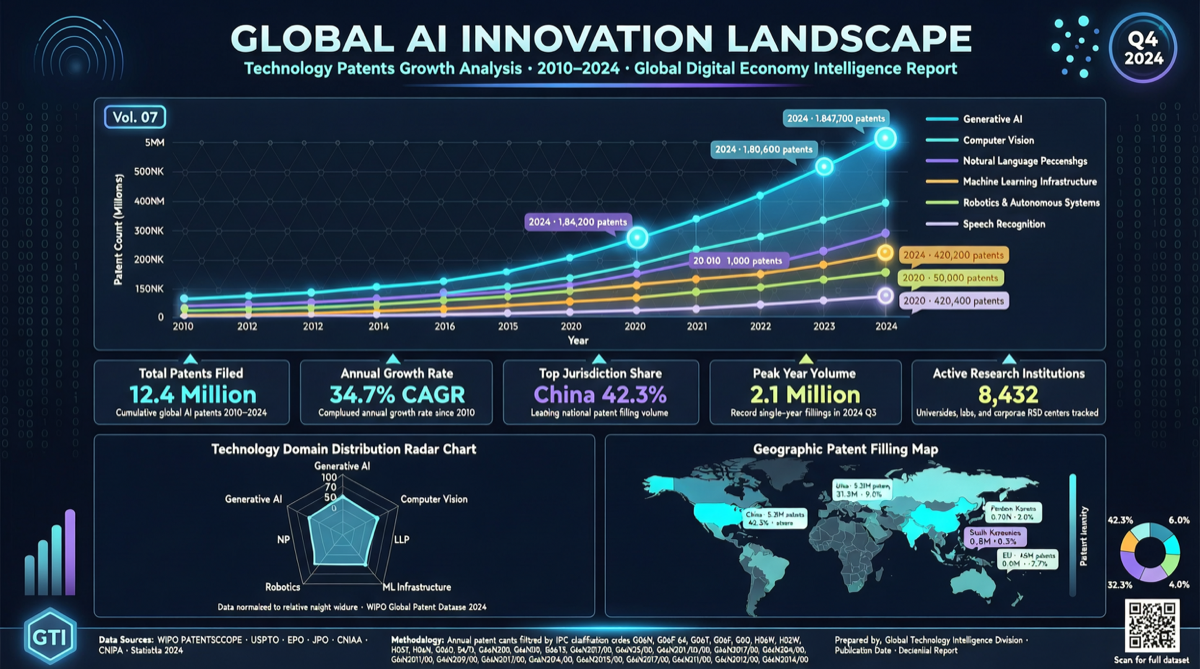
Core Data
- China AI patents: ~60% of global total
- China robot patents: ~2/3 of global total
- Photovoltaic industry roadmap: 180-240GW new capacity expected in 2026
What 60% AI Patents Means
Policy Drivers
- “New Generation AI Development Plan” continued implementation
- Local governments building AI industrial parks and innovation centers
- University evaluation systems tilting toward AI research
Industry Scale
- World’s largest AI application market
- Dense layout of internet giants and AI unicorns
- Manufacturing digital transformation driving AI integration patents
Talent Base
- World’s largest AI engineer and researcher pool
- University AI program expansion
- Accelerated return of overseas talent
Patent Structure Analysis
| Field | Global Share | Strength |
|---|---|---|
| Computer Vision | ~65% | ★★★★★ |
| Speech Recognition | ~58% | ★★★★☆ |
| Natural Language Processing | ~52% | ★★★★☆ |
| Robot Control | ~67% | ★★★★★ |
| Autonomous Driving | ~48% | ★★★☆☆ |
| AI Chip Design | ~35% | ★★☆☆☆ |
| Foundation Model Architecture | ~30% | ★★☆☆☆ |
Key Finding: China leads in application and engineering-layer patents (vision, speech, robot control) but lags in foundational architecture and chip design.
Implications for Startups and Investors
Expansion Opportunities
- Chinese AI tech (CV, speech, robot control) has clear cost advantage in Southeast Asia, Middle East, Africa
- Patent barriers provide legal moat for overseas expansion
Foundational Tech Is Still Blue Ocean
- AI chip design (35% global share) and foundation model architecture (30%) are clear gaps
- Huge space for startups and investment in these directions
Robotics Sector Worth Watching
- 2/3 of global robot patents in China
- Humanoid robots, industrial collaborative robots, service robots are three explosion directions
Warning Signals
- Invention patents ratio is low: Many are utility models and design patents
- Overseas patent layout insufficient: PCT international applications lag behind domestic grants
- Commercialization rate needs improvement: Many patents stay on paper