Core Conclusion
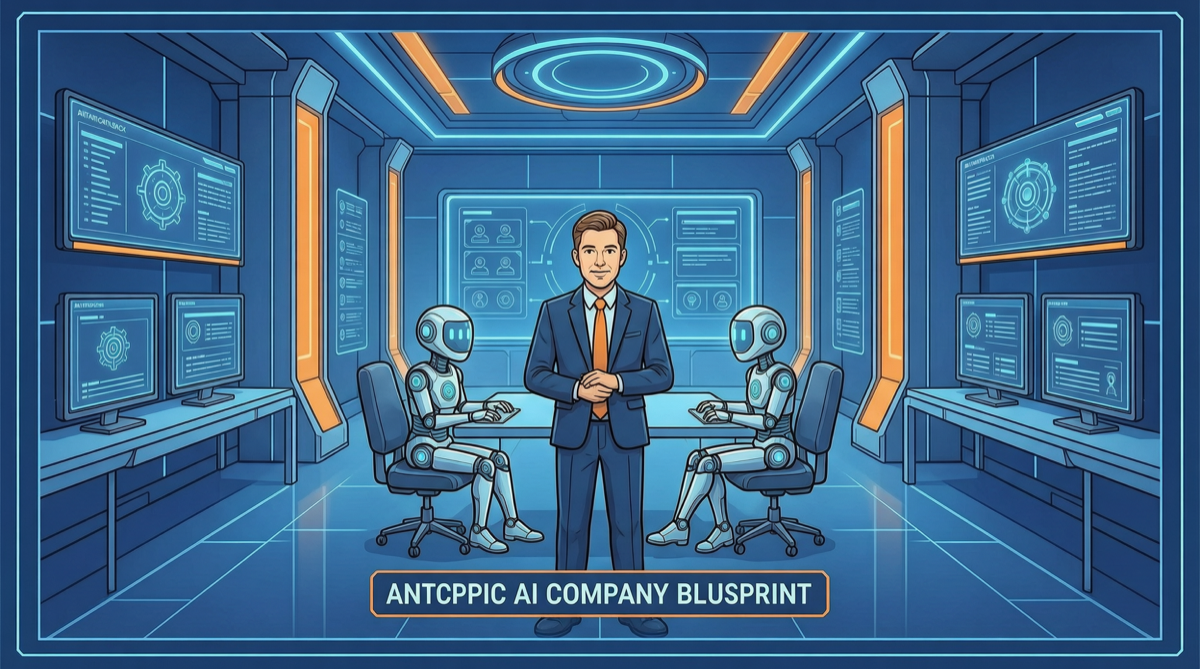
Anthropic just published a complete “AI Company” architecture blueprint — this is not a concept demo, but an actionable engineering plan. Built on Claude + Google Cloud Agent Stack, the core design:
- 1 Human CEO: Only sets goals and reviews, the rest of the time can “go to sleep”
- Multiple AI Employees: Each takes on a different role (development, design, analysis, operations)
- Automatic Task Division: Agents self-decompose tasks, assign work, and call each other
- Cross-Session Long-Term Memory: Agents retain context and don’t lose progress across new sessions
The tweet gained 22K impressions and 661 bookmarks, showing that community interest in “AI organizational structure” has far surpassed single-agent discussions.
Why Anthropic + Google Cloud?
This is not Anthropic acting alone, but a deeply integrated plan with Google Cloud Agent Stack. Clear division of labor:
| Layer | Responsible | Capability |
|---|---|---|
| Reasoning | Claude (Anthropic) | Complex reasoning, code generation, multi-step planning |
| Orchestration | Google Cloud Agent Stack | Agent lifecycle management, tool routing, state persistence |
| Memory | Agent Stack + Claude Projects | Cross-session memory, shared knowledge base |
| Execution | Google Cloud Infrastructure | Deployment, scaling, monitoring |
The key insight: Claude provides intelligence, Google Cloud provides the skeleton. Without Agent Stack’s orchestration, multiple Claude agents cannot collaborate; without Claude’s reasoning, Agent Stack is just an empty shell.
From “Solo Tools” to “Organizational Structure” — The Paradigm Shift
The 2025 agent discussion centered on “what one agent can do.” In 2026, the core question becomes “how do you organize a group of agents.”
| Phase | Characteristic | Examples |
|---|---|---|
| 2024: Conversational AI | Human asks → AI answers | ChatGPT, Claude Chat |
| 2025: Single Agent Tools | One agent executes multi-step tasks | Claude Code, OpenClaw |
| 2026: Multi-Agent Organization | Multiple agents divide labor, share memory | AI Company Blueprint |
This shift means: the productivity bottleneck is no longer “is AI smart enough” but “is the organizational efficiency high enough.”
Action Recommendations
If you’re considering introducing agents into your workflow:
- Don’t start with an “all-in-one agent”: Define 2-3 clear roles first (e.g., “code reviewer,” “documentation writer,” “data analyst”)
- Solve the memory problem first: An agent team without cross-session memory is like resetting new employees every week
- Test Google Cloud Agent Stack: If you already use Claude, this is the most natural orchestration layer
- Start small: 3 well-coordinated agents > 12 conflicting agents
Landscape Judgment
Anthropic’s choice to publish the “AI Company” blueprint at this moment signals two things:
- Claude is upgrading from “programming assistant” to “enterprise management platform”: Not just writing code, but managing entire workflows
- Google Cloud found its differentiator: While AWS and Azure both offer AI services, Agent Stack’s organizational orchestration capability is a unique selling point
When the “AI Company” moves from blueprint to practice, the next competitive dimension will be: whose agent organization runs faster, more stable, and cheaper.