The News
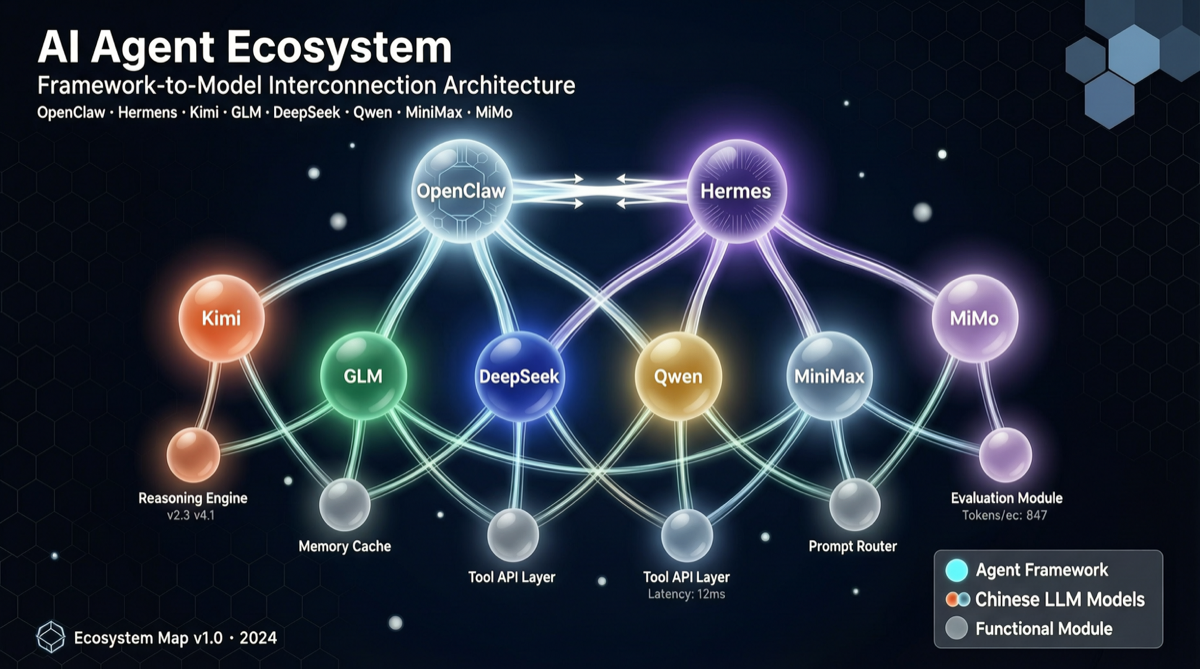
In late April 2026, multiple AI agent framework projects began integrating Chinese domestic large models at scale. Notable developments include:
- The XiaoLongMao platform announced simultaneous compatibility with both OpenClaw and Hermes Agent frameworks, while integrating Kimi, GLM, DeepSeek, and other Chinese models. Users simply need to fill in their API keys—no additional configuration required.
- Open-source agent frameworks like OpenClaw and Hermes are seeing increasingly comprehensive documentation for Chinese model integration.
- Multiple developers on X/Twitter shared their practical experiences using Chinese models to power agent workflows.
This marks a shift in agent framework competition: from “how many features” to “how many models supported.”
Positioning of Six Chinese Models in Agent Scenarios
Based on cross-testing by multiple developers, the six Chinese models have differentiated advantages in agent scenarios:
| Model | Strength in Agent Scenarios |
|---|---|
| DeepSeek | Strong reasoning, suitable for multi-step reasoning agent tasks |
| Kimi | Strong research and document processing, ideal for knowledge-type agents |
| GLM | Standardized code structure, perfect for developer workflow agents |
| Qwen | High code output efficiency, suitable for automated coding agents |
| MiniMax | Outstanding task planning—plans before executing |
| MiMo (Xiaomi) | Open-source friendly, suitable for self-built agent infrastructure |
This differentiation means: there is no “best” agent model, only the most suitable model for a specific scenario.
OpenClaw vs Hermes: Two Agent Framework Paths
OpenClaw
OpenClaw is positioned as a coding agent:
- Excels at generating executable code directly from natural language descriptions
- Well integrated with mainstream IDEs and development toolchains
- Mature workflows for code generation and debugging
Hermes Agent
Hermes is positioned as a general-purpose agent framework:
- Supports creative workflow integration with ComfyUI
- Flexible task orchestration capabilities
- Advantages in creative content generation and multimodal tasks
The complementarity of these two means: products supporting both frameworks (like XiaoLongMao) can provide developers with a complete toolchain from coding to creativity.
Why This Trend Matters
1. Lowering the Agent Development Barrier
Previously, using agent frameworks meant being locked into a specific model provider (usually OpenAI or Anthropic). Now, developers can:
- Run agents at lower costs (Chinese model API prices are generally lower)
- Dynamically switch models based on task type
- Use locally deployed Chinese models in scenarios with high data compliance requirements
2. Model Competition Driving Framework Innovation
When frameworks must adapt to multiple models, the abstraction layer of the framework itself must become more robust. This in turn drives:
- More unified API design
- Better model capability detection and fallback mechanisms
- More flexible task orchestration strategies
3. Autonomy of the Chinese Developer Ecosystem
The combination of agent frameworks + Chinese models means Chinese developers can build complete AI applications without relying on overseas APIs. This has significant implications for data compliance and supply chain security.
Practical Advice
If You Are New to Agent Frameworks
- Choose between OpenClaw and Hermes (based on needs: coding vs general-purpose)
- Start testing with free quotas from Kimi or GLM
- Switch to the most suitable model based on actual performance
If You Already Use Agent Frameworks
- Evaluate whether to add Chinese model compatibility (cost advantages are significant)
- Pay attention to the framework’s multi-model routing capabilities
- Consider using different models for different task types
Cost Reference
Chinese model API prices are typically 1/5 to 1/10 of international models. For agent scenarios requiring massive token consumption, this difference accumulates rapidly.
Outlook
The “Chinese model integration race” among agent frameworks has just begun. As more frameworks join this trend, we can expect:
- More comprehensive model benchmarks and selection guides
- Cross-framework model interoperability protocols
- Model-framework combination solutions tailored for specific industries (finance, healthcare, education)
The competition for AI agents is no longer just about technology—it’s about ecosystem. Whoever can better integrate Chinese models and open-source frameworks will gain the upper hand in the Chinese market.