Core Conclusion
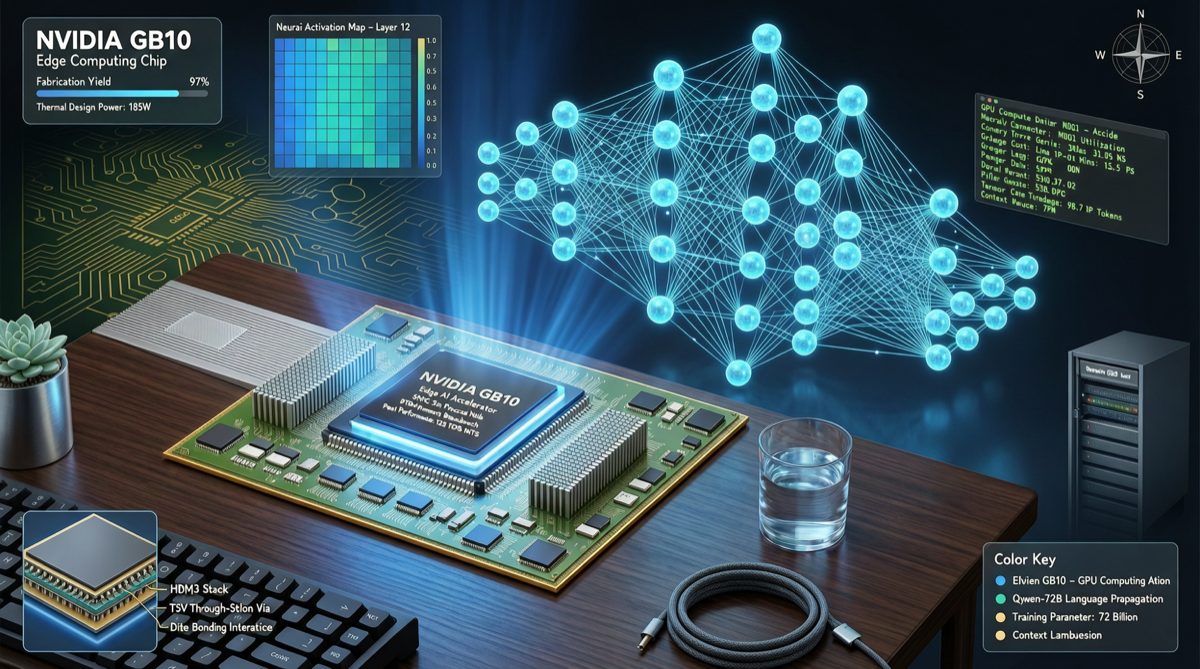
Real-world testing of Qwen3.6-27B on NVIDIA GB10 proves a key trend: 27B-class open-source models are breaking through hardware barriers, moving from "requiring multiple 4090s" to "usable on a single edge card."
This isn't a performance breakthrough story — it's an accessibility breakthrough story. When frontier-level open-source models can run on consumer-grade edge devices, the participation threshold for local AI research gets redefined.
Test Data
Community developers report:
- Model: Qwen3.6-27B (Q6 quantized)
- Hardware: NVIDIA GB10 (edge version of Grace Blackwell superchip)
- Status: "Mildly usable" — functional, though not peak performance
The GB10 is NVIDIA's edge inference product, integrating Grace CPU and Blackwell GPU, designed for low-power, high-density local AI inference. Q6 quantization compressed the 27B model's memory footprint to a level the GB10 can handle.
Why This Matters
1. 27B Is the Sweet Spot for Open-Source Models
Qwen3.6-27B isn't just any model — it's the flagship open-source version of Alibaba's Qwen 3.6 series, performing excellently across multiple benchmarks:
| Metric | Qwen3.6-27B | Comparison |
|---|---|---|
| Open weights | ✅ MIT license | No commercial licensing needed |
| Reasoning ability | Frontier-level | Approaching Opus-level reasoning distillation |
| Local deployment | Single card viable (quantized) | Consumer-grade hardware feasible |
The 27B parameter scale sits precisely at the balance point between "smart enough" and "can actually run."
2. GB10's Edge Positioning
The GB10 isn't a datacenter-grade GPU — it's an integrated solution for edge scenarios. Its core advantages:
- Low power consumption: Suitable for desktop/edge device deployment
- High integration: CPU + GPU unified, reducing system complexity
- NVIDIA ecosystem: CUDA compatibility, mature toolchain
Running Qwen3.6-27B on GB10 means models at this level can now be deployed to office desktops, development workstations, and even home labs.
3. Strategic Significance of Local Inference
When models can run locally, several key problems get solved:
- Data privacy: Sensitive data never leaves the machine
- Continuous availability: No dependency on API quotas or network connectivity
- Cost control: One-time hardware investment, unlimited inference calls
- Customization: Can load local knowledge bases and custom prompts
Comparative Analysis: Edge Inference Solution Selection
| Solution | Hardware Cost | Model Size | Inference Speed | Use Case |
|---|---|---|---|---|
| GB10 + Qwen3.6-27B Q6 | Medium | 27B | Usable | Daily coding assistant, research prototypes |
| RTX 4090 + Qwen3.6-27B Q4 | Higher | 27B | Smooth | Heavy usage, real-time interaction |
| RTX 3090 + Qwen3.6-27B Q6 | Medium | 27B | Usable | Budget-conscious, latency-tolerant |
| Cloud API | Pay-per-use | Unlimited | Very fast | Burst needs, large-scale batch processing |
Getting Started Guide
If you want to try GB10 + Qwen3.6-27B local inference:
- Hardware: NVIDIA GB10 module (or rent via cloud service)
- Model: Download Qwen3.6-27B GGUF quantized version from Hugging Face
- Inference framework: Recommend llama.cpp or Ollama
- Quantization choice: Q6 balances usability and quality; try Q4 if memory is tight
# Ollama method
ollama run qwen3.6:27b-q6

# llama.cpp method
./llama-cli -m qwen3.6-27b-q6.gguf -p "Hello, introduce yourself"
Landscape Assessment
Edge inference is moving from "can it run?" to "does it run well?" Qwen3.6-27B's usable performance on GB10 is just the starting point. With continued optimization in quantization techniques, speculative decoding, and fused kernels, local inference performance and experience will keep improving.
For developers and researchers, this means an important strategic choice: you don't need to wait for the optimal cloud model solution — you can run a good-enough model locally and customize and optimize it to your needs.