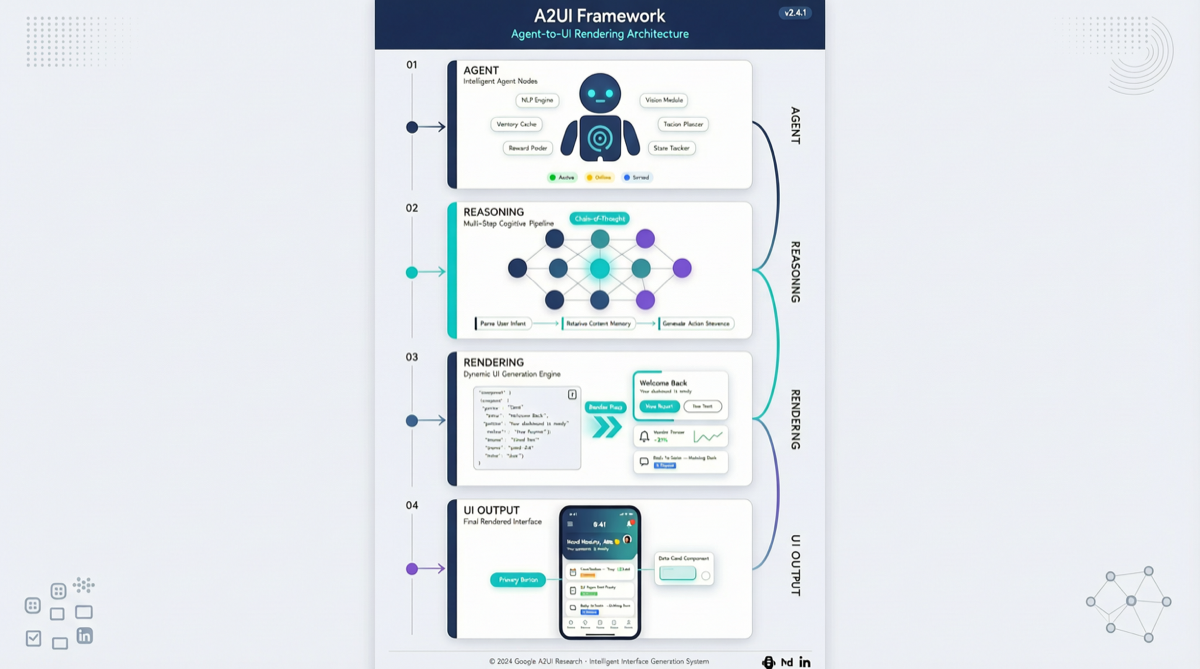
The agent finished reasoning, called tools, got the data—and then what? Spit out a JSON blob for the frontend to parse manually?
Google's A2UI (Agent-to-UI) has a more direct answer: the agent outputs frontend components directly, and the browser renders them on the spot.
This repo currently sits at 14.6k stars on GitHub, maintained by Google's official team (engineers like jacobsimionato and gspencergoog), with support for both React and Angular.
What Problem It Solves
The traditional agent output flow looks like this:
Agent → JSON → Frontend parses JSON → Manually builds UI → Renders
A2UI shortens that pipeline:
Agent → Structured UI description → Renderer renders directly
The difference? The frontend doesn't need to know the agent's business logic. The agent decides which components to use, what data to fill, and how to arrange them—the frontend just executes the rendering instructions.
This is a direct competitor to CopilotKit, Vercel AI SDK, and other "Generative UI" approaches—but A2UI takes an open-source, framework-neutral path, not tied to any specific cloud platform or framework.
What the Architecture Tells Us
The repo structure reveals some design decisions:
agent_sdks/: Agent SDK directory, suggesting Google is pushing for a standardized Agent-to-UI protocolrenderers/: Renderer directory, supporting both React and Angular as independent moduleseval/: Evaluation directory, meaning the project has rigorous quality assessment (not just a README dump)- 708 commits, with updates in the last 20 hours—this isn't an experimental side project
One notable detail: the React renderer's latest commit is [react] Exclude SVG elements from CSS reset—this level of granularity tells me someone is using it in production and filing bugs.
Where It Fits in the Generative UI Landscape
Generative UI is one of the core bottlenecks for agent deployment in 2026. Vercel's AI SDK, CopilotKit's AG-UI Protocol—they're all doing something similar: letting agents output dynamic UI.
A2UI's differentiation:
- Framework-neutral: Not React-only, Angular support is real
- Google backing: Not a startup project, has full-time Google engineers
- Protocol ambition: The
agent_sdks/directory hints at a cross-framework Agent-to-UI standard
This echoes the Flutter vs. React Native debate—the winner isn't necessarily the technically best, but the one with the most complete ecosystem. A2UI has Google's ecosystem resources, but Vercel and CopilotKit have first-mover advantage in the developer community.
Can You Use It Today
Yes, but don't rip out your production UI rendering pipeline yet.
Reasons:
- Still in active iteration (708 commits, 2 tags), API may not be stable
- Eval directory exists but no public benchmark reports
- Only React and Angular for now—Vue users are out of luck
Recommended approach: add an A2UI renderer to your agent project, run it alongside your existing JSON output for a while, and compare UI rendering accuracy and latency.
What to Watch
- Agent SDK standardization—if Google can make Agent-to-UI a cross-framework open protocol, this changes the Generative UI landscape
- Vue support timeline—significant user base in China
- Interoperability with CopilotKit's AG-UI Protocol—will these two打通 or go separate ways?
A2UI isn't another "agent framework." It solves the last mile of agent deployment—what the user actually sees. Without solving that, even the smartest agent is just a backend API.
Sources: