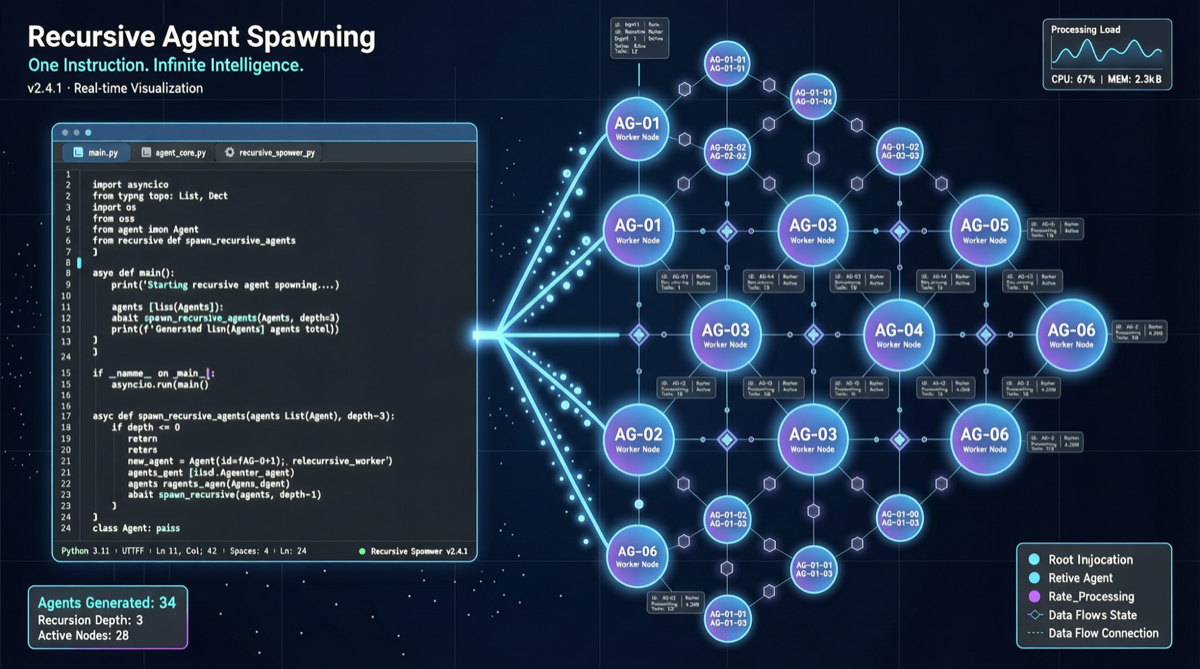
"Agents spawning agents" has been talked about to death in the AI community. Most demos end up spawning ten flashy windows and then doing nothing.
But Cursor /orchestrate is different.
It is a skill built on the Cursor SDK, with the core capability of recursively spawning sub-agents to decompose and complete complex tasks. Not spawning a bunch of agents and hoping they do not fight, but with a clear layered architecture.
Architecture Is Not Concurrency, It Is Separation of Concerns
Some people first reaction is "is not this just multi-agent parallelism?" No.
The key is separation of concerns: root planner handles task decomposition and assignment, scoped workers handle specific sub-tasks, and verifier checks result quality. This is not a simple concurrency trick, but a control plane architecture.
As one community developer put it:
"The important part is not spawning many agents. That is the easy surface-level trick. The important part is the separation of concerns: root planner -> scoped worker -> verifier."
That is the part worth watching.
Internal Data Is Not Boring
Cursor team tested on their own projects:
- Internal skills auto-research: token usage reduced by 20%, while eval scores actually improved
- Internal backend cold start time: reduced by 80%
These two numbers together tell an interesting story. Token usage went down but quality went up, meaning the recursively spawned sub-agents are not doing useless work — each sub-task scope is narrow enough that agents do not get lost in context. The cold start time reduction confirms parallel decomposition works.
How to Use It
Installation is simple, run in Cursor:
/add-plugin orchestrate
Then call it through the Cursor SDK. It requires some engineering foundation to define task boundaries and verification logic — this is not a "type one sentence and everything is done" toy.
How It Differs from Cursor Previous Parallel Tasks
Cursor previously released parallel multitasking, which can split plans into parallel sub-tasks run by async sub-agents simultaneously.
The difference with /orchestrate is recursion and verification. Parallel tasks are "split once, run in parallel"; orchestrate is "after splitting, sub-agents can split again, and every layer has verification."
This is more like evolving from "team分工" to "an organization with management hierarchy."
Worth Following?
If you are already using Cursor SDK for engineering automation, /orchestrate is worth trying immediately. The token savings are significant for high-frequency usage scenarios.
If you just use the Cursor editor for coding, this feature direct value is limited — it targets teams with CI/CD pipelines and automated code maintenance needs.
But the architectural thinking itself is worth reference. When your Agent task complexity exceeds a certain threshold, the simple "one prompt does everything" approach collapses. At that point, layered orchestration is not optional — it is mandatory.
The community is already discussing porting this pattern to Claude Code and other agent frameworks. If it proves universally applicable, the standard paradigm for agent orchestration may be changing.
Primary sources: