Bottom Line First
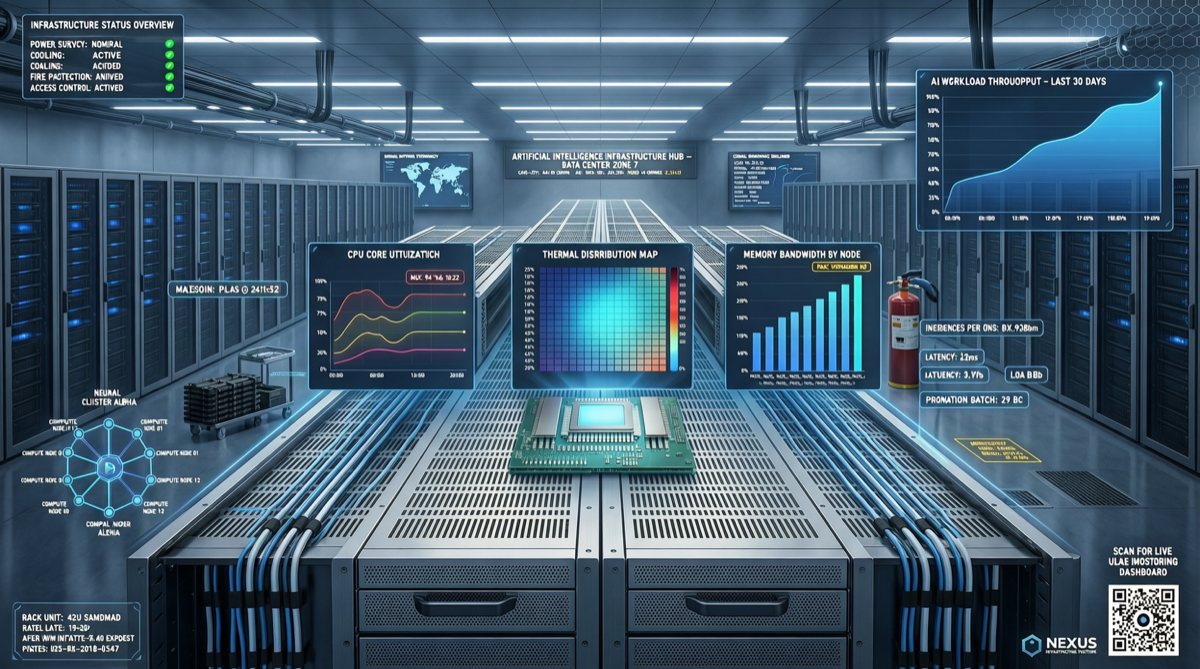
While everyone is watching GPUs and HBM, UBS released an overlooked but extremely important analysis: the rise of agentic AI is reshaping data center architecture, shifting from “GPU-centric training” to “complex orchestration execution,” and this shift will cause server CPU total addressable market (TAM) to grow approximately 5x by 2030—from $30 billion to $170 billion.
What Happened
UBS research team noted in recent analysis that AI infrastructure investment focus is undergoing a structural shift:
Core Data
| Metric | 2025 | 2030 (Forecast) | Growth |
|---|---|---|---|
| Server CPU TAM | $30 billion | ~$170 billion | ~5x |
| Per-agent workload CPU core demand | Baseline | 3-5x | 3-5 times |
Driving logic:
- Agentic AI needs to perform complex orchestration, reasoning, tool calls, and state management on top of LLMs
- These orchestration tasks are highly CPU-dependent, not GPU-dependent
- Each agent workload requires 3-5x more CPU cores than traditional GPU training
Background: Big Tech AI Capex Frenzy
Morgan Stanley May forecast provides larger context:
| Company | 2026 AI Capex | 2027 Forecast |
|---|---|---|
| Amazon | ~$150B | Growing |
| ~$150B | Growing | |
| Meta | ~$150B | Growing |
| Microsoft | ~$150B | Growing |
| Oracle | ~$20B | Growing |
| Total | ~$805B | ~$1.1T |
Global data center construction total spending is expected to reach $2.9 trillion by 2027.
Why CPU Demand Will Surge
Agentic AI Workload Characteristics
Traditional AI training/inference workload:
GPU-intensive: Matrix computation, tensor operations → GPU utilization 80%+
CPU-light: Data preprocessing, result post-processing → CPU utilization 20-30%
Agentic AI workload:
CPU-intensive: Task orchestration, tool calls, state management, multi-agent coordination → CPU utilization 60-80%
GPU-assisted: LLM inference, embedding computation → GPU utilization 40-60%
Key difference: Agents do not just “call a model once,” but rather:
- Understand task → CPU (natural language processing)
- Plan steps → CPU (reasoning and decision-making)
- Call tools (search, database, API) → CPU (network I/O, data processing)
- Analyze results → CPU (result evaluation and decision)
- Iterate → repeat above steps 5-50 times
Each step requires CPU participation, while GPU only plays a role in step 1 and part of step 4.
CPU Consumption in Specific Scenarios
| Agent Scenario | CPU-intensive Steps | Estimated CPU Core Multiple |
|---|---|---|
| Coding Agent | File reading, code analysis, shell execution, test running | 3-4x |
| Research Agent | Web crawling, document parsing, knowledge graph construction | 4-5x |
| Data Analysis Agent | Database queries, data cleaning, visualization rendering | 3-5x |
| Customer Service Agent | Context management, tool routing, conversation state maintenance | 2-3x |
| Multi-Agent Orchestration | Task distribution, result aggregation, conflict resolution | 5-8x |
Investment and Market Impact
Beneficiaries
| Company/Sector | Benefit Logic | Watch Point |
|---|---|---|
| Intel | Highest x86 server CPU market share, directly benefits from CPU demand growth | Need to watch AMD and ARM competition |
| AMD | EPYC server CPU continues growing, AI workload optimization in progress | Data center market share keeps expanding |
| ARM ecosystem (Ampere, AWS Graviton) | Energy efficiency advantage more evident in agent orchestration scenarios | Cloud provider self-developed chip trend |
| Memory manufacturers | CPU-intensive workloads need larger memory bandwidth and capacity | Traditional DRAM demand beyond HBM |
| Cloud providers | CPU instance demand growth pushes revenue | Need to adjust instance mix |
Overlooked Risks
- GPU investment ROI may be lower than expected: If workloads shift toward CPU, large GPU investments may face underutilization
- Power and cooling bottleneck shift: CPU cluster power and cooling needs differ from GPU clusters, existing data center designs may not apply
- Software stack mismatch: Current AI infrastructure (Kubernetes, inference frameworks) is mainly optimized around GPU, CPU orchestration tool ecosystem is not yet mature
Special Significance for Chinese Market
Chinese AI infrastructure faces GPU supply constraints (US export controls), and CPU demand growth may actually bring new opportunities:
- Domestic CPUs (Hygon, Phytium, Loongson) in agent orchestration scenarios demand may be activated
- Huawei Ascend “CPU+NPU”collaborative architecture may be better suited for agentic AI workloads
- 2026 China AI chip shipments expected at 3 million units, with domestic share continuously increasing
Action Recommendations
If you are an infrastructure investor:
- Reevaluate AI infrastructure investment portfolio—CPU-related targets may be undervalued
- Watch server CPU supply chain (packaging, testing, memory accessories)
- Note data center design trend changes
If you are a cloud user:
- Evaluate current AI workload CPU/GPU ratio—may have over-provisioned GPUs
- Try running agent orchestration tasks on CPU-intensive instances, may be lower cost
- Watch for cloud provider new CPU-optimized instance types
If you are an AI application developer:
- Optimize agent CPU usage efficiency: reduce unnecessary tool calls, cache intermediate results
- Consider CPU resource constraints when designing agent architecture
- Evaluate CPU vs GPU cost-benefit ratio, varies greatly by scenario
Landscape Assessment
Agentic AI is changing our definition of “AI infrastructure.” For the past two years, industry narrative has been dominated by GPUs and HBM—but agentic AI actual workload distribution is revealing an overlooked fact: AI is not just a GPU story, CPU role is resurging.
This does not mean GPUs are no longer important—GPUs remain core for training and large-scale inference. But in AI journey from “model training” to “agent execution,” CPU value has been seriously underestimated. UBS 5x growth forecast may not be the endpoint, but the starting point.