Trading Data
Meta's Q1 earnings, released on April 29, 2026, delivered the following numbers:
| Metric | Q1 2026 Actual | Market Expectation | Change |
|---|---|---|---|
| Revenue | $56.3B | $59.56B | Below expectations |
| Q2 Revenue Guidance | $58-61B | $59.56B | In line |
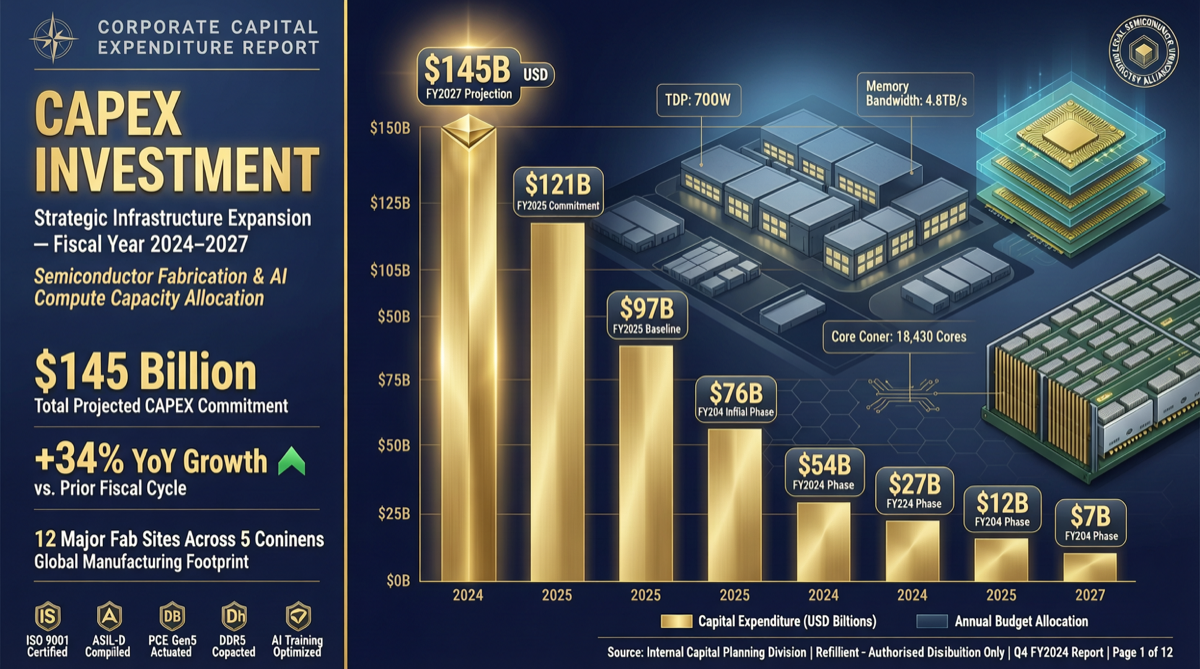
| Full-Year CAPEX | $125-145B | $115-135B | Significantly raised |
| CAPEX Increase | +$10-15B | — | ~10-12% upward revision |
Even more notable was Zuckerberg's statement during the earnings call:
"Most of that is due to higher component costs, particularly memory pricing."
This isn't "we plan to spend more" — it's "we have no choice but to spend more."
Company Business
Meta's current AI strategy revolves around three pillars:
- Avocado Model: Meta's next-generation foundation model, originally scheduled for March release but delayed to May due to performance falling short of expectations. Internal testing shows it surpasses Llama 4 and Google's older Gemini versions, but still hasn't reached Meta's "comprehensive leadership" threshold.
- Llama Ecosystem: Open-source strategy continues; Llama 4 Scout (MoE architecture, 10M context window) has been released.
- AI Infrastructure: Large-scale GPU cluster investments supporting recommendation systems, advertising, Meta AI assistant, and other businesses.
The significant CAPEX increase directly reflects structural changes in AI infrastructure costs.
Investment Thesis: Memory Is Becoming the Bottleneck in the AI Race
Why Memory?
HBM (High Bandwidth Memory) is the core component of current AI chips. NVIDIA's GB10, Blackwell, and other AI accelerators are highly dependent on HBM bandwidth and capacity. HBM production is concentrated in just three companies: Samsung, SK Hynix, and Micron.
The 2026 supply-demand landscape:
| Factor | Impact |
|---|---|
| Demand Surge | Every major company is expanding AI clusters; HBM demand up 200%+ YoY |
| Limited Capacity | HBM production lines take 18-24 months to build; no quick capacity expansion possible in the short term |
| Technology Upgrade | HBM4 entering mass production; yield ramping phase drives up costs |
| Price Leverage | Seller's market; suppliers have extremely strong pricing power |
Meta isn't the only company feeling memory price pressure. Previous reports have highlighted HBM's "token economics" — memory costs are becoming one of the largest components of AI inference costs.
Ripple Effects of the CAPEX Increase
| Company | CAPEX Trend | Drivers |
|---|---|---|
| Meta | $125-145B (2026) | Memory price increases + cluster expansion |
| Continued AI infrastructure investment in Q1 revenue | Full-stack AI strategy | |
| Microsoft | Agent 365 + data center expansion | Enterprise AI infrastructure |
| Amazon | AWS AI service expansion | Cloud + AI dual engine |
Throughout 2026, the combined AI CAPEX of the five major tech companies is expected to exceed $600B. This doesn't even include spending by Chinese tech companies.
Impact on the Industry
1. The "Golden Age" for Memory Suppliers
Samsung, SK Hynix, and Micron have unprecedented pricing power in the HBM market. This means:
- HBM prices may continue rising until new capacity comes online (expected H2 2027)
- Memory costs will be directly passed through to AI service pricing
- Startups face increasing difficulty and cost in acquiring HBM
2. Rising Importance of Model Efficiency
When memory costs become the primary variable, model design philosophy must inevitably change:
- MoE (Mixture of Experts) architecture has an advantage — not all parameters need to be loaded into memory every time
- Quantization and compression techniques see increased demand — reducing memory footprint = reducing costs
- Small models + Agent orchestration patterns may be more economical than a single super-large model
3. Subtle Shifts in the Competitive Landscape
Meta's CAPEX increase sends a signal: the AI race isn't slowing down — it's accelerating.
But notably, Meta's Avocado model has experienced delays — spending more money doesn't equal faster results. This reflects a broader issue: there are significant diminishing marginal returns on AI infrastructure investments.
Actionable Recommendations
| Role | Recommendation |
|---|---|
| AI Startups | Consider using quantized models or MoE architectures to reduce memory requirements; explore reserved instances from cloud providers |
| Enterprise IT | List memory/storage costs as a separate line item in AI budgets, avoiding them being obscured by GPU compute costs |
| Investors | Focus on the HBM supply chain (Samsung, SK Hynix, Micron) and memory optimization technology companies |
| Developers | Learn model quantization, LoRA fine-tuning, and other techniques to reduce memory footprint |
Landscape Assessment
Meta's CAPEX increase is a key signal telling us:
- The AI arms race isn't slowing down — even with revenue slightly below expectations, Meta is still ramping up investment
- The bottleneck is shifting — from "not enough compute" to "memory is too expensive," a structural change
- Efficiency is competitiveness — against the backdrop of rising memory costs, whoever can do more with less memory has the advantage
- Open source could become a differentiation weapon — if the Llama ecosystem leads in memory efficiency, it will attract more cost-sensitive users
The 2026 AI investment narrative is shifting from "who spends more" to "who spends smarter." Rising memory costs are forcing everyone to rethink how they calculate AI infrastructure ROI.