Cursor says it's entered a "third era."
Cursor 3.0, codename Glass, released on April 2, is not a patch-and-fix update — interface rebuilt, workflow rebuilt, even the definition of the developer's role has changed. The official line: developers will spend most of their time "using natural language to instruct different AI agents, monitor progress, and review outcomes."
Sounds radical. But after using it for a while, I think the direction is right, even if the pace might be slower than Cursor claims.
From Completion to Agent Swarms
Cursor's evolution is clear:
- First generation: code completion. You type, it guesses the next line.
- Second generation: Composer dialogue. You describe requirements, it writes code snippets.
- Third generation: autonomous agent work. You give direction, it breaks down tasks, calls tools, pushes progress forward.
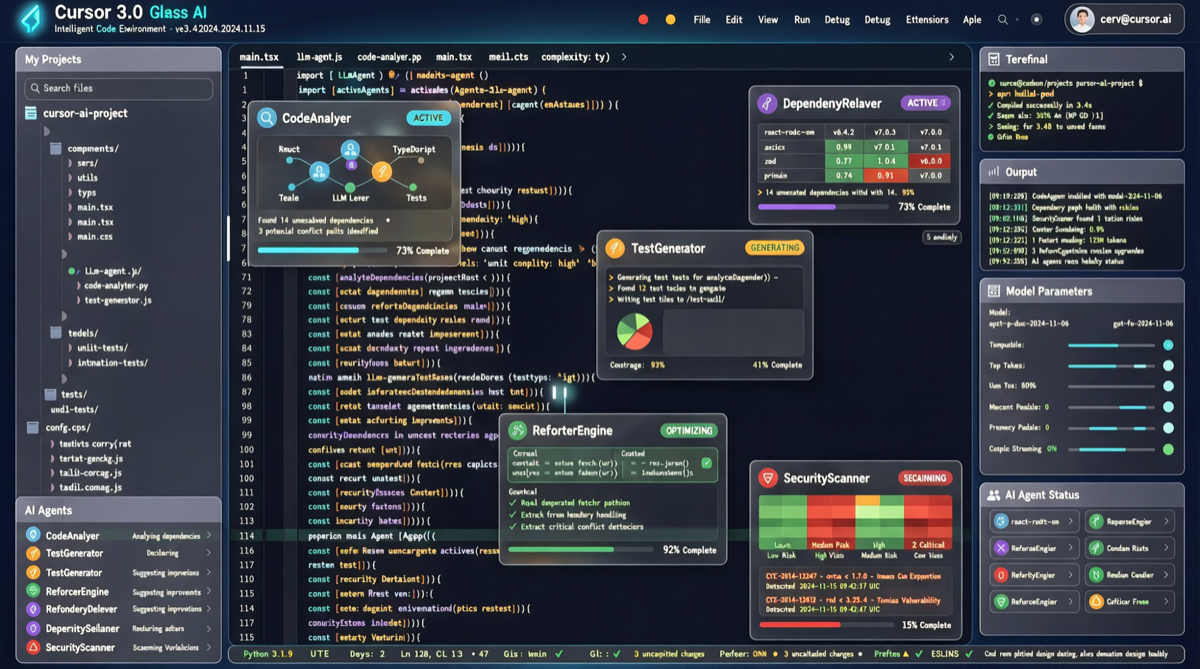
The core change in Glass is elevating "agents" from a feature to a work mode. It's no longer a button triggering a function — the entire IDE has become a multi-agent collaboration environment. You can assign different agents to different tasks simultaneously — one writes frontend components, one runs tests, one updates docs — and you review from the sidelines.
Honestly, it felt a bit jarring at first. Being used to hands on the keyboard, line by line, suddenly becoming a "supervisor" requires a psychological transition. But after running a few real projects, the efficiency gains are real.
What Works, What Doesn't
Works well:
- Scaffolding, template code, repetitive component development — things that don't need much creativity, perfectly reasonable to hand off.
- Test writing, doc updates — the classic "necessary but annoying" tasks.
- Batch changes during refactoring — like uniformly updating calls to a function.
Not ready yet:
- Core business logic architecture design — agents can't yet make "good judgments," only execute existing ones.
- Complex debugging across service boundaries — agents get stuck where they lack full context.
- Requirements understanding that needs cross-team communication — that's a people problem, not a technical one.
Pricing
Cursor 3.0's pricing hasn't changed, but the value has gone up. Same monthly fee, significantly more capability now. If you previously thought of Cursor as just an "advanced completion tool," Glass is worth a re-evaluation.
But don't expect it to let you hire one fewer engineer. It changes work rhythm, not team size.
I've partially migrated my daily development workflow to Cursor 3.0, mainly for scaffolding and testing. I still handle core architecture design myself — not because I don't trust agents, but because some judgments only humans can make right now.
Main sources:
- Cursor official blog
- Hands-on experience