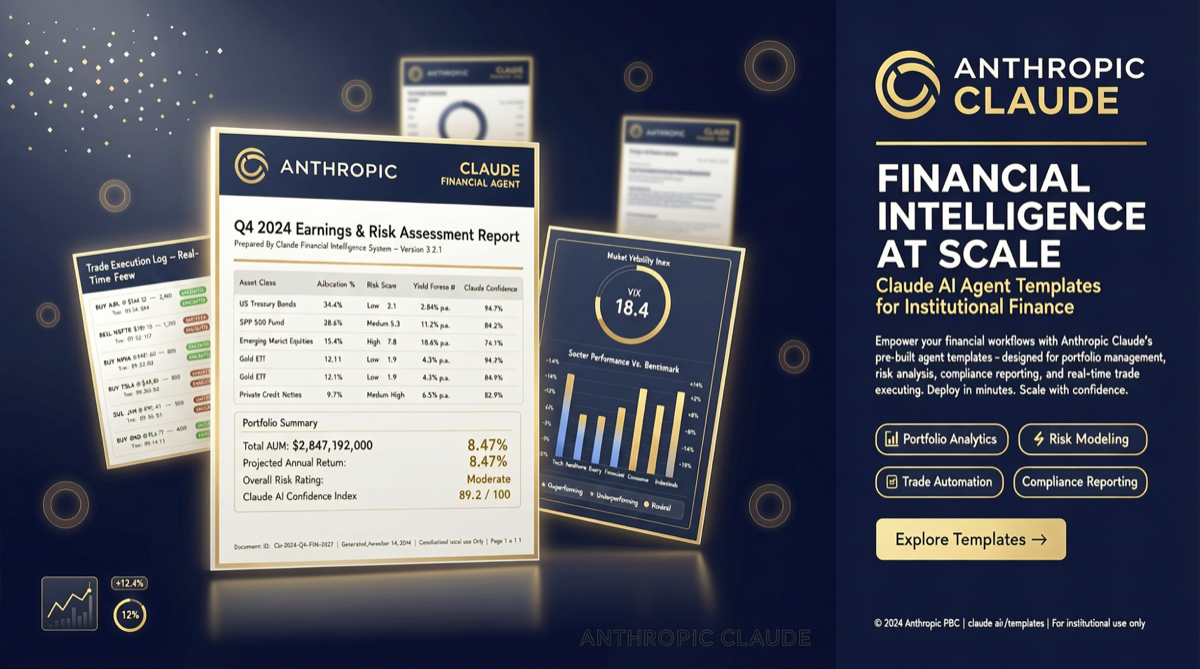
Anthropic did something uncharacteristic for an AI company: it open-sourced a complete set of financial industry agent workflow templates.
Not demos. Not proof-of-concepts. Ten deployable Managed Agent templates covering earnings review, GL reconciliation, KYC screening, market research, and valuation review—the daily grunt work of finance professionals.
22.8k stars, 12,529 gained in one week. This growth rate tells one thing: enterprises don't need another "what AI can do" PPT. They need "how AI specifically does this thing" operational manuals.
10 Templates, One by One
The managed-agent-cookbooks directory contains 10 agent templates, each for a specific scenario.
1. earnings-reviewer
Input: company earnings reports, historical financial data Output: anomaly flags, key metric change analysis, risk alerts
The core value isn't "reading financial reports"—any LLM can do that. The value is in structuring the review logic: is revenue recognition compliant, are non-recurring items classified correctly, do YoY/QoQ changes have reasonable explanations.
2. gl-reconciler
Automatically compares records across different ledgers, flags inconsistencies.
The most painful work at month-end for finance teams. Two systems' exports don't match, checking line by line. This agent handles most routine discrepancies, surfacing only what truly needs human judgment.
3. kyc-screener
Customer identity verification and compliance screening. Connects to sanctions lists, PEP databases, automates initial screening.
Compliance teams'刚需. Not replacing human approval, but automating the mechanical labor of "checking lists, comparing," leaving human energy for cases that truly need judgment.
4. market-researcher
Collects, organizes, analyzes market data and industry information, generates research briefs.
Different from "ask AI to write an industry report." It has explicit source strategies, validation processes, and output formats. Not generating text that looks like a research report, but outputting traceable, verifiable structured analysis.
5. meeting-prep-agent
In finance, meeting prep isn't just organizing an agenda. It requires reading relevant materials in advance, identifying key topics, preparing data support.
This agent targets the two hours of prep work before finance meetings.
6. model-builder
Assists in building financial models—DCF, LBO, comparable company analysis.
Note: it doesn't "auto-build models for you to sign off." It handles formula setup, data filling, format adjustments—the time-consuming parts that don't require professional judgment. Model logic and key assumptions are still yours.
7. month-end-closer
Month-end close process automation assistant. Checks entry completeness, reconciles account balances, generates close checklists.
8. pitch-agent
Assists in preparing pitch books. Organizes company data, generates analysis charts, writes narrative text.
9. statement-auditor
Financial statement audit assistant tool. Sampling tests, anomaly detection, audit working paper organization.
10. valuation-reviewer
Independent review of existing valuation results, checks assumption rationality, model completeness, sensitivity analysis adequacy.
Common Design Patterns
Three clear patterns emerge:
First, each agent has a very narrow scope. Not a "finance全能assistant," but one agent doing one thing. This seems limited but is the correct design for enterprise—clear scope means auditable trails, controllable permissions, locatable errors.
Second, human-in-the-loop is default. These aren't fully automatic. Every agent's output requires human review. This isn't a capability compromise—it's a financial industry compliance requirement.
Third, all deployable to Office 365 via the claude-for-msft-365-install directory. Anthropic's target is embedding these agents directly into the environments finance professionals already use—Excel, Outlook, SharePoint.
Practical Value
If you're not in finance, these templates have limited direct use. But they signal something important:
AI agents are shifting from "general conversation tools" to "vertical industry workflow components." Anthropic isn't building generic Claude—it's building "Claude agents that embed directly into financial business processes." If this approach replicates to other industries (legal, healthcare, education), it's a massive market.
Takeaway: don't just stare at general AI tools. Observe the design patterns of these vertical agent templates—narrow scope, human-in-the-loop, embedded in existing toolchains. These patterns apply equally to building your own agent workflows.
Sources: