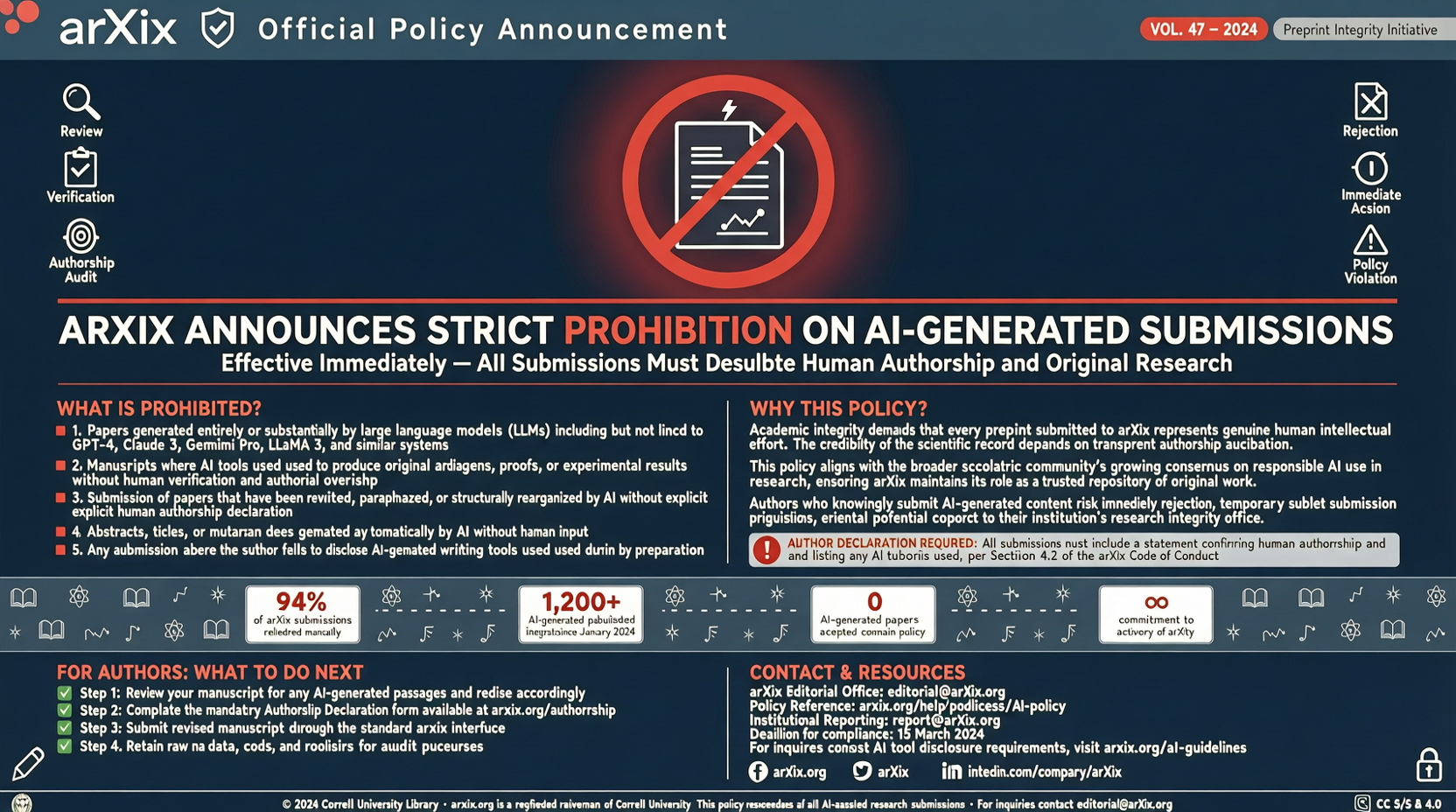
The research community’s “AI spam army” has finally been sanctioned.
Ars Technica reported welcome news for many researchers: arXiv has instituted a “one-year ban” penalty for submitting AI-generated papers. That is, if you’re found to have submitted AI-generated content to arXiv, your account will be suspended immediately—and you’ll be barred from submitting any papers for an entire year.
Why Is arXiv So Urgent?
Because AI-generated junk papers have flooded the platform.
arXiv is the world’s largest scientific preprint platform, where researchers in physics, computer science, mathematics, biology, and other fields post preliminary findings of scholarly value—before formal peer review. It serves as essential infrastructure for scientific communication.
But recently, this infrastructure has been severely polluted by AI slop (low-quality AI-generated content). Some users are using large language models to mass-produce texts that look like papers, then flooding arXiv with submissions. These papers often:
- Cite non-existent literature
- Fabricate data
- Describe experiments never actually conducted
- Draw meaningless or nonsensical conclusions
For arXiv moderators, reviewing such junk consumes enormous effort. For genuine researchers, it’s becoming increasingly difficult to locate valuable work amid the deluge.
So arXiv struck back hard: one violation, one-year ban.
This Isn’t Just arXiv’s Problem
arXiv’s crisis is merely the tip of the iceberg. Around the same time, Ars Technica also reported on a parallel issue: the bug bounty industry is likewise being overwhelmed by AI slop.
Security researchers have observed that more and more companies are receiving vulnerability reports auto-generated by AI. These reports often appear well-formatted and detailed—but in reality, they either rehash known, trivial issues or describe entirely fictional “hallucinated vulnerabilities.” Security teams must now spend significant time filtering out these AI-generated noise reports, while genuinely valuable findings risk being buried.
Both cases point to the same trend: the cost of generating AI content is approaching zero—yet verifying its authenticity still demands substantial human time and effort.
Is a “One-Year Ban” Enough?
Some may argue the one-year suspension is too lenient. But given arXiv’s nature—as an open, non-commercial preprint platform—this penalty is already exceptionally severe. Being unable to submit papers for a year represents a major setback for an active researcher.
A deeper question remains: How does arXiv determine whether a paper is AI-generated?
Current detection tools—including AI-detection models and watermarking techniques—still suffer from false positives. Could a paper written by a human but heavily polished with AI assistance be misclassified? Could a paper authored by a non-native English speaker—whose prose is less fluent—be wrongly flagged as AI-generated?
arXiv must strike a delicate balance between combating AI slop and avoiding false accusations against legitimate researchers.
A Broader Implication
arXiv’s ban on AI-generated papers reflects an accelerating reality: AI is transforming the entire knowledge-production pipeline—from creation, to publication, to review.
On the creation side, AI lowers the barrier to writing—but also slashes the cost of producing text that merely looks credible. On the publication side, platforms must develop new filtering mechanisms to cope with AI content overload. On the review side, traditional peer review needs adaptation—how should reviewers assess whether a paper reflects authentic research or is merely an AI collage?
There are no simple answers to these questions. But arXiv’s “one-year ban” sends a clear signal: the research community rejects AI-generated junk.
It may also serve as a timely reminder to the broader AI industry: the more powerful the generation capability, the greater the responsibility.