What is the most time-consuming part of conducting research?
It's not reading papers, writing code, or running experiments. It's stringing these steps together to form a closed loop. Formulating a hypothesis, searching literature to verify it, designing experiments, analyzing results, identifying flaws, refining the hypothesis—this cycle requires extensive manual coordination, and every step can easily hit a bottleneck.
Shanghai Jiao Tong University's ARIS project aims to let AI autonomously complete this loop. Moreover, its methodology is highly distinctive: rather than having a single agent work alone, it makes multiple agents "adversarially" interact with each other, collaborating through confrontation.
What is ARIS
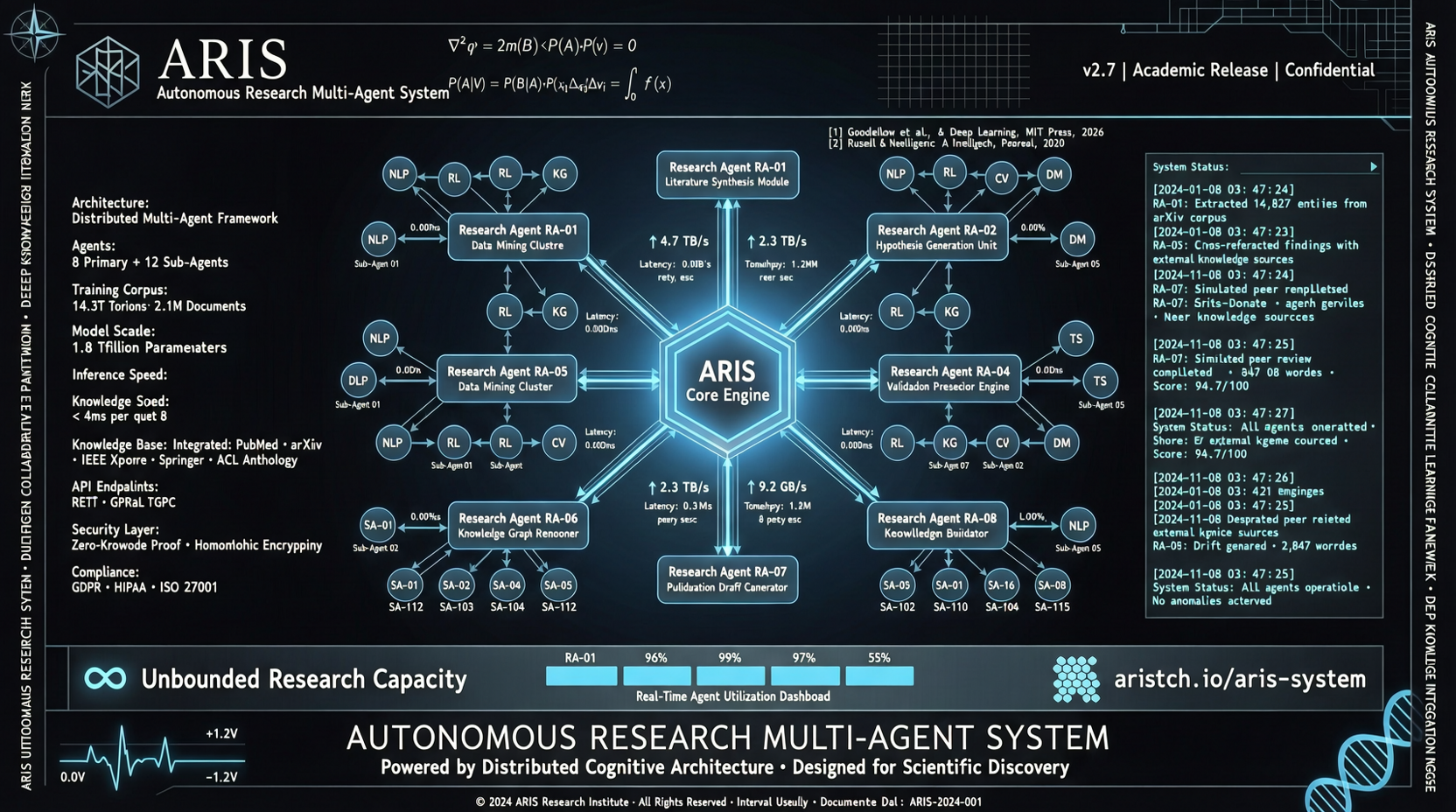
ARIS stands for "Autonomous Research via Adversarial Multi-Agent Collaboration". It is not a single AI model, but a system composed of multiple agents. These agents assume different roles—some are responsible for proposing hypotheses, others for critiquing, and others for experimental verification—they drive research progress through adversarial interactions among themselves.
The inspiration for this methodology comes from the real-world research process. Great research is rarely produced by a single person working in isolation; instead, it is honed through academic debate, peer review, and repeated questioning. ARIS encodes this "progress through adversarial interaction" logic into a multi-agent system.
The project has garnered 116 upvotes on the trending page of Papers with Code and 9.7k stars on GitHub, making it one of the hottest projects in the AI for Science field recently.
Adversarial Collaboration vs. Harmonious Collaboration
Multi-agent systems are not a new concept. Anthropic's Claude can orchestrate multi-agent workflows, and Microsoft's AutoGen follows the same direction. However, the design logic of most existing systems is "collaboration"—multiple agents divide the labor, cooperate, and leverage their respective strengths.
What sets ARIS apart is "adversarial" interaction. It introduces a critic role whose job is not to help, but to pick apart. It aims to find flaws in hypotheses, defects in experimental design, and over-interpretations in conclusions.
This may sound counterintuitive, but it is precisely the essence of scientific research. Scientific progress does not rely on "everyone agreeing," but on "someone pointing out that you are wrong." This is exactly what Popper's "falsificationism" argues.
Actual Performance
ARIS currently demonstrated capabilities include:
- Autonomous Literature Review: Agents can search, read, and synthesize relevant papers
- Hypothesis Generation & Critique: Proposing research hypotheses, which are then questioned by critic agents
- Experimental Design & Execution: Automatically generating code, running experiments, and analyzing results
- Iterative Optimization: Refining research directions based on critiques and experimental outcomes
Of course, it is far from replacing human researchers. But it demonstrates an intriguing possibility: AI can do more than just act as an "executor" (you give it a task, it completes it for you); it can act as an "explorer" (it identifies problems, proposes solutions, and verifies hypotheses on its own).
Comparison with Other Approaches
During the same period, other teams are conducting similar explorations. For instance, Google DeepMind's Gemini Deep Think project is also advancing AI autonomy in scientific discovery. However, DeepMind's approach focuses more on "deep reasoning within a single model," whereas ARIS follows the path of "adversarial multi-agent collaboration."
Both approaches have their pros and cons. Deep reasoning within a single model is easier to control and understand, but it may be limited by a singular perspective on complex tasks. Adversarial multi-agent collaboration can generate more diverse lines of thought, but it also comes with higher system complexity and unpredictability.
My Assessment
The significance of ARIS does not lie in what it can already do today, but in proving that the concept of "autonomous research" can transition from science fiction to engineering reality.
Of course, the road ahead is long. Issues like the reliability, explainability, and safety of adversarial multi-agent systems still need to be resolved. Especially in scientific research, which demands extremely high rigor, agent "hallucinations" and "overconfidence" could be fatal.
But the direction is right. If AI can help human scientists share the workload of hypothesis generation and literature synthesis, allowing humans to focus their energy on core innovations, then the value of AI for Science will already be realized.
The ambition of adversarial collaboration is even greater—it wants AI to be not just an assistant to humans, but a "research partner" capable of independent thinking, independent questioning, and independent discovery.
How much of this ambition will be realized, time will tell.
Primary Sources: