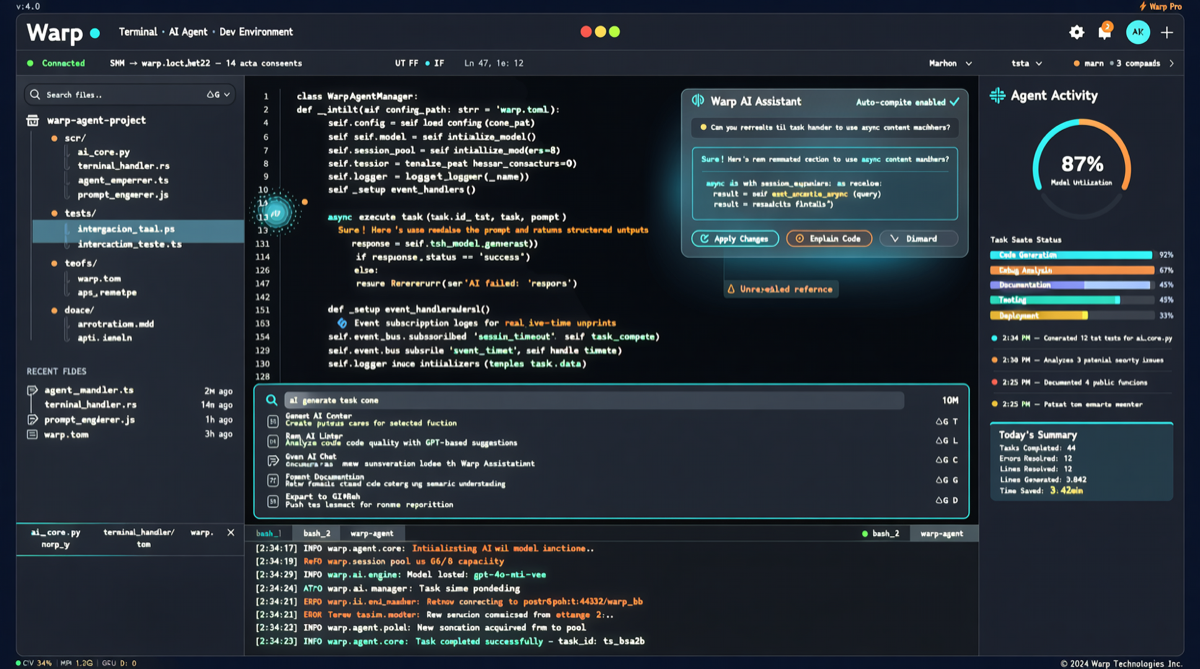
If you’ve seen a project gaining 12,822 stars in a single day on GitHub Trending recently, it’s Warp. As of April 30, this Rust-built terminal development environment has accumulated 44,200 stars, making it the hottest open source project of the day.
Warp positions itself not as “yet another terminal emulator,” but as an “agentic development environment” — redefining how developers interact with machines from the terminal up. Its core idea is transforming the terminal from a passive tool that “waits for your commands” into an active collaborator that “understands your intent and helps execute.”
Technically, Warp chooses Rust as its foundation, ensuring cross-platform performance and memory safety. Maintained by core developers including oz-agent, exzshao, and vorporeal, the project already has 2,643 forks.
Warp’s surge has several contextual drivers: terminal tools have long lacked innovation — iTerm2, Alacritty solved rendering and performance, but never fundamentally changed the “human types, machine executes” paradigm; the rise of AI coding agents (Cursor, Claude Code, Codex) has normalized “describe intent in natural language” interaction, and that expectation naturally extends to the terminal; and developer trust in AI tools is growing, lowering the acceptance threshold from “assistive autocomplete” to “autonomous execution.”
Warp’s growth metrics are worth watching: 12,822 daily stars is nearly unprecedented for a terminal project on GitHub. This isn’t just a signal about the project itself, but reflects a rapidly growing overall demand for agentic workflows among developers.
Quick start: Visit Warp GitHub, clone or download a release, and launch to experience.
Main sources: