What Happened
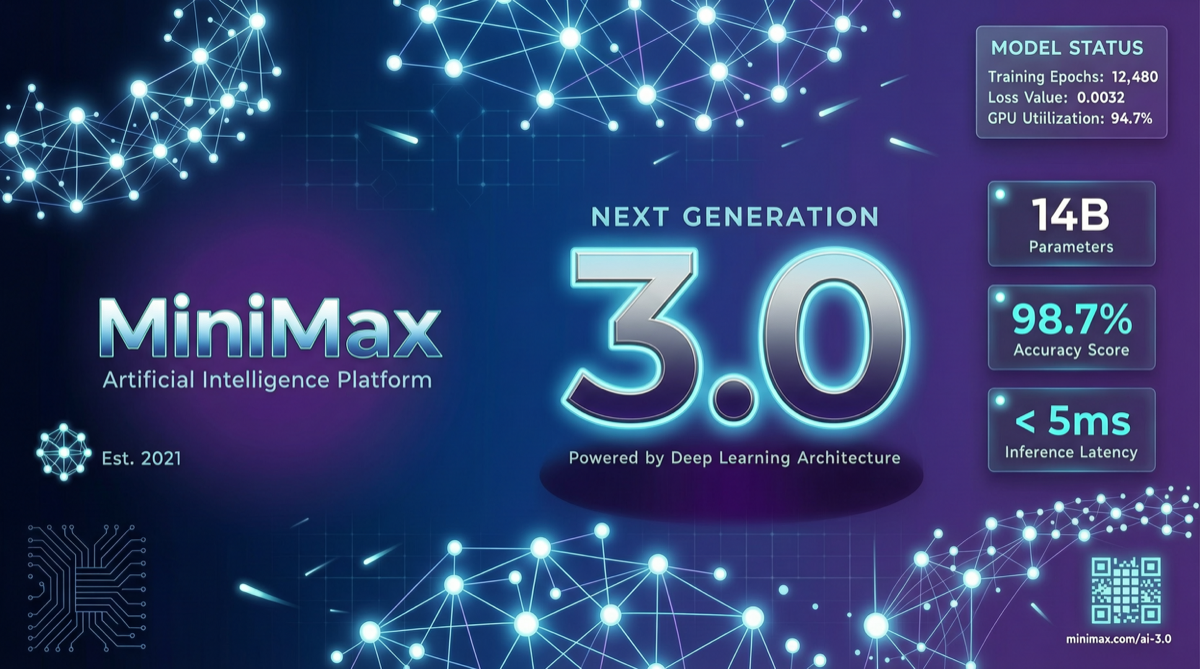
On May 1, community rumors emerged that MiniMax 3.0 is about to launch. This comes less than three months after the release of MiniMax M2.5/M2.7, but market response has far exceeded expectations.
More notable is the revenue data: MiniMax’s revenue over the past 20 days has already surpassed the entire year of 2025. This is not a marketing story — it’s the natural result of a product crossing the practicality threshold.
Why M2.5 Became the Turning Point
Looking at the development trajectory of Chinese models, a clear watershed emerged in early 2026:
| Model | Release Date | Practicality Milestone |
|---|---|---|
| Kimi K2.5 | 2026.01 | Long context capability met, Agent scenarios viable |
| GLM 5 | 2026.02 | Coding and reasoning caught up to international leaders |
| MiniMax M2.5 | 2026.02 | Multimodal understanding + self-evolution, costs dropped significantly |
As community observers noted: “Kimi 2.5, GLM5, and MiniMax M2.5 have all crossed that practicality threshold. 2026 will inevitably be the first year of practical Chinese AI.”
MiniMax’s revenue explosion validates a simple logic: if the model is genuinely useful, the market will pay. M2.5’s self-evolution capability allows continuous improvement in few-shot or even zero-shot scenarios, dramatically reducing trial-and-error costs for enterprise users.
What MiniMax 3.0 Might Be
While the company hasn’t announced specifics, the technical roadmap offers reasonable predictions:
Problems M2.5 Already Solved:
- Multimodal understanding (text, images, audio unified processing)
- Tool calling and task decomposition in Agent scenarios
- Reduced fine-tuning dependency through self-evolution
Expected Breakthroughs for 3.0:
| Dimension | Expected Improvement | Competitive Benchmark |
|---|---|---|
| Context Window | Possibly 2M+ tokens | Kimi K2.6 supports 1M+ |
| Inference Efficiency | Further MoE optimization | GLM 5.1 demonstrated efficient inference |
| Multimodal Generation | From understanding to generation | GPT-5.5 supports full modalities |
| Agent Native | Built-in workflow orchestration | Claude Opus 4.7 validated this approach |
Market Positioning
If MiniMax 3.0 launches as expected, it enters a highly crowded battlefield:
- Kimi K2.6: #1 in open-weight SWE-bench, strong Agent capabilities
- GLM 5.1: Comprehensive coding and reasoning upgrade, strong ecosystem integration
- Qwen 3.6 Max: Domestic benchmark leader, most complete open-source ecosystem
- DeepSeek V4: Trillion-parameter MoE, extreme cost efficiency
MiniMax’s differentiating advantages lie in self-evolution capability and multimodal-native design. If 3.0 can strengthen Agent orchestration and tool ecosystem on these foundations, it has a chance to climb from the second tier to the first among Chinese models.
Actionable Takeaways
- Enterprise users: If evaluating M2.5, consider waiting for 3.0 before making procurement decisions, unless current needs are already well-served by M2.5
- Developers: Watch for API changes on the MiniMax open platform — 3.0 may bring new billing models and tool interfaces
- Investors: MiniMax stock has been under pressure; the 3.0 news could be a catalyst, but watch for actual release timelines